
Topic – 3.2
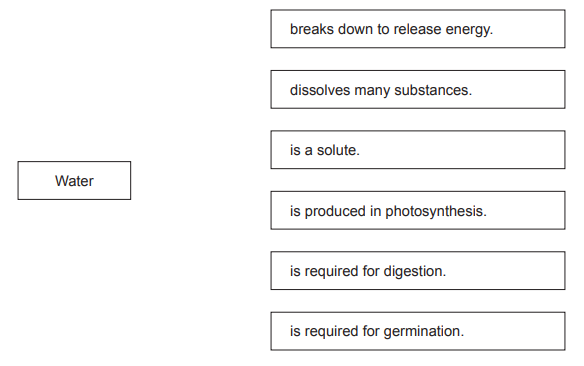
(a) Water is an important biological molecule. The box on the left contains the word ‘Water’. The boxes on the right contain some sentence endings.
Draw a line from the box on the left to each correct statement about water. Draw three lines.
(b) Students investigated the movement of water in model animal cells using dialysis tubing. Fig. 1.1 is a diagram of the apparatus used in the investigation.
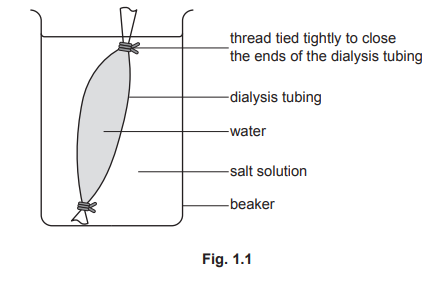
(i) State the name of the part in Fig. 1.1 which represents:
the partially permeable membrane of an animal cell …………. .
the cytoplasm of an animal cell ………. .
(ii) Draw an arrow on Fig. 1.1 to show the direction of water movement during the investigation.
(iii) State the name of the process of water diffusing across a partially permeable membrane.
(c) Animal cells placed in pure water will burst. State the structure that prevents a plant cell from bursting when it is placed in pure water.
▶️ Answer/Explanation
Ans:
(a) Correct matches for water properties: 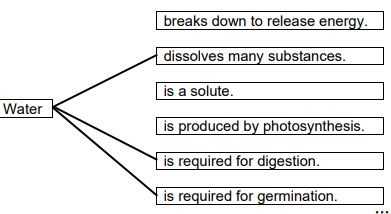
(b)(i) – Partially permeable membrane: Dialysis tubing (selectively allows water to pass). – Cytoplasm: Water inside the tubing (represents cell contents).
(b)(ii) Arrow direction: From water (inside tubing) → salt solution (osmosis occurs toward higher solute concentration).
(b)(iii) The process is osmosis (passive diffusion of water across a membrane).
(c) Plant cells resist bursting due to their rigid cell wall, which counteracts osmotic pressure.
Topic – 4.1
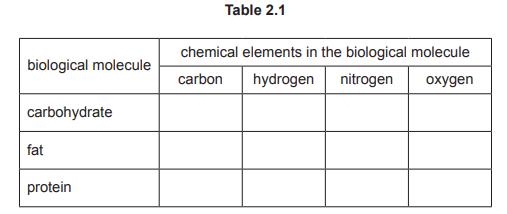
(a) Biological molecules are made of chemical elements. Complete Table 2.1 by placing ticks (✓) in the boxes to show which chemical elements each biological molecule is made from
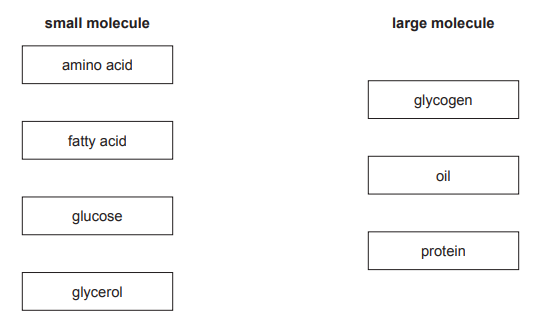
(b) Large molecules are made from smaller molecules. The boxes on the left show the names of some small molecules. The boxes on the right show the names of some large molecules. Draw a line from each small molecule to the large molecule that it makes. Draw four lines.
(c) (i) Complete the sentences about excretion. Choose the correct words to complete the sentences.
assimilation digestion faeces gain glucose
ions metabolism nitrogen plasma removal urea
Excretion is the ………… of the waste products of ……….. and substances in excess of requirements. A kidney excretes ………. , excess ………… and excess water.
(ii) State the name of an organ in the human body that excretes carbon dioxide.
(d) Fig. 2.1 is a diagram of part of the human excretory system and associated blood vessels.
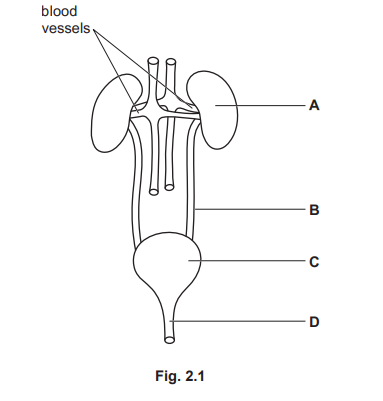
(i) State the letter of a structure in Fig. 2.1 that excretes excess water.
(ii) State the letter in Fig. 2.1 that identifies the urethra.
(iii) State the name of the structure labelled C in Fig. 2.1.
(iv) State the name of the vein that removes blood from the kidneys.
(e) Excretion is one characteristic of living organisms. State two other characteristics of living organisms.
▶️ Answer/Explanation
Ans:
(a) Biological molecule elements:
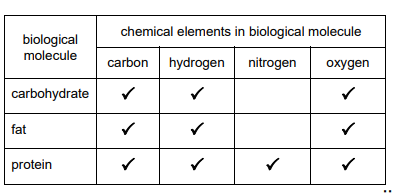
Explanation: Carbohydrates and lipids contain C, H, O; proteins add N (sometimes S); nucleic acids include P.
(b) Molecule matching:
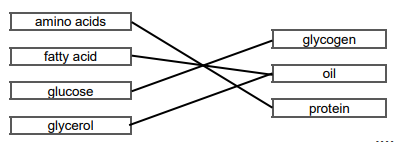
Explanation: Monosaccharides → starch (polymerization); fatty acids → lipids (ester bonds); amino acids → proteins (peptide bonds); nucleotides → DNA (phosphodiester bonds).
(c)(i) Excretion is the removal of the waste products of metabolism and substances in excess of requirements. A kidney excretes urea, excess ions, and excess water.
Key point: Metabolism produces urea (from proteins) and excess ions/water are regulated by kidneys.
(c)(ii) Lungs excrete carbon dioxide (a byproduct of respiration).
(d) Excretory system:
(i) A (kidney filters blood to excrete water)
(ii) D (urethra carries urine out)
(iii) Bladder (stores urine)
(iv) Renal vein (returns filtered blood to circulation)
(e) Two other characteristics: respiration (energy release) and growth (increase in cell number/size).
Topic – 17.4
Fig. 3.1 is a pedigree diagram for a plant that can have either blue flowers or purple flowers. Blue flower colour is dominant to purple flower colour.
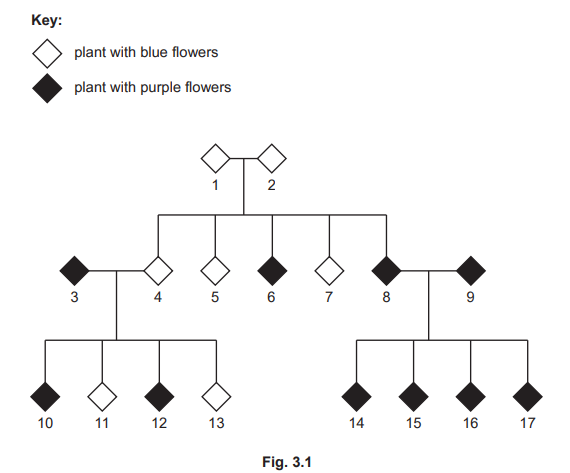
The allele for blue flowers is represented by the letter B. The allele for purple flowers is represented by the letter b. The possible genotypes for these plants are BB or Bb or bb.
(a) (i) State the genotypes of plants 1, 4 and 6 in Fig. 3.1.
(ii) Describe how a gardener could use selective breeding to grow plants that only produce blue flowers.
(b) A different type of plant can produce red flowers or white flowers. The allele for red flowers is dominant and is represented by the letter R. The allele for white flowers is recessive and is represented by the letter r. Two plants were crossed. Complete the Punnett square by writing in:
- the colours of the parent plant flowers
- the offspring genotypes.
State the phenotypic ratio for this cross.
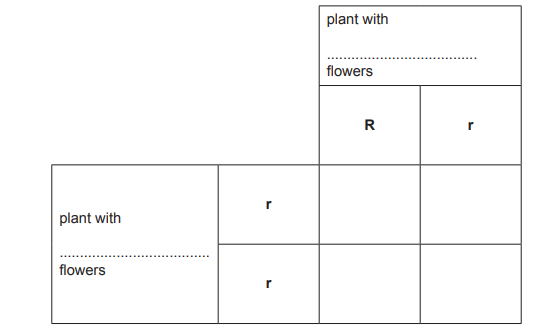
Phenotypic ratio ……… red flowers : ……… white flowers
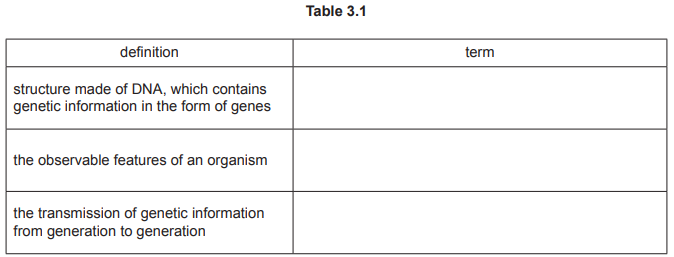
(c) Table 3.1 contains some definitions of genetic terms. Write the correct term next to each definition in Table 3.1.
▶️ Answer/Explanation
Ans:
(a)(i)
Plant 1: Bb (heterozygous, produces both blue and purple offspring)
Plant 4: Bb (heterozygous, produces purple offspring)
Plant 6: bb (homozygous recessive, purple flowers)
(a)(ii)
To breed plants with only blue flowers:
1. Cross two blue-flowered plants (BB or Bb).
2. Select offspring that produce only blue flowers when self-pollinated (BB genotype).
3. Repeat the process to eliminate heterozygous (Bb) plants.
(b)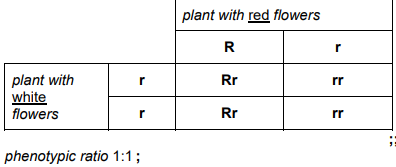
Phenotypic ratio: 3 red flowers : 1 white flower
(c)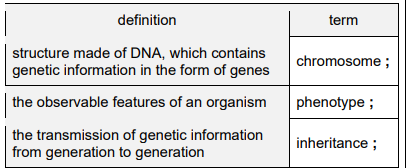
Detailed Explanation:
Part (a)(i): The genotypes are determined by analyzing the pedigree chart. Plant 1 must be Bb since it produces both blue and purple offspring. Plant 4 is Bb as it produces a purple offspring (bb). Plant 6 shows purple flowers, so its genotype is bb.
Part (a)(ii): Selective breeding involves choosing plants with desired traits (blue flowers) and eliminating those with undesired traits (purple flowers) over generations.
Part (b): The Punnett square shows a cross between two heterozygous plants (Rr × Rr), resulting in a 3:1 phenotypic ratio of red to white flowers.
Part (c): The terms match standard genetic definitions: allele, genotype, phenotype, and dominant.
Topic – 9.2
Fig. 4.1 is a diagram of the human heart.
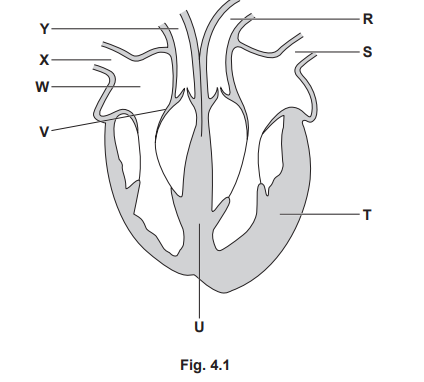
(a) Complete Table 4.1, using Fig. 4.1. Letters may be used once, more than once or not at all. 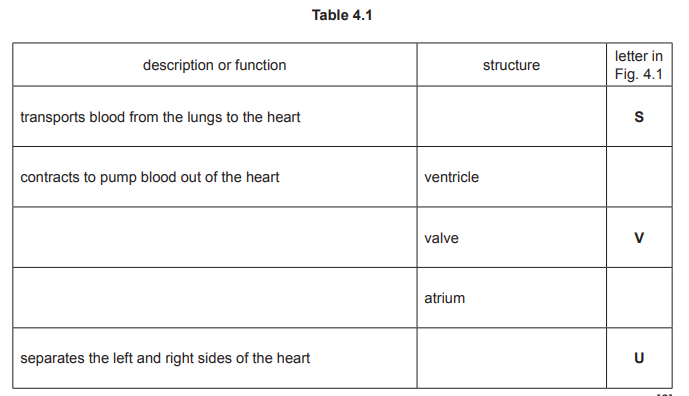
(b) Describe two ways the structure of an artery differs from the structure of a vein.
▶️ Answer/Explanation
Ans:
(a) The completed table identifies key heart structures and their functions:
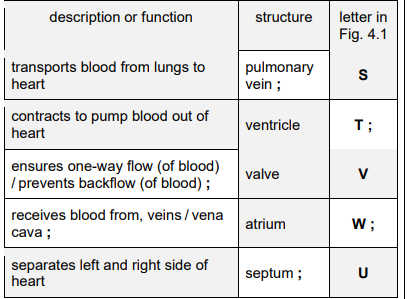
- Right atrium (A): Receives deoxygenated blood from the body.
- Left ventricle (D): Pumps oxygenated blood to the aorta.
- Pulmonary artery (B): Carries deoxygenated blood to the lungs.
- Vena cava (C): Returns deoxygenated blood to the heart.
(b) Two structural differences between arteries and veins:
- Wall thickness: Arteries have thicker muscular walls to withstand high pressure from the heart, while veins have thinner walls.
- Valves: Veins contain valves to prevent backflow of blood, whereas arteries lack valves due to their high-pressure flow.
- Lumen size: Arteries have a narrower lumen compared to veins, which have a larger lumen to accommodate slower blood flow.
Topic – 14.1
(a) (i) Describe the role of the mammalian nervous system.
(ii) State the two parts of the central nervous system.
(b) Fig. 5.1 is a diagram showing a reflex arc.
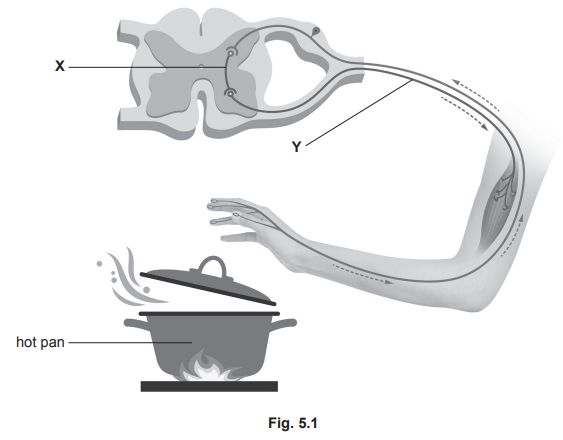
Complete the sentences about the reflex arc. The hot pan shown in Fig. 5.1 is the ………… in this reflex arc. The arrows shown in Fig. 5.1 represent the movement of an electrical ………. along the neurones. X is a ……… neurone and Y is a ……….. neurone. A junction between two neurones is called a …… .
▶️ Answer/Explanation
Ans:
(a)(i) any one from:
idea of coordination of, (named) body functions / (named) responses ;
idea of regulation of (named) body functions
The mammalian nervous system coordinates and regulates body functions, enabling rapid responses to stimuli (e.g., withdrawing a hand from heat).
(a)(ii) brain ;
spinal cord
The central nervous system (CNS) consists of the brain (processes information) and spinal cord (transmits signals between brain and body).
(b) stimulus ;
impulse ;
relay ;
motor ;
synapse
In the reflex arc:
- The hot pan is the stimulus triggering the reflex.
- Arrows show the electrical impulse traveling along neurones.
- X is a relay neurone (connects sensory and motor neurones in the spinal cord).
- Y is a motor neurone (carries impulses to muscles).
- The junction between neurones is a synapse (where neurotransmitters transmit signals).
Topic – 8.3
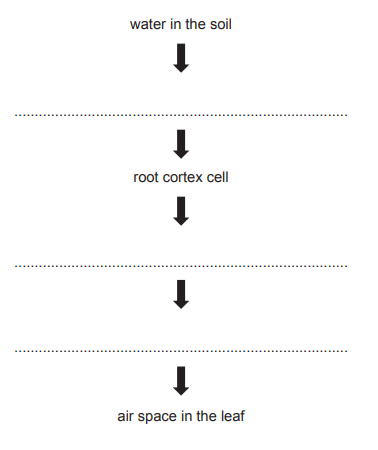
(a) Water moves from the soil to a leaf. Using words from the list, complete the flowchart by writing the names of the structures in the correct order in the spaces provided.
The words may be used once, more than once or not at all.
ciliated cell cuticle guard cell mesophyll cells phloem root hair cell stomata xylem
(b) Fig. 6.1 shows part of a cross-section of a leaf.
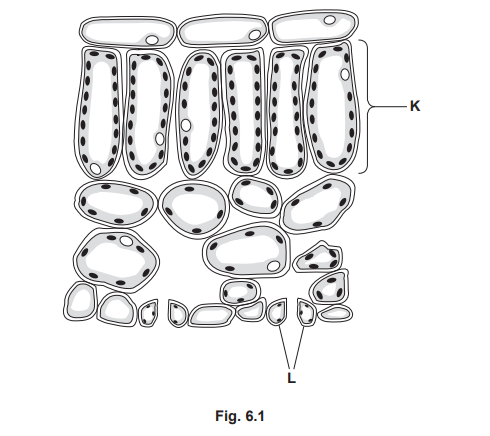
(i) State the function of the parts labelled L on Fig. 6.1.
(ii) Describe how layer K in Fig. 6.1 is adapted for photosynthesis.
(c) A scientist investigated the effect of temperature on the rate of transpiration from leaves. Fig. 6.2 shows the apparatus used. The mass of the leafy shoot and test-tube of water was measured at 0 minutes and at 60 minutes. The apparatus was used at a range of temperatures. All variables apart from temperature were kept the same. There was no air movement during this investigation.
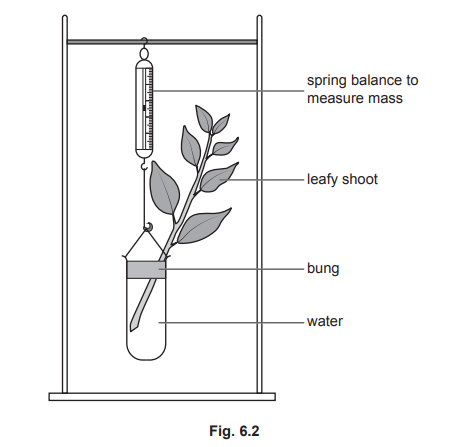
Table 6.1 shows the results.
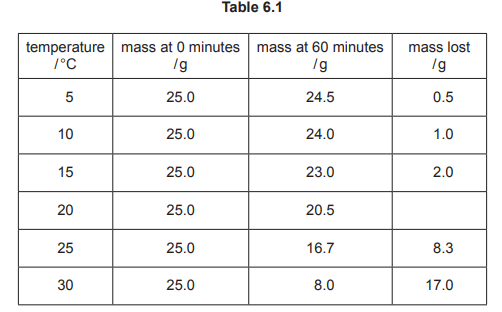
(i) Calculate the mass lost at 20°C. Write your answer in Table 6.1. [1]
(ii) Calculate the percentage decrease in mass at 25°C. Give your answer to the nearest whole number. Space for working.
(d) Describe the effect of temperature on the rate of transpiration for the data shown in Table 6.1.
(e) The apparatus was used for a new investigation to determine the effect of wind speed on transpiration. The temperature was maintained at 25°C. A fan was used to move air past the leafy shoot. Predict the effect of increased wind speed on the rate of transpiration and on the mass of the leafy shoot.
▶️ Answer/Explanation
Ans:
(a) The correct order of water movement is: root hair cell → xylem → mesophyll cells. Root hairs absorb water from soil, xylem transports it upwards, and mesophyll cells receive it for photosynthesis.
(b)(i) Structures labeled L (stomata) regulate gas exchange (CO₂ in, O₂ out) and control transpiration by opening/closing.
(b)(ii) Layer K (palisade layer) is adapted for photosynthesis with:
- Densely packed cells containing many chloroplasts
- Positioned near the upper surface for maximum light absorption
- Columnar shape to increase surface area
(c)(i) Mass lost at 20°C = 24.8 g (initial) – 20.3 g (final) = 4.5 g.
(c)(ii) Percentage decrease at 25°C: \[ \frac{25.0 – 16.7}{25.0} \times 100 = 33\% \] (rounded to nearest whole number).
(d) Transpiration rate increases with temperature (from 4.5 g/h at 20°C to 8.3 g/h at 30°C) because higher temperatures increase water molecule kinetic energy and evaporation.
(e) Increased wind speed would:
- Increase transpiration rate by removing water vapor faster from leaf surfaces
- Cause greater mass loss (>8.3 g at 25°C) due to enhanced evaporation
Final Answers:
(a) root hair cell → xylem → mesophyll cells
(b)(i) Regulate gas exchange/transpiration
(b)(ii) Many chloroplasts, tightly packed cells
(c)(i) 4.5 g
(c)(ii) 33%
(d) Increases with temperature
(e) Transpiration and mass loss increase
Topic – 21.3
(a) The mineral ion iron is a component of a balanced diet. People who do not get enough iron from their diet can develop anaemia. Fig. 7.1 shows the percentage of children with anaemia in four countries in the year 2000 and in the year 2015.

Describe the data shown in Fig. 7.1.
(b) Mineral ions are part of a balanced diet. State three other components of a balanced diet.
(c) Some crop plants have been genetically modified to improve their nutritional value.
(i) State the meaning of the term genetic modification.
(ii) Describe two examples of genetic modification in crop plants, other than improving their nutritional value.
(iii) State two reasons why bacteria are often used for genetic modification.
▶️ Answer/Explanation
Ans:
(a) The graph shows:
- Countries A and C saw decreases in childhood anaemia (e.g., Country A dropped from ~30% to ~15%).
- Country B had an increase (from ~10% to ~15%).
- Country D remained unchanged (~5%).
This suggests improved nutrition in A and C but worsening in B.
(b) Three other diet components:
- Carbohydrates (energy source)
- Proteins (growth/repair)
- Vitamins (e.g., vitamin C for immunity)
(c)(i) Genetic modification (GM) involves altering an organism’s DNA to introduce new traits (e.g., inserting genes for pest resistance).
(c)(ii) GM examples:
- Herbicide-resistant crops (e.g., Roundup Ready soybeans)
- Pest-resistant crops (e.g., Bt cotton produces insecticidal proteins)
(c)(iii) Bacteria are used because:
- They reproduce rapidly, speeding up research.
- They can express complex proteins (e.g., human insulin).