
Question 1
Fig. 1.1 shows the distance–time graph for a student. The student walks out of a classroom, stops to talk to some friends, and then walks to their next class.
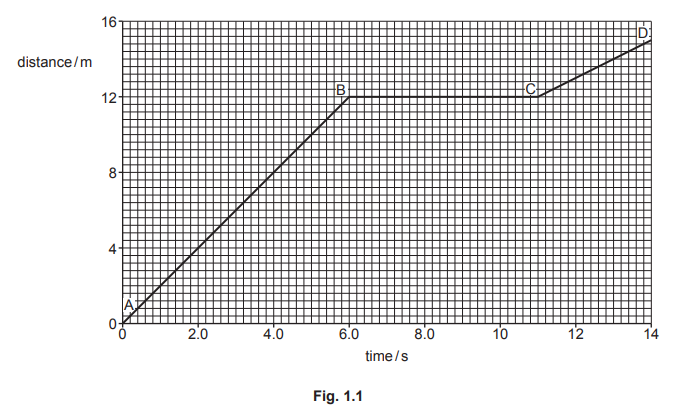
(a) Describe the motion of the student between time = 0 and time = 6.0 s.
(b) Calculate the speed of the student between time = 0 and time = 6.0 s.
(c) Determine the length of time for which the student stops walking.
(d) Compare the student’s speed in section AB with the speed in section CD.
Most-appropriate topic codes (Cambridge IGCSE Physics 0625):
• Topic 1.2 — Motion (Parts (a), (b), (c), (d))
▶️ Answer/Explanation
(a)
For the correct answer:
(walking with) constant/steady/uniform speed
Between $0$ and $6.0\text{ s}$, the graph is a straight, sloping line, which indicates a constant gradient. On a distance–time graph, this means the student covers equal distances in equal intervals of time, moving at a constant speed.
(b)
For the correct answer:
$2\text{ m/s}$
Speed is found from the gradient: $v = \frac{\Delta s}{\Delta t}$. The distance changes from $0\text{ m}$ to $12\text{ m}$ in $6.0\text{ s}$, so $v = \frac{12\text{ m}}{6.0\text{ s}} = 2\text{ m/s}$.
(c)
For the correct answer:
$5.0\text{ s}$
The student is stationary when the graph is horizontal. This occurs from $6.0\text{ s}$ to $11.0\text{ s}$, giving a stopped time of $11.0 – 6.0 = 5.0\text{ s}$.
(d)
For the correct answer:
faster OR more (before talking to friends / in section AB) OR double / twice (the speed)
Speed in section AB is $2\text{ m/s}$. In section CD, the student covers $4\text{ m}$ in $4\text{ s}$, giving $1\text{ m/s}$. The speed in AB is therefore greater, specifically twice that in CD.
Questions 2
(a) A student determines the volume of a piece of metal. The student pours \(30cm^3\) of water into a measuring cylinder. The piece of metal is submerged in the water and the new volume reading on the measuring cylinder is \(42cm^3\). Calculate the volume of the piece of metal.
(b) The mass of another piece of metal is 320g. The volume of the piece of metal is \(40cm^3\). Calculate the density of the metal. Give the correct unit.
(c) The student drops the piece of metal into a tank of water. Two vertical forces act on the piece of metal as it falls through the water in the tank. On Fig. 2.1, each arrow represents a vertical force.
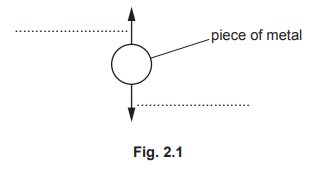
(i) Complete the diagram in Fig. 2.1 by labelling the two forces.
(ii) The upward force is the same size as the downward force. Describe the motion of the piece of metal as it falls through the water.
Most-appropriate topic codes (Cambridge IGCSE Physics 0625):
• Topic 1.4 — Density (Parts (a), (b))
• Topic 1.5.1 — Effects of forces (Parts (c)(i), (c)(ii))
▶️Answer/Explanation
(a)
For the correct answer:
(42 – 30 = ) 12 \(cm^3\)
The volume of an irregularly shaped solid that sinks can be found by the displacement method. The initial volume of water is \(30 cm^3\). After submerging the metal, the new volume is \(42 cm^3\). The volume of the metal is the difference between these two readings.
(b)
For the correct answer:
\(( \rho =)\) 8(.0)
\(( \rho =)\) 320 ÷ 40
(density =) mass ÷ volume OR \(( \rho =)\) m / V in any form
\(g / cm^3\)
Density is defined as mass per unit volume, given by the equation \(\rho = \frac{m}{V}\). Using the values provided, \(\rho = \frac{320g}{40cm^3} = 8.0 g/cm^3\). The unit for density is derived from the units of mass and volume used.
(c)(i)
For the correct answer:
friction / drag (upward arrow)
weight (downward arrow)
As an object falls through a fluid like water, it experiences two main vertical forces. The downward force is its weight, caused by gravity. The upward force opposing the motion is the frictional force, also known as drag or water resistance in this context.
(c)(ii)
For the correct answer:
(falling with) {constant / steady / uniform} speed
When the upward force of drag becomes equal in size to the downward force of weight, the resultant force on the object is zero. According to Newton’s laws of motion, an object with no resultant force acting on it will not accelerate, so it continues to fall at a constant speed, known as its terminal velocity.
Question 3
Fig. 3.1 shows a computer on the surface of a desk.
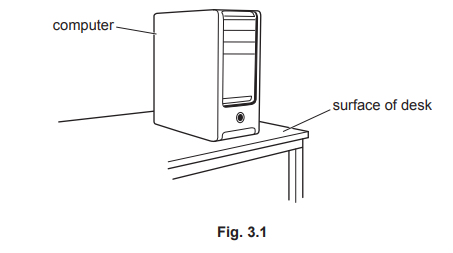
(a) The weight of the computer is 48N. The area of the computer in contact with the surface of the desk is 20cm2. Calculate the pressure due to the computer on the surface of the desk.
(b) A student uses a force of 12N to tilt the computer as shown in Fig. 3.2.
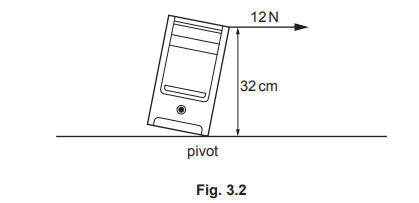
Calculate the moment of the 12N force about the pivot.
Most-appropriate topic codes (Cambridge IGCSE Physics 0625):
• Topic 1.8 — Pressure (Part (a))
• Topic 1.5.2 — Turning effect of forces (Part (b))
▶️ Answer/Explanation
Ans
(a) \(( \rho =)\) 2.4 \(N / cm^2\)
\(( \rho =)\) 48 ÷ 20
\(( \rho =)\) F ÷ A
(b) (moment = ) 380 (Ncm)
(moment = ) \(12 \times 32\)
moment = \(force \times (perp.)\) distance from pivot
Detailed solution:
(a) Pressure is force per unit area; substituting weight (48 N) and contact area (20 cm²) into \(p = F/A\) yields \(48 / 20 = 2.4\ \mathrm{N/cm^2}\).
(b) Moment of a force equals force × perpendicular distance; the 12 N force acts at 32 cm from the pivot, so moment = \(12 \times 32 = 380\ \mathrm{N\ cm}\) (to 2 s.f.).
Questions 4
Fig. 4.1 shows a student using a battery-powered device.

(a) State the energy store in the battery.
(b) The student pushes the device along the floor at a constant speed with a horizontal force of 14N. The student pushes the device for a distance of 4.5m. Calculate the mechanical work done by the force pushing the device.
(c) The student uses the device for a time of 30s. The energy input to the device is 5400J. Calculate the power input to the device.
Most-appropriate topic codes (Cambridge IGCSE Physics 0625):
• Topic 1.7.1 — Energy (Part (a))
• Topic 1.7.2 — Work (Part (b))
• Topic 1.7.4 — Power (Part (c))
▶️ Answer/Explanation
(a)
For the correct answer:
chemical (potential energy)
A battery stores energy in the form of chemical potential energy. This energy is released when a chemical reaction occurs within the battery, converting the stored chemical energy into electrical energy to power the device.
(b)
For the correct answer:
63 (J)
(work done =) \(14 \times 4.5\)
(work done =) force × distance (moved in direction of force)
Mechanical work done is calculated using the equation \(W = Fd\). Here, the constant force is \(14\text{ N}\) and the distance moved in the direction of the force is \(4.5\text{ m}\). Multiplying these values gives the total work done: \(14\text{ N} \times 4.5\text{ m} = 63\text{ J}\).
(c)
For the correct answer:
180 (W)
(power input =) 5400 ÷ 30
(power input =) energy input ÷ time OR \(\Delta E ÷ t\)
Power is defined as the rate at which energy is transferred. Using the equation \(P = \frac{\Delta E}{t}\), the total energy input of \(5400\text{ J}\) is divided by the time of \(30\text{ s}\). This calculation yields a power input of \(\frac{5400\text{ J}}{30\text{ s}} = 180\text{ W}\).
Question 5
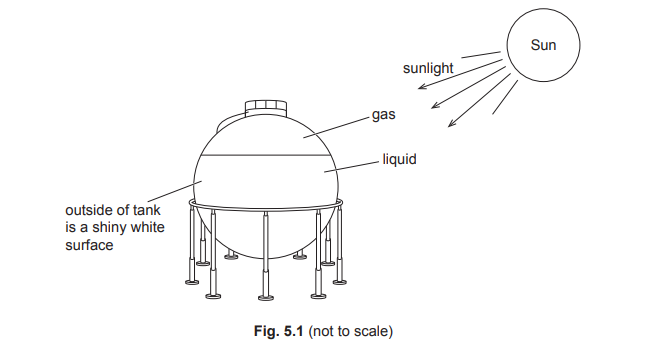
Most-appropriate topic codes (Cambridge IGCSE Physics 0625):
• Topic 2.1.2 — Particle model (Part (a))
• Topic 2.1.3 — Gases and the absolute scale of temperature (Part (b))
• Topic 2.3.3 — Radiation (Part (c))
▶️ Answer/Explanation
(a)
For the correct answer:
• particles are close together but arranged randomly • particles move randomly and can slide past each other • particles have some vibrational energy and collide with each other
In a liquid, particles are still held closely by intermolecular forces but have enough kinetic energy to move around each other. This gives liquids a fixed volume but no fixed shape, allowing them to flow and take the shape of their container.
(b)
For the correct answer:
pressure increases
• particles move faster / have increased kinetic energy
• more frequent and harder collisions with the container walls
At constant volume, raising the temperature of a gas increases the average kinetic energy of its particles. These faster-moving particles collide with the container walls more frequently and with greater force, resulting in a higher pressure exerted on the container.
(c)
For the correct answer:
infrared radiation (through space and atmosphere)
conduction (through the metal container)
Thermal energy from the Sun reaches the container as infrared radiation, which can travel through the vacuum of space. The metal container absorbs this radiation, heating up. The heat is then transferred through the metal walls to the petrol inside via conduction.
Question 6
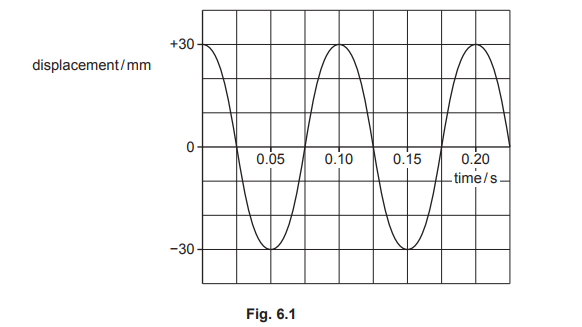
Most-appropriate topic codes (Cambridge IGCSE Physics 0625):
• Topic 3.1 — General properties of waves (Parts (a)(i), (a)(ii), (b)(i), (b)(ii))
▶️ Answer/Explanation
(a)(i)
For the correct answer:
30 (mm)
The amplitude is the maximum displacement of a point on the wave from its undisturbed rest position. In Fig. 6.1, the vertical axis shows displacement in mm, and the wave peaks reach +30 mm (with troughs at -30 mm). The amplitude is therefore 30 mm.
(a)(ii)
For the correct answer:
10 (Hz)
idea of frequency = no. of waves per second
Frequency is the number of complete wave cycles passing a point per unit time. From Fig. 6.1, two complete waves are shown occurring over a time period of 0.20 s. Using the frequency formula f = number of waves / time, the calculation is f = 2 / 0.20 s = 10 Hz.
(b)(i)
For the correct answer:
electromagnetic wave(s) OR any named electromagnetic wave OR wave (on surface of) water OR (seismic) S-wave / secondary wave
A transverse wave is one where the particle vibrations are perpendicular to the direction of energy propagation. Examples from the syllabus include all electromagnetic waves (such as light or radio waves), water ripples, and seismic S-waves.
(b)(ii)
For the correct answer:
(vibrations or they are) at right angles OR perpendicular to direction of propagation OR direction of energy transfer
In a transverse wave, the oscillations of the medium or field occur in a plane that is perpendicular (at a 90° angle) to the direction in which the wave energy is travelling. This contrasts with longitudinal waves where vibrations are parallel to the direction of propagation.
Question 7
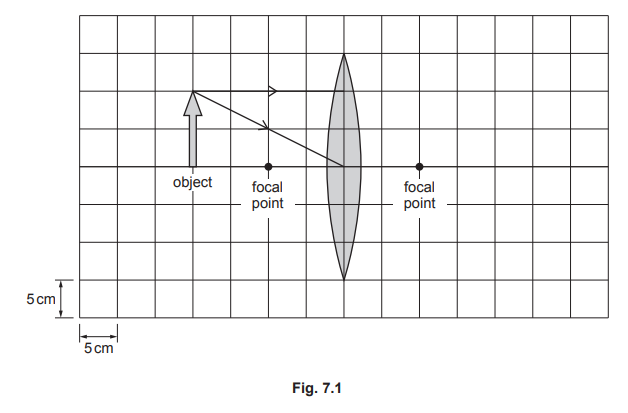

Most-appropriate topic codes (Cambridge IGCSE Physics 0625):
• Topic 3.2.3 — Thin lenses (Parts (a)(i), (a)(ii))
• Topic 3.3 — Electromagnetic spectrum (Parts (b)(i), (b)(ii), (b)(iii))
▶️ Answer/Explanation
(a)(i)
10 (cm)
\((focal length =) 2 \times 5\)
The focal length is the distance from the lens centre to the principal focus. Each grid square represents 5 cm, and the focal point is two squares from the lens, giving 10 cm.
(a)(ii)
ray continued in straight line through centre of lens
ray parallel to axis continued to pass through focal point
(top of) image position indicated as where rays cross
The central ray passes straight through the lens undeviated. The parallel ray refracts to pass through the focal point on the opposite side. The image is real and inverted, formed where the rays intersect.
(b)(i)
X-rays
The electromagnetic spectrum in order of increasing frequency and decreasing wavelength includes radio, microwaves, infrared, visible, ultraviolet, X-rays, and gamma rays. The missing region between ultraviolet and gamma is X-rays.
(b)(ii)
security marker OR detecting fake bank notes OR sterilising food / water
Ultraviolet light causes fluorescent materials to glow visibly, making it useful for security marking and forgery detection. It also has germicidal properties for sterilisation.
(b)(iii)
damage to (surface) cells / skin / eyes OR (leading to) cancer / eye conditions
Excessive UV exposure damages DNA in skin cells, causing sunburn and increasing the risk of skin cancers and cataracts due to its ionising-like effects on living tissue.
Question 8
(a) Fig. 8.1 shows a permanent bar magnet.
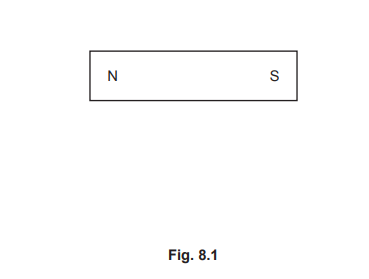
Describe an experiment to identify the pattern and directions of the magnetic field lines around the bar magnet. You may draw on Fig. 8.1 as part of your answer.
(b) State the name of a material that is suitable for a permanent magnet.
(c) State one use of a permanent magnet.
Most-appropriate topic codes (Cambridge IGCSE Physics 0625):
• Topic 4.1 — Simple phenomena of magnetism (Parts (a), (b), (c))
▶️ Answer/Explanation
(a)
For the correct answer:
use of compass to give direction of field lines
first method (use of plotting) compass(es) idea of mark arrow position OR move compass in direction of arrow start from different position(s) OR join up marks / draw lines (to show pattern)
OR alternative method
(use of plotting) compass(es) place number of compasses around magnet idea that arrows line up to show pattern
Detailed Solution: Place the bar magnet on a flat surface. Place a small plotting compass near the north pole; the compass needle aligns with the field. Mark the position of the compass needle ends, then move the compass so its tail is at the new dot. Repeat this process to trace a continuous field line from the north pole to the south pole. The direction is shown by the compass arrow pointing away from the north pole.
(b)
For the correct answer:
steel
Detailed Solution: Steel is a magnetically hard material with high retentivity, meaning it retains its magnetism once magnetised. This makes it suitable for manufacturing permanent magnets.
(c)
For the correct answer:
electric motors OR loudspeakers OR burglar alarms
Detailed Solution: Permanent magnets provide a constant magnetic field. In a loudspeaker, a permanent magnet interacts with a varying magnetic field from a current-carrying coil to vibrate a diaphragm and produce sound waves.
Question 9
A student connects the electrical circuit shown in Fig. 9.1.
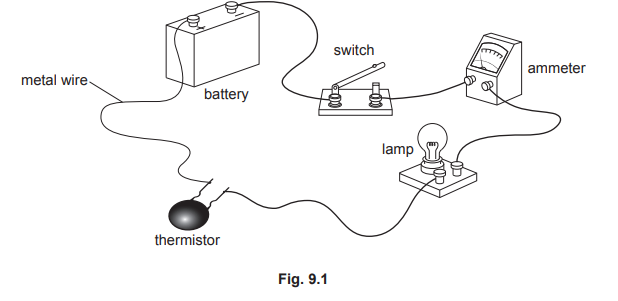
(a) Fig. 9.2 shows part of the circuit diagram for the circuit in Fig. 9.1. 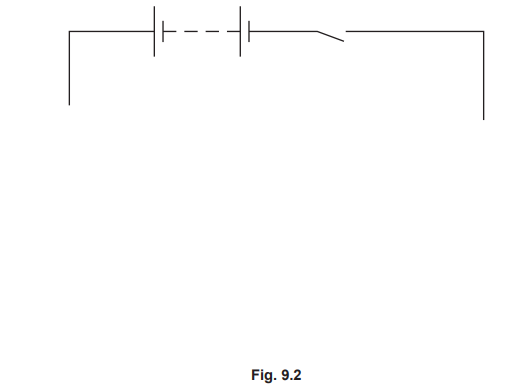
Complete the circuit diagram in Fig. 9.2 to represent the circuit in Fig. 9.1. Use standard electrical symbols.
(b) The potential difference across the lamp is 5.4V and the current in the lamp is 0.20A.
(i) Calculate the resistance of the lamp.
(ii) The lamp is switched on for 30s. Calculate the energy transferred in the lamp during this time.
(c) The student increases the temperature of the thermistor. State and explain what happens to the current in the circuit
Most-appropriate topic codes (Cambridge IGCSE Physics 0625):
• Topic 4.3.1 — Circuit diagrams and circuit components (Part (a))
• Topic 4.2.4 — Resistance (Part (b)(i))
• Topic 4.2.5 — Electrical energy and electrical power (Part (b)(ii))
• Topic 4.2.4 — Resistance (Part (c))
▶️ Answer/Explanation
(a)
correct symbol for:
ammeter
lamp
thermistor
symbols connected in series circuit
The circuit diagram must be completed by adding the correct standard electrical symbols for the ammeter, lamp, and thermistor, ensuring they are connected in a single series loop as shown in the physical circuit layout of Fig. 9.1.
(b)(i)
27 \((\Omega)\)
5.4 ÷ 0.2(0)
(R=) V ÷ I OR V = \(I \times R\) or in any form
Resistance is calculated using the equation \(R = \frac{V}{I}\). Substituting the given values of potential difference (5.4 V) and current (0.20 A) into the formula yields \(R = \frac{5.4}{0.20} = 27 \, \Omega\).
(b)(ii)
32 (J)
(E =) \(5.4 \times 0.2 \times 30\)
(E=) VIt OR \(P \times t\) OR \(I^2 \times R \times t\)
The energy transferred is determined using \(E = VIt\). Substituting the potential difference (5.4 V), current (0.20 A), and time (30 s) into the equation gives \(E = 5.4 \times 0.20 \times 30 = 32.4 \, \text{J}\), which rounds to 32 J.
(c)
current increases
(because) resistance (of thermistor) decreases
A thermistor is a temperature-dependent resistor with a negative temperature coefficient (NTC). As its temperature increases, its resistance significantly decreases, which reduces the total resistance of the series circuit and causes the current to increase according to Ohm’s law.
Question 10
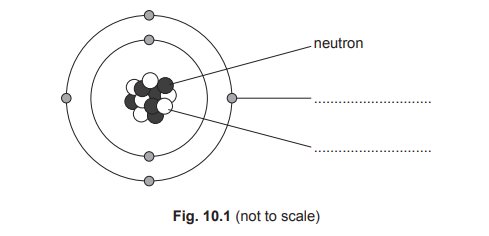

Most-appropriate topic codes (Cambridge IGCSE Physics 0625):
• Topic 5.1.1 — The atom (Parts (a), (b))
• Topic 5.2.4 — Half-life (Part (c))
▶️ Answer/Explanation
(a)
For the correct answer:
electron
proton
The diagram shows a central nucleus composed of protons and neutrons, with particles orbiting in shells around it. The particle labelled in the outer orbit is an electron, which carries a negative charge. The particle labelled within the nucleus is a proton, which carries a positive charge.
(b)
For the correct answer (any three from):
3 protons (in nucleus)
4 neutrons (in nucleus)
3 electrons outside nucleus
nucleus labelled
electron orbits seen
The nuclide notation $^{7}_{3}\text{Li}$ indicates that the nucleus contains 3 protons (the atomic number) and a total of 7 nucleons, meaning there are $7 – 3 = 4$ neutrons. Since atoms are neutral, there must be 3 electrons orbiting the nucleus in distinct shells.
(c)
For the correct answer:
$(5700 \times 3 =)$ 17 100 (years)
(from 120 mg to 15 mg takes) 3 half-lives
The mass of the isotope halves with each half-life: $120\text{ mg} \rightarrow 60\text{ mg} \rightarrow 30\text{ mg} \rightarrow 15\text{ mg}$. This sequence requires three half-lives. The total time taken is therefore $3 \times 5700\text{ years} = 17100\text{ years}$.
Question 11
Fig. 11.1 represents the four planets nearest to the Sun.
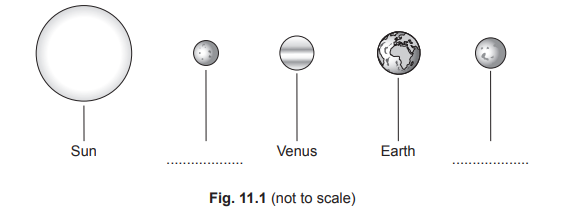
(a) Two of the planets in Fig. 11.1 are not labelled. On each dotted line, write the name of the planet.
(b) The distance of Venus from the Sun is \(1.1 × 10^{11}\text{ m}\). The speed of light is \(3.0 × 10^8\text{ m/s}\). Calculate the time it takes light to travel from the Sun to Venus.
(c) The mass of the Earth is greater than the mass of Venus. The gravitational field strength on the surface of the Earth is 9.8N/kg. Suggest a value for the gravitational field strength on the surface of Venus. Give a reason for your answer.
Most-appropriate topic codes (Cambridge IGCSE Physics 0625):
• Topic 6.1.2 — The Solar System (Part (a))
• Topic 6.1.1 — The Earth (Part (b))
• Topic 6.1.2 — The Solar System (Part (c))
▶️ Answer/Explanation
(a)
Mercury
Mars
The eight planets in order from the Sun are Mercury, Venus, Earth, Mars, Jupiter, Saturn, Uranus, and Neptune. In Fig. 11.1, the first unlabelled planet closest to the Sun is Mercury, and the fourth planet shown is Mars.
(b)
370 (s)
\(1.1 \times 10^{11} \div 3.0 \times 10^8\)
speed = distance ÷ time OR \((t =) \, d \div s\)
The time for light to travel a given distance is calculated using the rearranged equation \(t = \frac{d}{v}\). Substituting the values gives \(t = \frac{1.1 \times 10^{11} \text{ m}}{3.0 \times 10^8 \text{ m/s}} = 366.6… \text{ s}\), which rounds to 370 s.
(c)
value smaller than 9.8 (N / kg)
Venus has smaller mass ORA OR gravitational field strength depends on / proportional to mass
The gravitational field strength at a planet’s surface is directly related to its mass; a planet with greater mass exerts a stronger gravitational pull. Since Earth has a greater mass than Venus, the gravitational field strength on Venus must be less than Earth’s value of 9.8 N/kg.