
Question 1
A girl is cycling along a straight horizontal road.
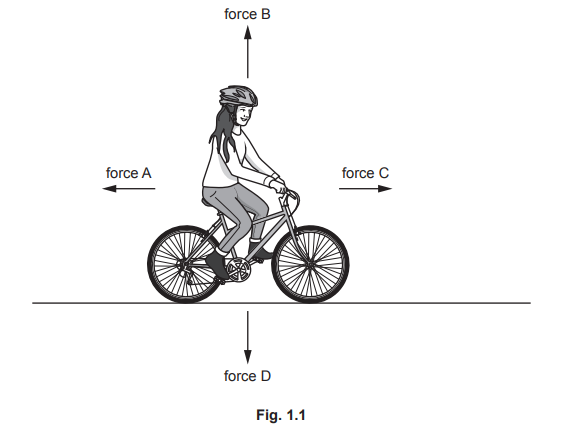
Fig. 1.1 shows the directions of the forces acting on the cyclist as she cycles in the direction of
force C.
(a) State which force shows the direction of:
(i) the force due to gravity
(ii) the force due to air resistance.
(iii) Force A changes and becomes larger than force C. State any effect this change has on the motion of the cyclist.
(b) Another cyclist travels a distance of 250 m in a time of 21 s.
(i) Calculate the average speed of the cyclist.
(ii) The cyclist exerts a force of 36N to move the cycle forwards. Calculate the work done by this force when the cyclist travels 250 m. Include the unit.
Most-appropriate topic codes (Cambridge IGCSE Physics 0625):
• Topic 1.5.1 — Effects of forces (Parts (a)(i), (a)(ii), (a)(iii))
• Topic 1.2 — Motion (Part (b)(i))
• Topic 1.7.2 — Work (Part (b)(ii))
▶️ Answer/Explanation
(a)(i) D
The force due to gravity (weight) always acts vertically downwards towards the centre of the Earth. In the diagram, force D is the only arrow pointing straight down.
(a)(ii) A
Air resistance (drag) is a frictional force that opposes the motion of an object moving through the air. Since the cyclist moves in the direction of force C, force A points backwards and represents the air resistance.
(a)(iii) decelerating / slowing down / less speed
Force C is the forward driving force, and force A is the backward resistive force. When force A becomes larger than force C, the resultant force acts opposite to the direction of motion, causing the cyclist to decelerate.
(b)(i) 12 (m/s)
Average speed is calculated by dividing the total distance travelled by the total time taken: $v = \frac{s}{t} = \frac{250\text{ m}}{21\text{ s}} = 11.9\text{ m/s}$, which rounds to $12\text{ m/s}$.
(b)(ii) 9000 J
Work done is the product of force and the distance moved in the direction of the force: $W = F \times d = 36\text{ N} \times 250\text{ m} = 9000\text{ J}$. The unit of work is the joule (J).
Question 2
Most-appropriate topic codes (Cambridge IGCSE Physics 0625):
• Topic 1.5.2 — Turning effect of forces (Parts (a), (b))
• Topic 1.5.3 — Centre of gravity (Part (b))
▶️ Answer/Explanation
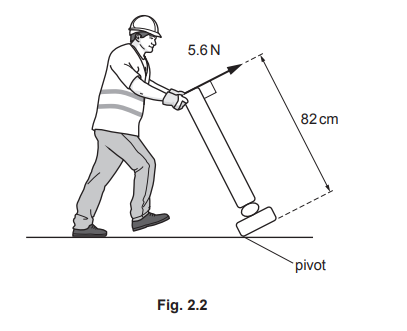
(a)
460 (Ncm)
\(5.6 \times 82\)
(moment =) \(force\times (perpendicular)\) distance in any form
Detailed solution: The moment of a force is calculated as the product of the force and the perpendicular distance from the pivot to the line of action of the force. From Fig. 2.2, the perpendicular distance is given as $82\text{ cm}$, and the force applied is $5.6\text{ N}$. Using the equation $\text{moment} = F \times d$, we find $\text{moment} = 5.6\text{ N} \times 82\text{ cm} = 459.2\text{ Ncm}$, which is approximately $460\text{ Ncm}$.
(b)
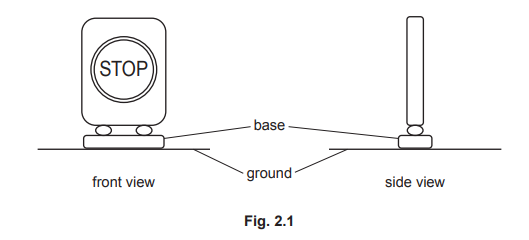
heavier base OR increases area of base lowers centre of mass / gravity
Detailed solution: To make the sign more stable without fixing it to the ground, the base should be made heavier or have a larger area. A heavier base increases the weight, providing a greater restoring moment to counteract the turning effect of the wind. A wider base increases the distance the centre of mass must be tilted before it falls outside the base, thereby lowering the centre of gravity and improving overall stability.
Question 3
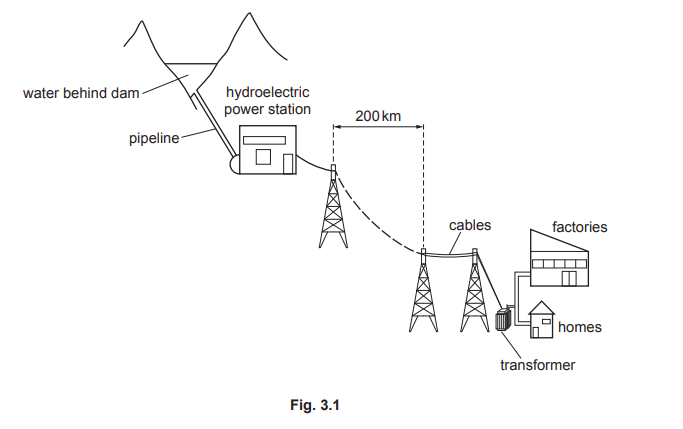
Fig. 3.1 represents a hydroelectric power station transmitting electrical energy to homes and factories far away.
(a) (i) State the energy store for the water behind the dam.
(ii) In the list of equipment, draw a ring around each item that a hydroelectric power station requires.
boiler cooling tower generator solar cell turbine
(b) (i) State the type of transformer shown in Fig. 3.1.
(ii) Give two reasons why the power station uses high voltages to transmit electrical energy over long distances.
(c) Hydroelectric power stations may replace coal‑fired power stations. State two advantages and two disadvantages of using hydroelectric power stations compared with coal‑fired power stations. Do not include building or maintenance costs.
Most-appropriate topic codes (Cambridge IGCSE Physics 0625):
• Topic 1.7.3 — Energy resources (Parts (a)(i), (a)(ii), (c))
• Topic 4.5.6 — The transformer (Parts (b)(i), (b)(ii))
▶️ Answer/Explanation
(a)(i)
For the correct answer:
gravitational OR potential
Water stored behind a dam is at a height, so it possesses gravitational potential energy due to its position in the Earth’s gravitational field.
(a)(ii)
For the correct answer:
generator AND turbine
A hydroelectric station uses falling water to spin a turbine, which is connected to a generator that converts the mechanical energy into electrical energy. Boilers, cooling towers, and solar cells are not used in this process.
(b)(i)
For the correct answer:
step-down
The transformer shown is near the homes and factories, reducing the high transmission voltage to a lower, safer voltage for domestic and industrial use.
(b)(ii)
For the correct answer (any two):
lower current (in cables)
reduced power / energy loss / increased efficiency OR reduced heating losses
thinner / cheaper / lighter cables
pylons can be further apart / not so strong
Transmitting at high voltage allows a lower current for the same power $(P = IV)$. A lower current reduces thermal energy lost as heat in the cables $(P = I^2R)$, improving efficiency and allowing thinner cables.
(c)
For the correct answer (any two advantages from):
no fuel costs
renewable
no air pollution / no $\mathrm{SO}_2$ / no acid rain
no greenhouse gases / $\mathrm{CO}_2$ emissions
no fuel to transport
creates lakes for recreation / tourism
quick start-up time owtte
For the correct answer (any two disadvantages from):
large area of land flooded
damage to wildlife habitats
population displacement
limited number steep sided valleys owtte
changes to water provision (downstream)
(output) can be affected by lack of rain / drought
Hydroelectric power uses a renewable source (water) and produces no direct air pollutants, unlike burning coal. However, building dams floods large areas, displacing communities and damaging ecosystems, and power output depends on seasonal rainfall.
Question 4
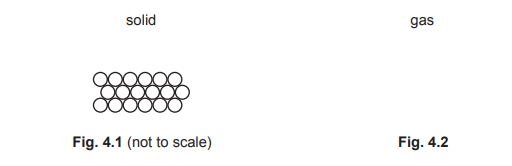
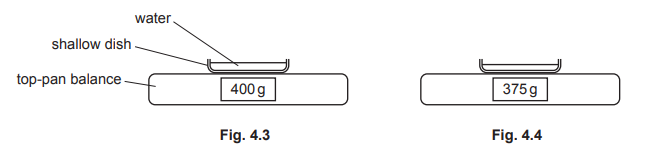
Most-appropriate topic codes (Cambridge IGCSE Physics 0625):
• Topic 2.1.1 — States of matter (Part (a)(i))
• Topic 2.1.2 — Particle model (Parts (a)(ii), (a)(iii))
• Topic 2.2.3 — Melting, boiling and evaporation (Parts (b)(i), (b)(ii))
▶️ Answer/Explanation
(a)(i)
vibrate
In a solid, particles are held closely together in a fixed, regular arrangement by strong intermolecular forces. They do not have enough energy to move from their positions, so their motion is limited to vibrating about fixed points.
(a)(ii)
random (arrangement)
clear separation of particles
Particles in a gas are widely spaced with no fixed pattern. The diagram should show particles distributed randomly across the available space with significant gaps between them, reflecting the negligible forces of attraction in the gaseous state.
(a)(iii)
any two from:
random
fast/high speed / high KE
colliding
Gas particles possess high kinetic energy, allowing them to overcome attractive forces. They move rapidly in straight lines in random directions, frequently colliding with each other and the walls of their container.
(b)(i)
evaporation
The mass of water decreases because some liquid water changes state to water vapour and escapes from the open dish into the surrounding air.
(b)(ii)
any two from:
(happens at the) surface
the more energetic particles escape
(liquid particles) → gas / vapour (particles)
Evaporation occurs at the liquid surface. Particles in the liquid have a range of kinetic energies; those near the surface with the highest energy overcome the attractive forces of neighbouring particles and escape to become vapour, reducing the average kinetic energy and mass of the remaining liquid.
Question 5
Fig. 5.1 represents an arrangement for heating water. The hot water is stored in the metal container.
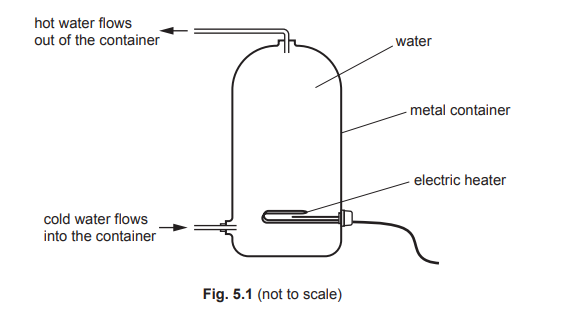
(a) Explain why the hot water is available at the top of the container. Use ideas about density.
(b) The electric heater is switched on for one hour every morning.
(i) State the name of the process that transfers thermal energy through the walls of the metal container.
(ii) Suggest one way of keeping the water hot after the heater is switched off.
Most-appropriate topic codes (Cambridge IGCSE Physics 0625):
• Topic 2.3.2 — Convection (Part (a))
• Topic 2.3.1 — Conduction (Part (b)(i))
• Topic 2.3.4 — Consequences of thermal energy transfer (Part (b)(ii))
▶️ Answer/Explanation
(a)
For the correct answer:
convection (current)
any two from:
(heated water) expands
(becomes) less dense
(less dense) water rises
When the water near the heater is warmed, its particles gain kinetic energy and move further apart, causing the water to expand and become less dense than the cooler water above it. This less dense, warmer water rises to the top of the container, while the denser, cooler water sinks to take its place, setting up a convection current that ensures hot water is available at the top.
(b)(i)
For the correct answer:
conduction
Thermal energy is transferred through the solid metal walls of the container primarily by conduction, a process where vibrating atoms or delocalised electrons pass kinetic energy to adjacent particles without any bulk movement of the material itself.
(b)(ii)
For the correct answer:
insulate / lag container owtte
To reduce the rate of thermal energy loss to the surroundings after the heater is off, the container can be wrapped with an insulating material, such as fibreglass or foam. This insulation traps air, which is a poor thermal conductor, thereby slowing down the transfer of heat and keeping the water hot for a longer period.
Question 6
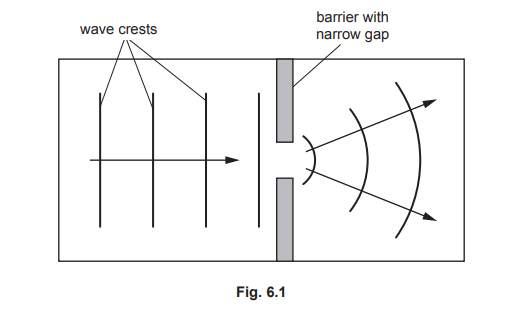
Choose one word from the list.
diffraction dispersion reflection refraction
The wave property demonstrated in Fig. 6.1 is …………….
Most-appropriate topic codes (Cambridge IGCSE Physics 0625):
• Topic 3.1 — General properties of waves (Parts (a), (b)(i), (b)(ii), (c))
▶️ Answer/Explanation
(a)
transverse
A transverse wave is defined by particle oscillation occurring perpendicular to the direction of energy propagation. Examples include electromagnetic radiation, water ripples, and seismic S-waves, where the vibrational movement is at a right angle to the wave’s forward travel path.
(b)(i)
diffraction
The image shows plane waves encountering a narrow aperture and subsequently spreading out in a curved, circular pattern beyond the opening. This characteristic bending and spreading of wavefronts around an obstacle or through a gap is known as diffraction.
(b)(ii)
correct wavelength indicated
The wavelength is the spatial period of a wave, measured as the distance between two successive identical points in phase, such as from crest to adjacent crest or trough to adjacent trough. Marking this distance on the diagram and labeling it ‘w’ correctly identifies the wavelength.
(c)
\(8.2 \, (\text{Hz})\)
\(42 \div 5.1\)
\(v = f \times \lambda\) OR \((\text{frequency} =) \frac{\text{speed}}{\text{wavelength}}\) in any form
The frequency of a wave is calculated using the general wave equation that relates speed (\(v\)), frequency (\(f\)), and wavelength (\(\lambda\)). Rearranging the equation \(v = f \times \lambda\) to solve for frequency yields \(f = \frac{v}{\lambda}\). Substituting the known values: \(f = \frac{42 \, \text{cm/s}}{5.1 \, \text{cm}}\), which results in an approximate frequency of \(8.2 \, \text{Hz}\).
Question 7
(a) Fig. 7.1 shows a ray of red light incident on a glass prism at point P. The ray of red light is refracted at point P
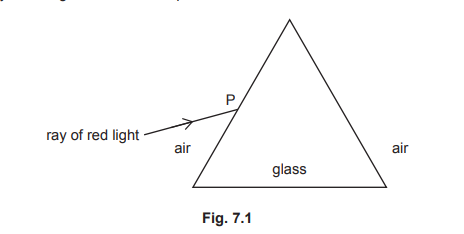
On Fig. 7.1:
(i) draw the normal at point P
(ii) draw the path of the ray of red light through the glass prism and into the air.
(b) A ray of blue light replaces the ray of red light. The angle of incidence for the blue ray entering the prism is the same as in Fig. 7.1. Describe any difference between the path of the blue ray in the prism and the path of the red ray in the prism.
(c) Another ray enters the glass prism and is totally internally reflected. State two conditions for a ray to be totally internally reflected.
Most-appropriate topic codes (Cambridge IGCSE Physics 0625):
• Topic 3.2.2 — Refraction of light (Parts (a), (b), (c))
▶️ Answer/Explanation
(a)(i) correct normal
(a)(ii) ray in glass refracted towards the normal; ray in air refracted away from the normal
(b) greater refraction / smaller angle of refraction (at air–glass boundary)
(c) (ray of light) travelling from glass to air; angle of incidence greater than critical angle
Detailed solution:
(a) The normal is a dashed line drawn perpendicular to the prism surface at point P. Upon entering the denser glass, the light slows down and bends towards this normal; upon exiting back into less dense air, it speeds up and bends away from the normal. (b) Blue light has a higher frequency and shorter wavelength than red light, causing it to slow down more in glass, resulting in a greater change in direction (greater refraction). (c) Total internal reflection requires the light to be in the optically denser medium (glass) moving towards a less dense medium (air), and the angle of incidence inside the glass must exceed the critical angle for the glass-air boundary.
Question 8
Most-appropriate topic codes (Cambridge IGCSE Physics 0625):
• Topic 4.2.4 — Resistance (Part (b))
• Topic 4.2.5 — Electrical energy and electrical power (Part (c))
• Topic 4.3.1 — Circuit diagrams and circuit components (Part (a))
▶️ Answer/Explanation
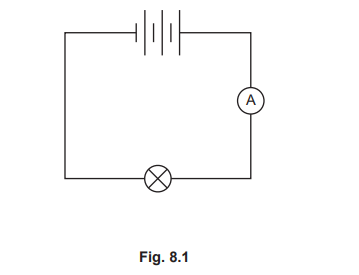
(a)
For the correct answer:
correct symbol voltmeter in parallel with lamp
A voltmeter must be connected in parallel with the component across which the potential difference is being measured. The symbol for a voltmeter is a circle with a ‘V’ inside, and it should be drawn with leads connected to the two terminals of the lamp.
(b)
For the correct answer:
$29\ \Omega$
The resistance is calculated using the equation $R = \frac{V}{I}$. Substituting the given values, $R = \frac{12\text{ V}}{0.41\text{ A}}$, which yields approximately $29.3\ \Omega$. Rounded to two significant figures to match the precision of the given current, the result is $29\ \Omega$.
(c)
For the correct answer:
$4.9\ \text{W}$
Electrical power is calculated using $P = I \times V$. Substituting the values, $P = 0.41\text{ A} \times 12\text{ V} = 4.92\text{ W}$. Rounded to two significant figures, the power transferred is $4.9\text{ W}$.
Question 9
(a) Fig. 9.1 shows three devices: a compass, a transformer and an electromagnet. The main parts of the devices are labelled.
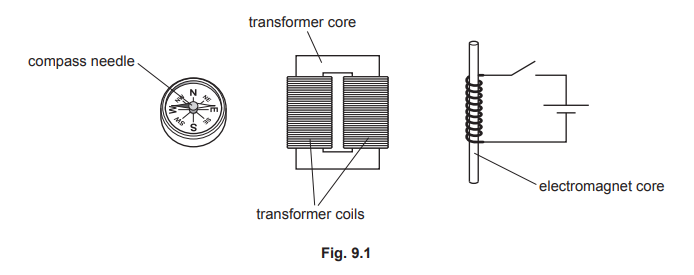
Complete Table 9.1 by adding a suitable metal for each part. Choose from the metals in the list. Each metal can be used once, more than once or not at all.
aluminium copper soft iron silver steel 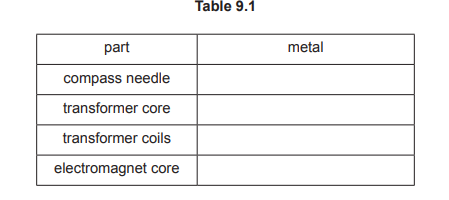
(b) The primary coil of a transformer is connected to a mains supply of 220V a.c. The primary coil has 1500 turns and the secondary coil has 650 turns. Calculate the output voltage of the secondary coil.
Most-appropriate topic codes (Cambridge IGCSE Physics 0625):
• Topic 4.1 — Simple phenomena of magnetism (Part (a), compass needle and electromagnet core)
• Topic 4.5.6 — The transformer (Part (a), transformer core and Part (b))
▶️ Answer/Explanation
(a)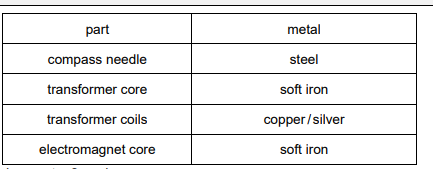
Detailed solution: A compass needle is a small permanent magnet, so it is made of steel, which retains magnetism. The core of an electromagnet must magnetise and demagnetise easily, so soft iron is used. Transformer cores also require a material that can be rapidly magnetised and demagnetised with minimal energy loss, so soft iron is again the appropriate choice.
(b)
95 (V)
\((V_s =) 650 / 1500 \times 220\) OR 1500 / 650 = 220 / \(V_s\)
\((V_p / V_s) = (N_p / N_s)\) in any form
Detailed solution: The transformer voltage ratio equation is \(\frac{V_p}{V_s} = \frac{N_p}{N_s}\). Substituting the given values gives \(\frac{220}{V_s} = \frac{1500}{650}\). Rearranging to solve for \(V_s\) yields \(V_s = 220 \times \frac{650}{1500} = 95.3\text{ V}\), which rounds to \(95\text{ V}\) as the output voltage.
Question 10
(a) The nuclide notation for an atom of protactinium‑234 is:

(i) State the number of protons in an atom of protactinium‑234.
(ii) State the number of nucleons in an atom of protactinium‑234.
(b) Three forms of the element protactinium are: protactinium‑234, protactinium‑230 and protactinium‑233. State the name given to these different forms of the same element.
(c) A teacher demonstrates radioactive decay by using a sample of protactinium‑234m.
(i) The sample emits beta (β)‑particles. State the nature of a beta (β)‑particle.
(ii) The teacher obtains data for a decay curve. Fig. 10.1 shows the decay curve for the sample of protactinium‑234m
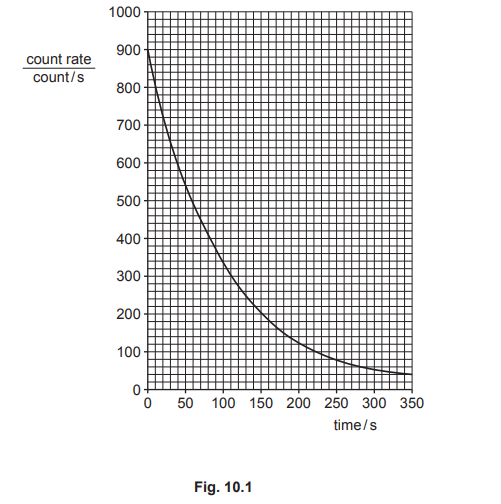
Calculate the half‑life of protactinium‑234m using the information in Fig. 10.1. Clearly show your working on the graph or in the space provided.
(iii) Suggest a reason why the half‑life of protactinium‑234m makes it suitable for this demonstration in a lesson.
Most-appropriate topic codes (Cambridge IGCSE Physics 0625):
• Topic 5.1.2 — The nucleus (Parts (a)(i), (a)(ii), (b))
• Topic 5.2.2 — The three types of nuclear emission (Part (c)(i))
• Topic 5.2.4 — Half-life (Parts (c)(ii), (c)(iii))
▶️ Answer/Explanation
(a)(i) 91
(a)(ii) 234
(b) isotopes
(c)(i) electron
(c)(ii) range 65–75 (s) / range 55–85 (s) / 2 associated values (e.g. 900 and 450 or 800 and 400 etc) seen / indicated
(c)(iii) small half-life / time in a lesson to collect enough data for a decay curve owtte
Detailed solution:
(a)(i) The bottom number (91) in nuclide notation $\frac{234}{91}\text{Pa}$ is the proton number (atomic number) $Z$. (ii) The top number (234) is the nucleon number (mass number) $A$. (b) Atoms of the same element with different nucleon numbers are called isotopes. (c)(i) A beta particle is a fast-moving electron emitted from the nucleus. (ii) Half-life is the time for the count rate to halve; e.g., from 800 to 400 counts/s takes approximately 70 s. (iii) Its short half-life allows a complete decay curve to be observed within a single lesson.
Question 11
(a) The Solar System contains a number of objects. Some of these objects are listed.
asteroids planets the Moon the Sun
Write these objects in order of their size
 (b) Redshift is an increase in the observed wavelength of the light emitted from distant galaxies.
(i) State what redshift indicates about the movement of distant galaxies.
(ii) State why redshift in the light from distant galaxies supports the Big Bang Theory.
(c) (i) Define one light‑year.
(ii) Scientists can send spacecraft to planets. There are many planets outside the Solar System. Suggest one reason, other than cost, why scientists do not send spacecraft to planets outside the Solar System.
(d) An electromagnetic wave travels from the Sun to the Earth in a time of 500s. The speed of the electromagnetic wave in space is \(3.0 × 10^8m/s\). Calculate the distance between the Sun and the Earth.
Most-appropriate topic codes (Cambridge IGCSE Physics 0625):
• Topic 6.1.2 — The Solar System (Part (a))
• Topic 6.2.3 — The Universe (Parts (b)(i), (b)(ii), (c)(i), (c)(ii))
• Topic 1.2 — Motion (Part (d))
▶️ Answer/Explanation
(a)
For the correct order:
Sun → planets → Moon → asteroids
The Sun is a star and contains most of the Solar System’s mass. Planets are large bodies orbiting the Sun, while moons are natural satellites orbiting planets and are smaller. Asteroids are minor rocky bodies, generally smaller than moons.
(b)(i)
receding / moving away
Redshift occurs when light waves are stretched, increasing wavelength. This indicates the source is moving away from the observer, analogous to the Doppler effect for sound.
(b)(ii)
(Universe) expanding
If light from all distant galaxies is redshifted, they are all moving away from us. This implies the Universe was once concentrated at a single point and has been expanding since.
(c)(i)
distance travelled by light (in space) in one year
A light-year is a measure of astronomical distance, defined by how far electromagnetic waves travel through vacuum in one Julian year.
(c)(ii)
distances vast OR (planets) too far away
Interstellar distances are immense; even travelling at light speed would take years or centuries. Current technology cannot sustain human life or communication over such durations.
(d)
\(1.5 \times 10^{11} \text{ m}\)
\(3.0 \times 10^8 \times 500\)
Using the wave speed equation \(v = \frac{s}{t}\), rearranged to \(s = v \times t\). Substituting values: \(s = (3.0 \times 10^8 \text{ m/s}) \times 500 \text{ s} = 1.5 \times 10^{11} \text{ m}\).