Question 1
What is the time for one complete swing of the pendulum?
Most-appropriate topic codes (Cambridge IGCSE Physics 0625):
▶️ Answer/Explanation
Detailed solution:
The time for one complete swing is known as the period ($T$) of the pendulum.
To find the time for a single swing when given a multiple, use the formula: $T = \frac{\text{total time}}{\text{number of swings}}$.
Substituting the given values: $T = \frac{30\text{ s}}{20}$.
This simplifies to $T = 1.5$ s.
Measuring multiple swings and dividing by the count improves accuracy by reducing the impact of reaction time errors.
Therefore, the time for one complete swing is $1.5$ s, which corresponds to option C.
Question 2
Most-appropriate topic codes (Cambridge IGCSE Physics 0625):
▶️ Answer/Explanation
Detailed solution:
The volume of an irregularly shaped solid cannot be calculated using a ruler and standard geometric formulas.
Instead, the displacement method is used: the solid is submerged in a liquid within a measuring cylinder.
The volume of the solid is equal to the change in the liquid level, calculated as $V_{solid} = V_{final} – V_{initial}$.
A balance measures mass ($m$), not volume ($V$), and a thermometer measures temperature ($\theta$ or $T$).
Therefore, the measuring cylinder is the only appropriate piece of apparatus for this task.
Question 3
Most-appropriate topic codes (Cambridge IGCSE Physics 0625):
▶️ Answer/Explanation
Detailed solution:
In a speed-time graph, the y-axis represents speed $v$ and the x-axis represents time $t$.
The area under the curve is the product of the two axes, which corresponds to $v \times t$.
Since speed is defined as $v = \frac{s}{t}$, rearranging for distance gives $s = v \times t$.
Therefore, the area under a speed-time graph represents the total distance travelled by the object.
Note that the gradient of the same graph would represent the acceleration $a = \frac{\Delta v}{\Delta t}$.
This matches Option C, whereas the other options describe different kinematic properties or gradients.
Question 4
Most-appropriate topic codes (Cambridge IGCSE Physics 0625):
▶️ Answer/Explanation
Detailed solution:
A force is an influence that can change the motion or shape of an object, measured in Newtons ($N$).
Weight is specifically defined as the gravitational force acting on an object that has mass ($m$).
It is calculated using the equation $W = m \times g$, where $g$ is the gravitational field strength.
In contrast, density ($\rho = \frac{m}{V}$), mass ($m$), and volume ($V$) are physical properties but not forces.
Since weight is a measure of pull due to gravity, it is the only quantity listed that is an example of a force.
Therefore, option D is the correct answer as it identifies weight as a force.
Question 5

Most-appropriate topic codes (Cambridge IGCSE Physics 0625):
▶️ Answer/Explanation
Detailed solution:
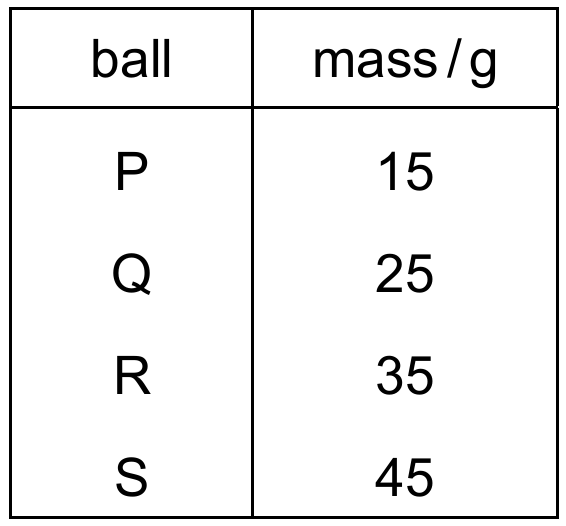
An object floats if its density is less than the density of the liquid ($\rho_{object} < 0.95\text{ g/cm}^{3}$).
Density is calculated using $\rho = \frac{m}{V}$, where $V = 30\text{ cm}^{3}$ for all balls.
For P: $\rho_{P} = \frac{15\text{ g}}{30\text{ cm}^{3}} = 0.50\text{ g/cm}^{3}$ (Floats).
For Q: $\rho_{Q} = \frac{25\text{ g}}{30\text{ cm}^{3}} \approx 0.83\text{ g/cm}^{3}$ (Floats).
For R: $\rho_{R} = \frac{35\text{ g}}{30\text{ cm}^{3}} \approx 1.17\text{ g/cm}^{3}$ (Sinks).
For S: $\rho_{S} = \frac{45\text{ g}}{30\text{ cm}^{3}} = 1.50\text{ g/cm}^{3}$ (Sinks).
Since only P and Q have densities lower than $0.95\text{ g/cm}^{3}$, they are the balls that will float.
Question 6
Most-appropriate topic codes (Cambridge IGCSE Physics 0625):
▶️ Answer/Explanation
Detailed solution:
The problem states the car is traveling at a constant speed along a straight road, which implies its velocity is constant.
According to Newton’s First Law, an object moving with a constant velocity has an acceleration of $a = 0~m/s^{2}$.
Using the formula $F = ma$, if the acceleration is zero, the resultant force $F$ acting on the object must also be $0~N$.
Although forces like gravity, friction, and air resistance are present, they are perfectly balanced.
Since the forces are in equilibrium, there is no net or resultant force acting in any direction.
Thus, option D is the only statement that correctly describes the physical state of the car.
Question 7
Most-appropriate topic codes (Cambridge IGCSE Physics 0625):
▶️ Answer/Explanation
Detailed solution:
To calculate the force, we use the formula for the moment of a force: Moment=F×d.
First, convert the distance from millimetres to metres: d=600 mm=0.6 m.
Rearranging the formula to solve for force gives F= d Moment .
Substitute the known values into the equation: F= 0.6 m 50 N m .
Calculating this yields F=83.33… N.
Rounding to two significant figures, the smallest force required is 83 N, which matches Option C.
Question 8
Most-appropriate topic codes (Cambridge IGCSE Physics 0625):
▶️ Answer/Explanation
Detailed solution:
Work done is defined as the product of the force applied to an object and the distance moved in the direction of that force.
Mathematically, this relationship is expressed by the formula $W = F \times d$, where $W$ is work in Joules, $F$ is force in Newtons, and $d$ is distance in meters.
Options A and C incorrectly suggest division, while option B incorrectly suggests addition.
Therefore, the only mathematically and physically correct representation of work done is given in option D.
Question 9
Most-appropriate topic codes (Cambridge IGCSE Physics 0625):
▶️ Answer/Explanation
Detailed solution:
Generating electricity from coal involves burning the fuel to release thermal energy, which is used in a boiler to turn water into high-pressure steam.
This steam then expands through a turbine, converting thermal energy into kinetic energy ($E_{k}$) to drive a generator.
In contrast, tidal (B) and hydroelectric (C) schemes use the gravitational potential energy ($\Delta E_{p} = mg\Delta h$) of water to turn turbines directly without heat.
Wind turbines (D) harness the kinetic energy of air directly, requiring no thermal cycle or steam production.
Therefore, only the combustion of fossil fuels like coal utilizes a boiler-steam-turbine sequence.
Question 10

Most-appropriate topic codes (Cambridge IGCSE Physics 0625):
▶️ Answer/Explanation
Detailed solution:
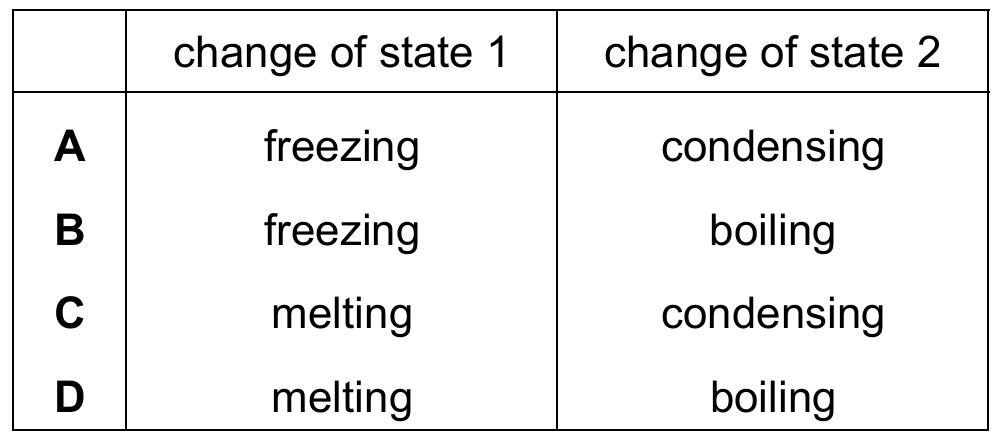
When a solid is heated, its particles gain kinetic energy until they overcome the attractive forces holding them in a fixed lattice, a process called melting (solid to liquid).
Continued heating of the resulting liquid further increases the energy of the particles until they can escape the surface and form a gas, which is known as boiling (liquid to gas).
In contrast, freezing and condensing are processes that involve the removal of thermal energy (cooling).
Therefore, the sequence of state changes described—solid to liquid, then liquid to gas—corresponds exactly to melting followed by boiling.
Matching this sequence to the table, Row D is the only correct description of the transitions occurring during heating.
Question 11
Most-appropriate topic codes (Cambridge IGCSE Physics 0625):
▶️ Answer/Explanation
Detailed solution:
Compression involves reducing the volume of a substance by pushing its particles closer together.
In the kinetic particle model, particles in a liquid are already packed closely with very small gaps between them.
Conversely, particles in a gas are much further apart, leaving significant empty space between them.
This large separation allows the gas particles to be forced into a smaller volume when pressure is applied.
Since liquid particles have negligible space between them, they are considered virtually incompressible.
Therefore, the ability of gases to be compressed is directly due to the particles being further apart than in liquids.
Question 12

Most-appropriate topic codes (Cambridge IGCSE Physics 0625):
▶️ Answer/Explanation
Detailed solution:
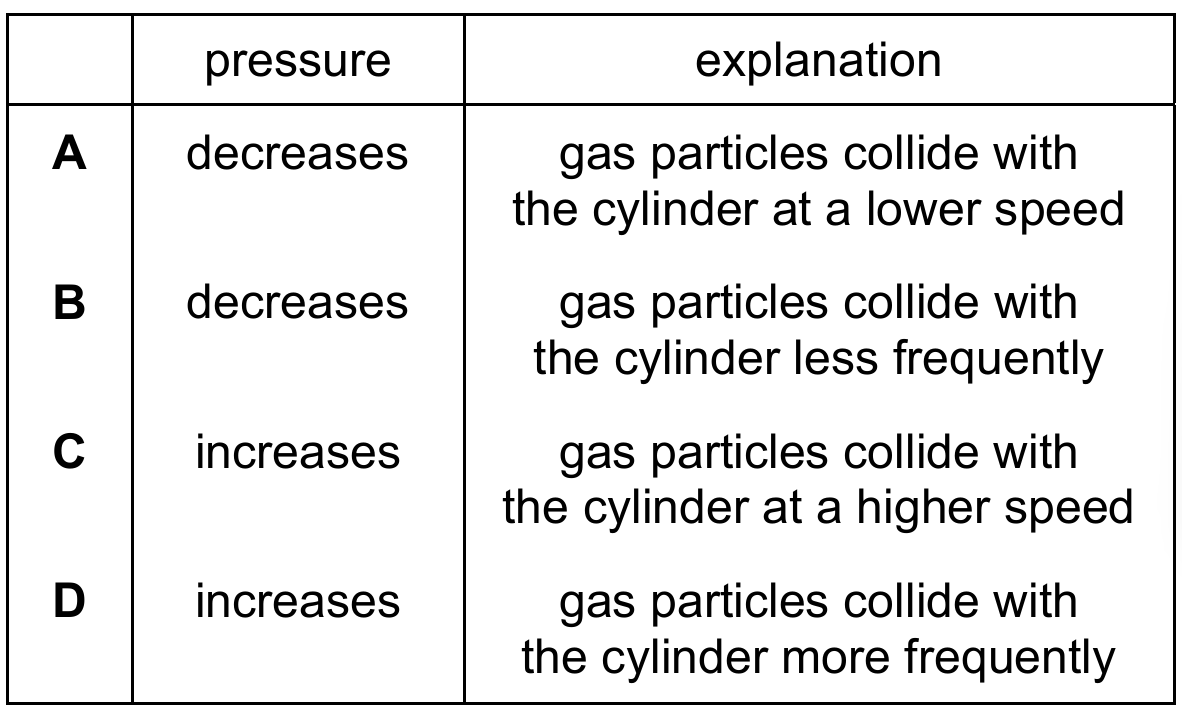
At a constant temperature, the average kinetic energy and speed of gas particles remain unchanged. According to Boyle’s Law, $pV = \text{constant}$, so increasing the volume $V$ results in a decrease in pressure $p$. Microscopically, as the volume increases, the particles are spread over a larger space, leading to an increase in the average distance between them. This results in the gas particles colliding with the cylinder walls less frequently per unit area. Consequently, the total force exerted on the walls decreases, which explains why the pressure decreases. Therefore, Row B provides the correct state and explanation.
Question 13
Most-appropriate topic codes (Cambridge IGCSE Physics 0625):
▶️ Answer/Explanation
Detailed solution:
When temperature increases, solids undergo thermal expansion, causing dimensions like length and diameter to increase. Since volume $V$ increases while mass $m$ remains constant, the density $\rho = \frac{m}{V}$ must decrease. Mass is a measure of the quantity of matter in an object and is independent of temperature or volume changes. Therefore, while the density (A), diameter (B), and length (C) all change due to expansion, the mass of the metal coin (D) remains constant.
Question 14
Most-appropriate topic codes (Cambridge IGCSE Physics 0625):
▶️ Answer/Explanation
Detailed solution:
Thermal conduction is the process where heat energy is transferred through a material via atomic vibrations and electron movement. Glass is an insulator, meaning it is a poor thermal conductor because it lacks free electrons to rapidly transfer energy. When hot water is poured, the thermal energy must travel through the thickness of the beaker wall to reach the hand. Because the rate of conduction in glass is low, there is a time delay of a few seconds before the outer surface reaches a high temperature. Therefore, the hand does not feel the heat immediately because glass does not conduct heat quickly.
Question 15
Most-appropriate topic codes (Cambridge IGCSE Physics 0625):
▶️ Answer/Explanation
Detailed solution:
When a liquid is heated, its particles gain kinetic energy and move further apart, causing the liquid to expand and increase its volume $V$. Since density is defined as $\rho = \frac{m}{V}$, and the mass $m$ remains constant, an increase in volume results in a decrease in density. The less dense, warmer liquid then rises above the cooler, denser liquid, creating a convection current. Options C and D are incorrect because the mass of individual particles does not change during heating. Thus, the formation of the current is driven by the decrease in density of the heated portion.
Question 16
Most-appropriate topic codes (Cambridge IGCSE Physics 0625):
▶️ Answer/Explanation
Detailed solution:
Thermal energy transfer between two solids in direct physical contact occurs via conduction.
The prompt states there is “no air gap” between the hotplate and the metal pan, ensuring direct contact.
In the metal hotplate, heat is transferred to the pan’s base as vibrating particles collide and transfer kinetic energy.
Convection (Options B and D) requires a fluid medium like a liquid or gas to circulate, which is not the case here.
Radiation (Option A) occurs through electromagnetic waves and does not require contact, but it is not the primary mode described.
Therefore, Statement C correctly identifies conduction as the method of energy transfer for the metal hotplate.
Question 17
Most-appropriate topic codes (Cambridge IGCSE Physics 0625):
▶️ Answer/Explanation
Detailed solution:
The distance between consecutive crests is the wavelength, so $\lambda = 10\text{ m}$.
When $12$ crests pass, there are $11$ complete wave cycles (intervals) occurring in $180\text{ s}$.
The frequency $f$ is the number of cycles per unit time: $f = \frac{11}{180}\text{ Hz} \approx 0.0611\text{ Hz}$.
Using the wave equation $v = f\lambda$, we calculate the speed: $v = 0.0611\text{ Hz} \times 10\text{ m} = 0.611\text{ m/s}$.
Alternatively, total distance $d = 11 \times 10\text{ m} = 110\text{ m}$, so speed $v = \frac{d}{t} = \frac{110\text{ m}}{180\text{ s}} \approx 0.61\text{ m/s}$.
This matches Option B (allowing for rounding in the provided key).
Question 18

Most-appropriate topic codes (Cambridge IGCSE Physics 0625):
• TOPIC 3.4: Sound (Describe the longitudinal nature of sound waves)
▶️ Answer/Explanation
Detailed solution:
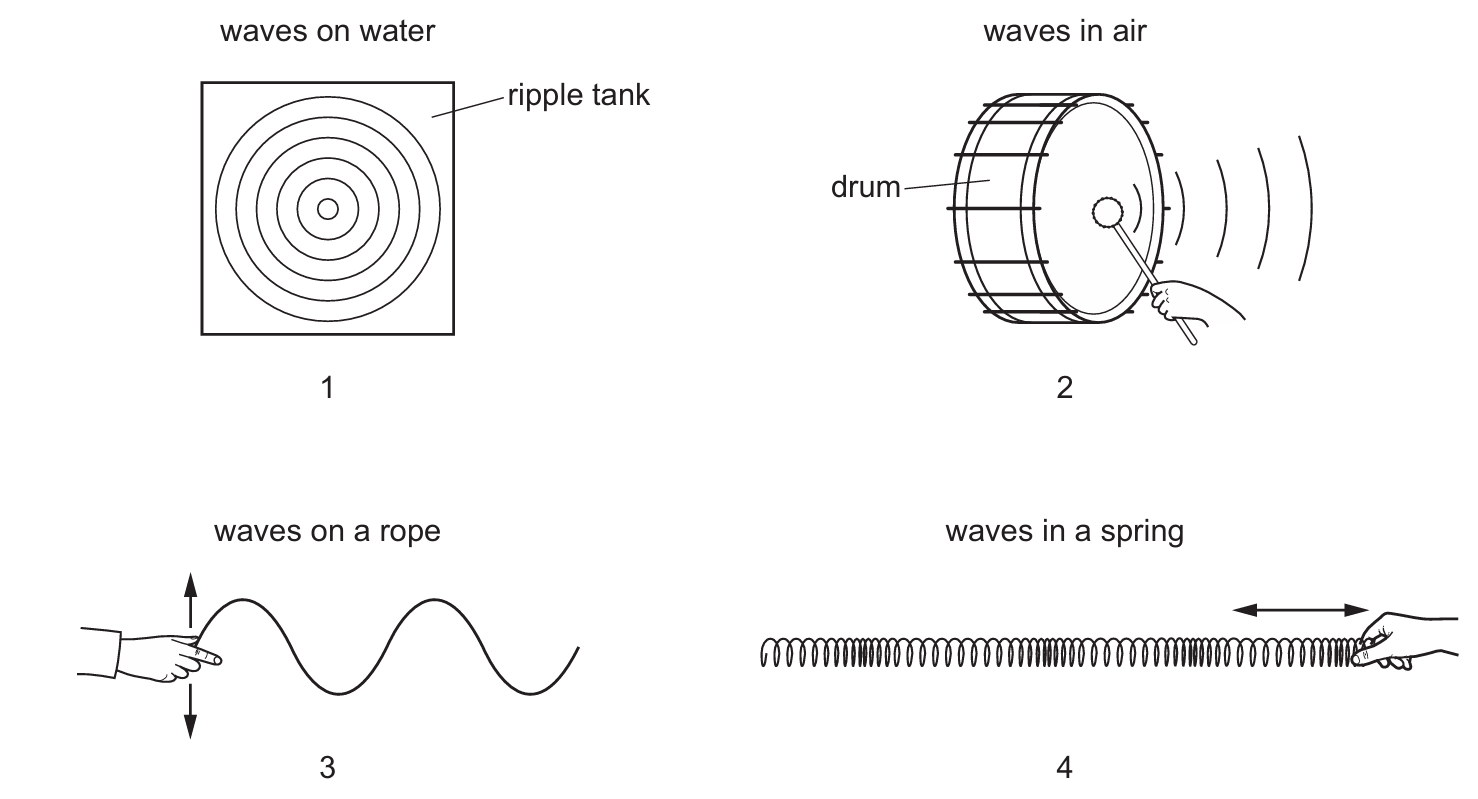
In longitudinal waves, particles vibrate parallel to the direction of wave travel. Diagram 2 represents sound waves in air, which are always longitudinal as they consist of compressions and rarefactions. Diagram 4 shows a spring being pushed and pulled horizontally, creating vibrations parallel to the energy transfer. Conversely, water waves (Diagram 1) and waves on a rope (Diagram 3) are transverse, where vibrations occur at $90^\circ$ to the direction of propagation. Therefore, only examples 2 and 4 describe longitudinal motion.
Question 19

Most-appropriate topic codes (Cambridge IGCSE Physics 0625):
▶️ Answer/Explanation
Detailed solution:
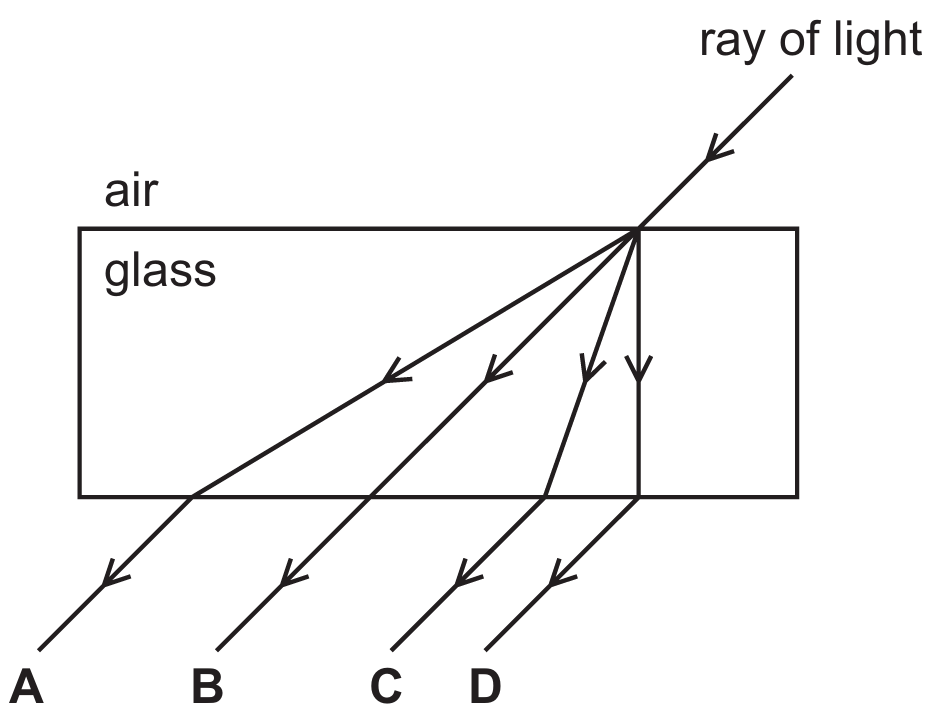
When light enters a denser medium like glass from air, it bends toward the normal because its speed decreases, making the angle of refraction $r$ smaller than the angle of incidence $i$. Upon exiting the glass back into air, the light speeds up and bends away from the normal. For a rectangular block with parallel sides, the emergent ray is parallel to the original incident ray but laterally displaced. Path C correctly shows the light bending toward the normal inside the glass and then exiting parallel to the entry path. Paths A and B fail to show the correct initial refraction, while D enters without bending at all ($i \neq 0$).
Question 20

Most-appropriate topic codes (Cambridge IGCSE Physics 0625):
▶️ Answer/Explanation
Detailed solution:
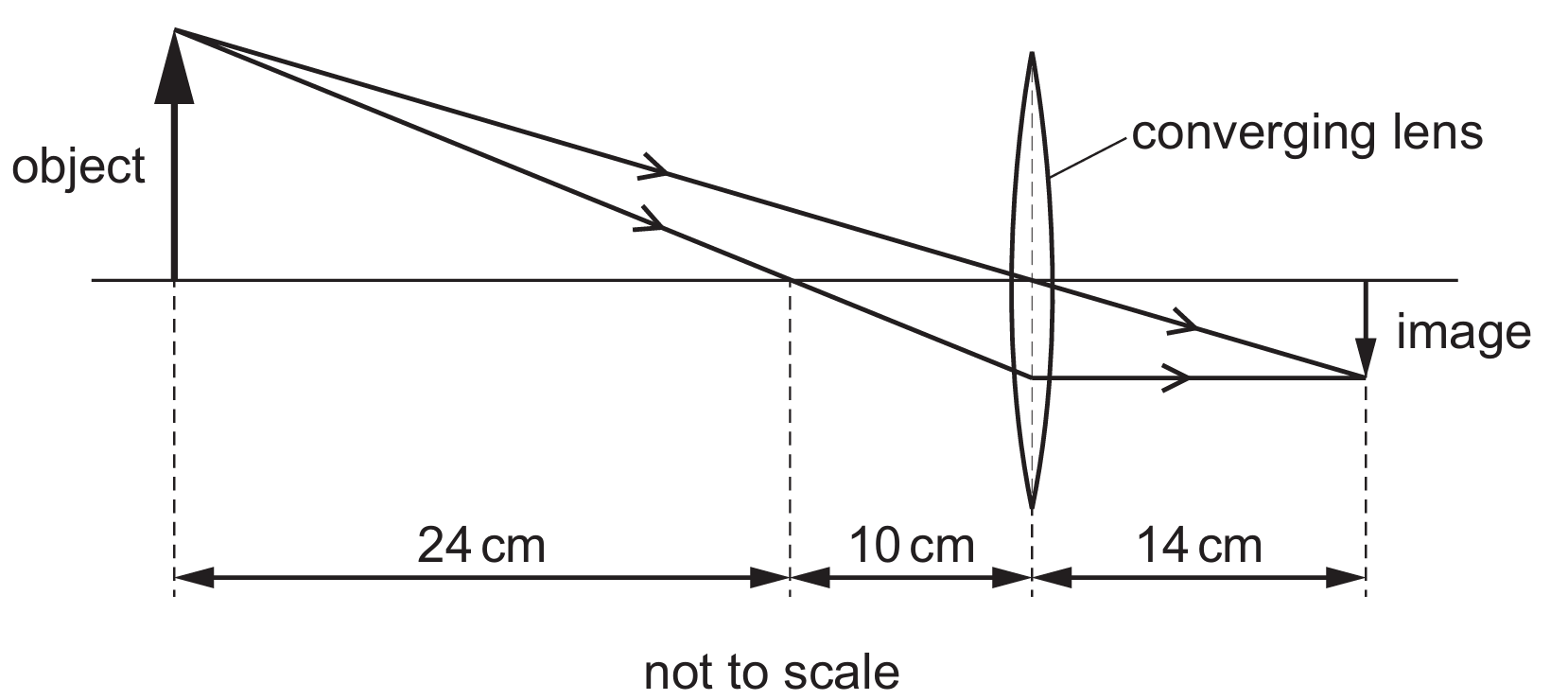
The focal length ($f$) of a converging lens is the distance from the center of the lens to the principal focus.
In the ray diagram, a ray traveling parallel to the principal axis is refracted through the principal focus.
The diagram shows a ray emerging from the top of the object, passing through the principal axis at a point before the lens, and then traveling parallel to the axis after refraction.
By the principle of reversibility, a ray passing through the focus on one side emerges parallel on the other.
The distance from this intersection point to the lens is marked as $10\text{ cm}$.
Therefore, the focal length of the lens is $10\text{ cm}$.
Question 21
Most-appropriate topic codes (Cambridge IGCSE Physics 0625):
▶️ Answer/Explanation
Detailed solution:
Remote controllers use pulses of electromagnetic radiation to communicate with electronic devices like televisions.
Infrared radiation is the standard choice for this application because it can carry data over short distances and does not pass through walls, preventing interference between rooms.
Other parts of the spectrum like $X-rays$ or $gamma~rays$ are high-energy ionizing radiations that would be hazardous to health.
Ultraviolet radiation is also unsuitable as it is primarily used for applications like sterilization or security marking.
According to the syllabus, infrared is specifically used for short-range communications such as remote controllers.
Therefore, the correct radiation type is infrared radiation, making Option B the correct answer.
Question 22
Most-appropriate topic codes (Cambridge IGCSE Physics 0625):
▶️ Answer/Explanation
Detailed solution:
High-frequency electromagnetic waves carry enough energy to ionize atoms and damage biological cells. According to the syllabus, ultraviolet ($UV$) radiation causes damage to surface cells and eyes, potentially leading to skin cancer. $X$-rays and $\gamma$-rays (gamma rays) possess even higher frequencies and can cause deeper mutations or significant cell death. In contrast, visible light (such as green and red) and radio waves do not have sufficient energy per photon to cause this type of ionising cell damage. Therefore, both gamma rays and ultraviolet are correct answers.
Question 23

Most-appropriate topic codes (Cambridge IGCSE Physics 0625):
▶️ Answer/Explanation
Detailed solution:
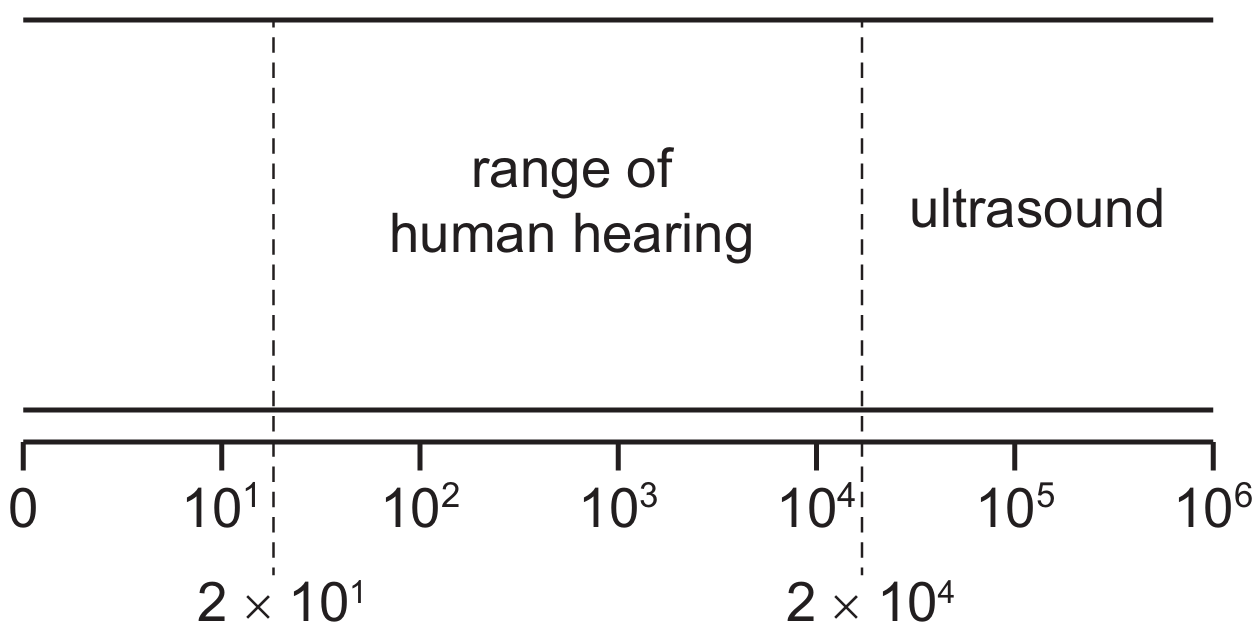
The diagram illustrates the limits of the human auditory system and the start of the ultrasound region.
The typical range of audible frequencies for a healthy human ear is approximately $20\text{ Hz}$ to $20000\text{ Hz}$ ($2 \times 10^1\text{ Hz}$ to $2 \times 10^4\text{ Hz}$).
Ultrasound is defined specifically as sound with a frequency higher than the upper limit of human hearing, which is $20\text{ kHz}$ or $20000\text{ Hz}$.
The horizontal axis uses a logarithmic scale to represent these numerical values, which correspond to the number of oscillations per second.
Therefore, the characteristics being measured are frequencies, and the standard unit for frequency is the Hertz ($\text{Hz}$).
Options A, C, and D refer to spatial or temporal properties that do not define the auditory boundaries shown.
Question 24

Most-appropriate topic codes (Cambridge IGCSE Physics 0625):
▶️ Answer/Explanation
Detailed solution:
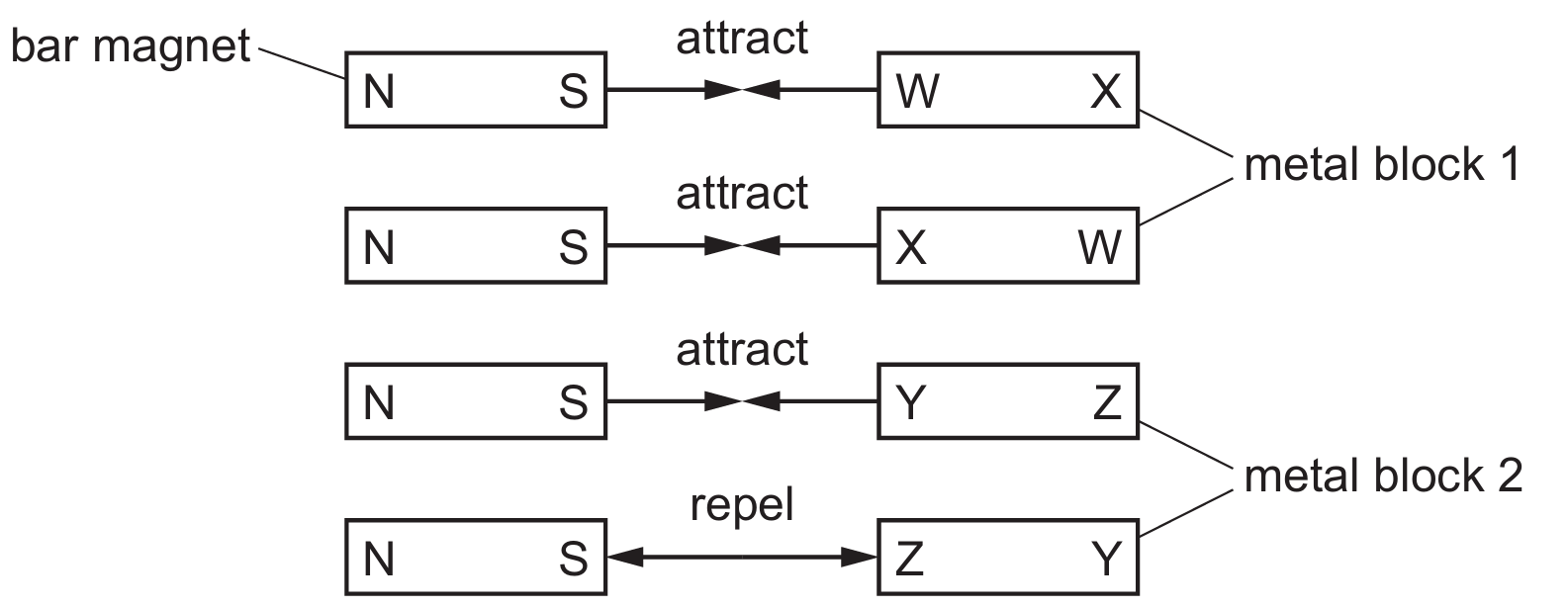
To identify if a block is a permanent magnet, it must exhibit repulsion; attraction can occur between a magnet and an unmagnetised magnetic material.
Metal block 1 is attracted at both ends (W and X), which indicates it is a magnetic material (like soft iron) but not a magnet itself.
Metal block 2 is attracted at end Y but repelled at end Z when facing the South pole of the bar magnet.
Since like poles repel, end Z must be a South pole, confirming block 2 is a permanent bar magnet.
Therefore, only metal block 2 is a bar magnet, making option C the correct choice.
Question 25
Most-appropriate topic codes (Cambridge IGCSE Physics 0625):
▶️ Answer/Explanation
Detailed solution:
Charging by friction occurs because of the transfer of electrons, which are the mobile negative charges in solids.
When the glass rod is rubbed with silk, work is done to overcome friction, providing energy for electrons to move.
Protons, which carry a positive charge $+1e$, are bound tightly within the nucleus and do not move during this process.
Since the glass rod becomes positively charged, it must have lost negative electrons $-1e$ to the silk cloth.
This leaves the rod with a net positive charge due to an excess of protons compared to the remaining electrons.
Therefore, the correct explanation is that negative charges moved from the glass rod to the silk cloth.
Question 26
Most-appropriate topic codes (Cambridge IGCSE Physics 0625):
▶️ Answer/Explanation
Detailed solution:
In a metallic lattice, positive ions are fixed in a regular structure and can only vibrate about fixed positions.
Metals contain “free” or delocalised electrons that are not bound to specific atoms and can move throughout the structure.
An electric current I is defined as the rate of flow of charge, expressed as I= t Q .
In a metal wire, this charge is carried by the movement of these free electrons along the length of the conductor.
While positive charges (atomic nuclei) exist, they do not move along the wire to constitute the current.
Therefore, an electric current in a metal is specifically the net flow of electrons in a particular direction.
Question 27
Most-appropriate topic codes (Cambridge IGCSE Physics 0625):
▶️ Answer/Explanation
Detailed solution:
Electromotive force $(e.m.f.)$ and potential difference $(p.d.)$ both represent work done per unit charge, defined by the equation $V = \frac{W}{Q}$ or $E = \frac{W}{Q}$.
Consequently, both quantities are measured in the same $SI$ unit: the volt $(V)$.
In contrast, current is measured in amperes $(A)$, charge in coulombs $(C)$, and resistance in ohms $(\Omega)$.
Since $e.m.f.$ and $p.d.$ share the same unit of volts, option B is the only correct pairing.
The other options (A, C, and D) incorrectly pair quantities with distinct units like $A$ and $C$ or $\Omega$ and $V$.
Question 28
Most-appropriate topic codes (Cambridge IGCSE Physics 0625):
▶️ Answer/Explanation
Detailed solution:
To find the resistance, we use Ohm’s Law, which defines resistance as the ratio of potential difference to current.
The formula is R= I V , where V is the voltage in volts and I is the current in amperes.
Substituting the given values: V=10 V and I=0.050 A.
The calculation is R= 0.050 10 = 5 1000 .
This results in R=200 Ω.
Therefore, the resistance of the resistor is 200 Ω, which corresponds to option D.
Question 29


Most-appropriate topic codes (Cambridge IGCSE Physics 0625):
▶️ Answer/Explanation
Detailed solution:
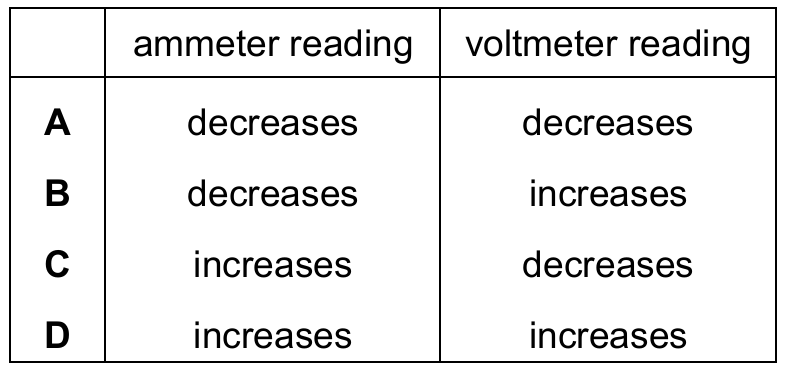
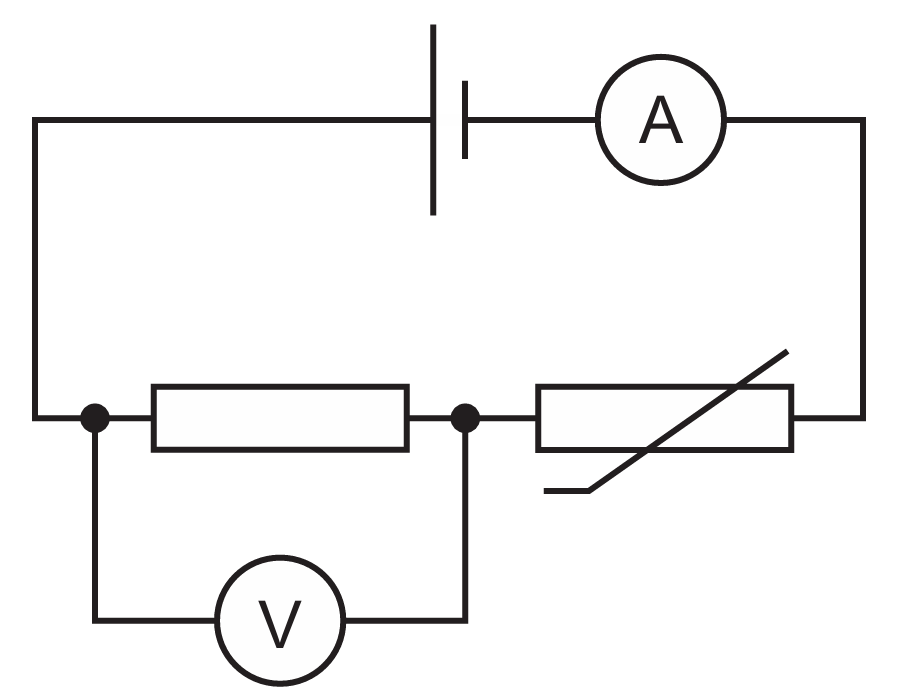
As the thermistor is heated, its resistance R th decreases because it is an NTC (negative temperature coefficient) component. Since the components are in series, the total circuit resistance R total =R+R th decreases, which causes the circuit current I to increase according to I= R total V supply , leading to a higher ammeter reading. The voltmeter is connected across the fixed resistor R; as the current I increases, the potential difference across it, V=I×R, must also increase. Consequently, both the ammeter and voltmeter readings increase, making option D the correct choice.
Question 30


Most-appropriate topic codes (Cambridge IGCSE Physics 0625):
• TOPIC 4.3.2: Series and parallel circuits (Calculate combined resistance of resistors in series)
▶️ Answer/Explanation
Detailed solution:
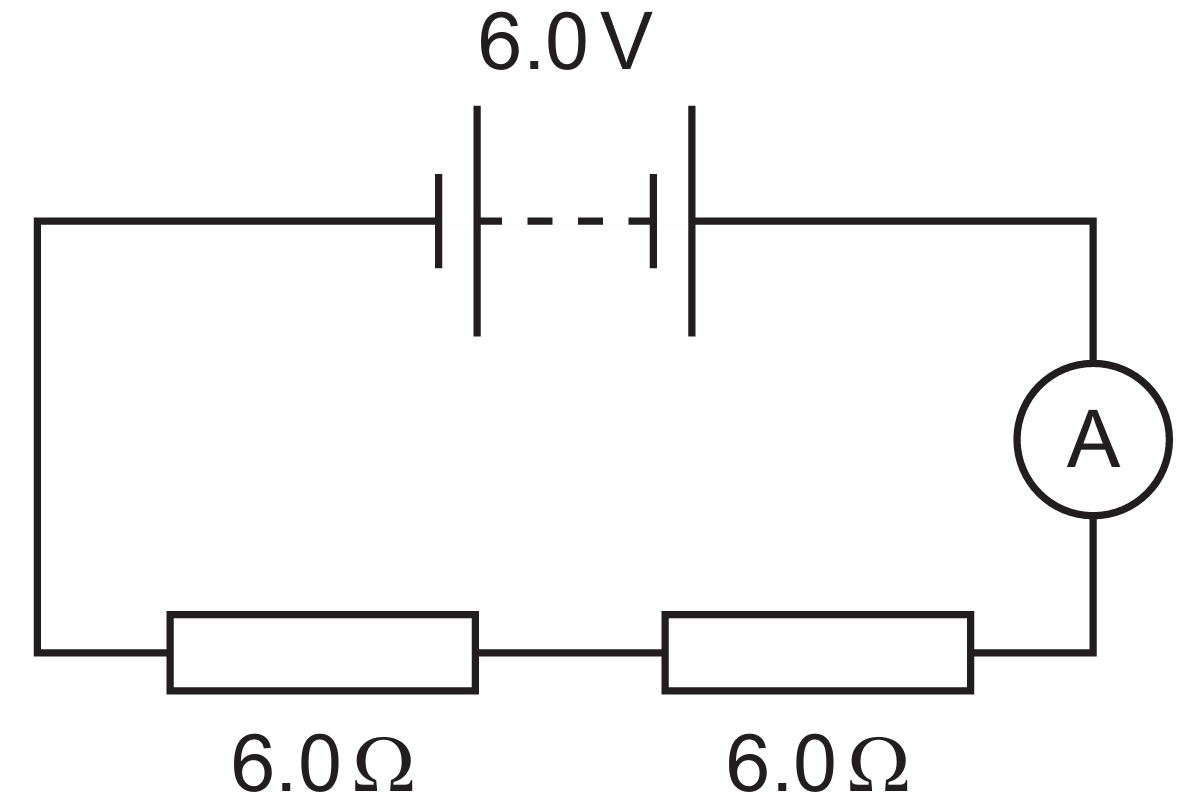
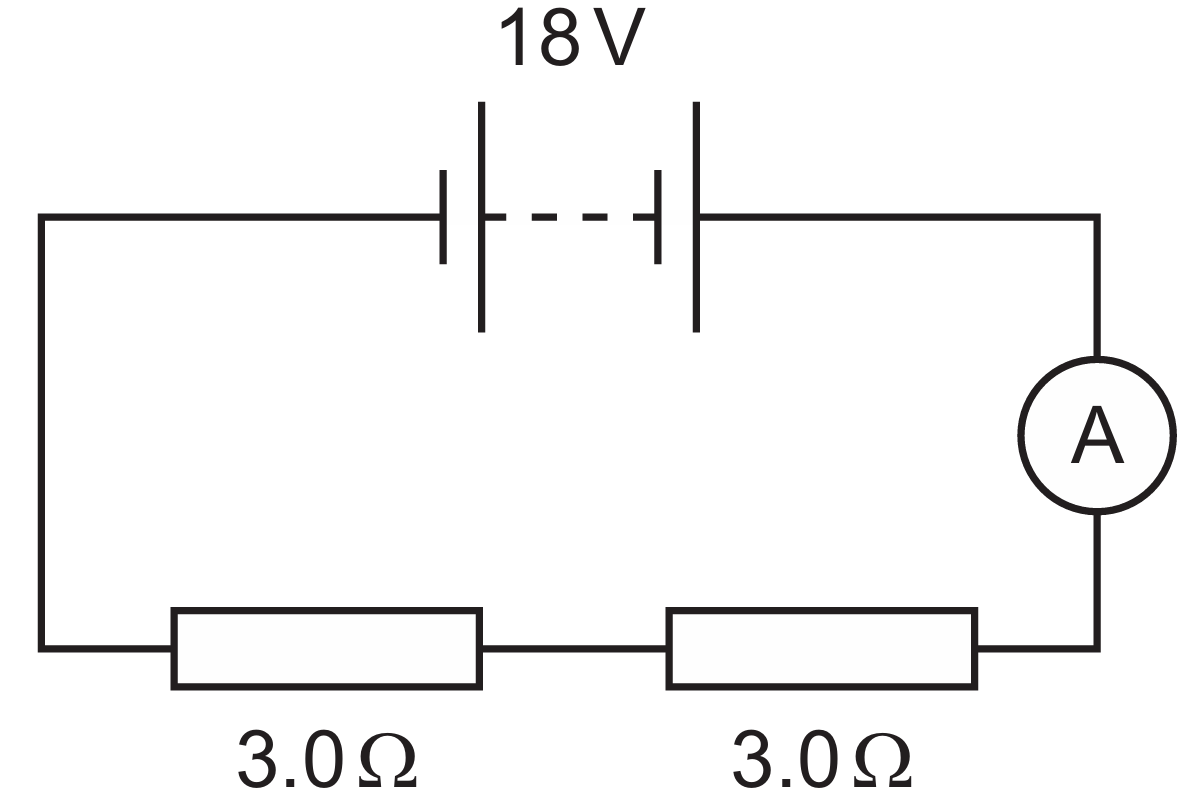
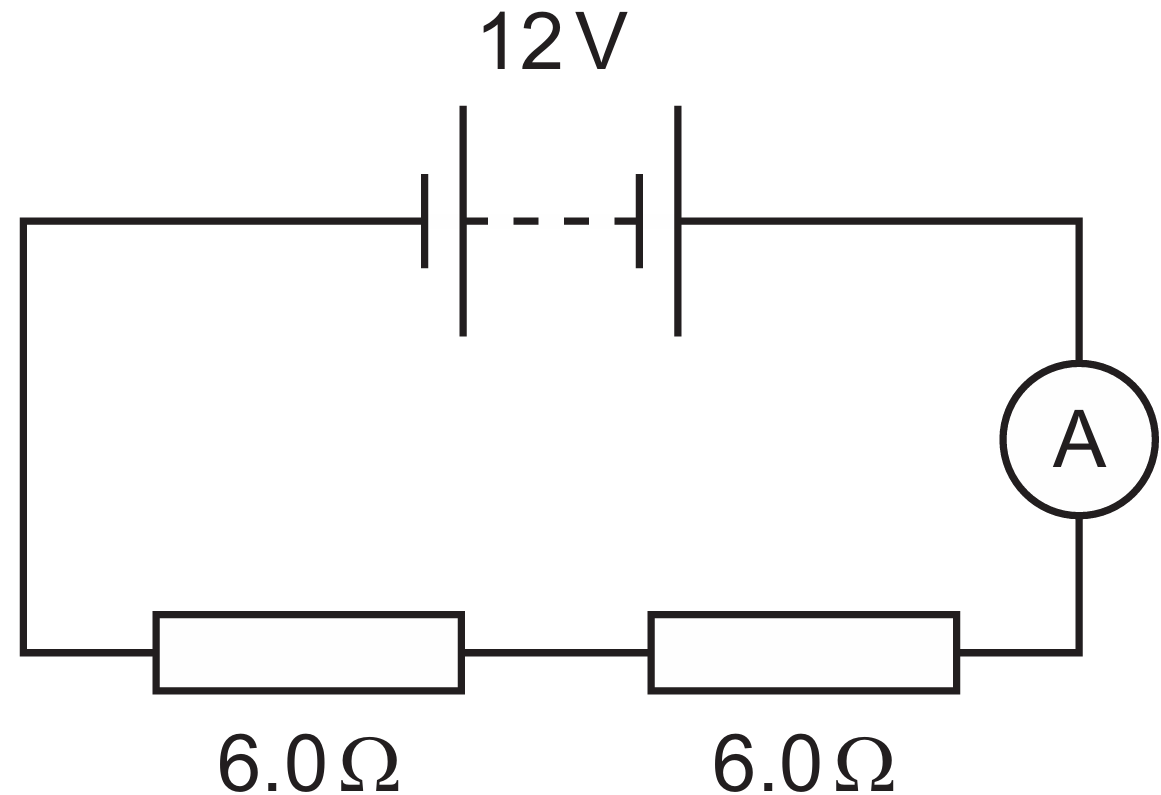
In a series circuit, the total resistance $R_{total}$ is the sum of individual resistances: $R_{total} = R_{1} + R_{2}$.
According to Ohm’s Law, the current $I$ measured by the ammeter is given by $I = \frac{V}{R_{total}}$.
For circuit B, the total resistance is $3.0\text{ }\Omega + 3.0\text{ }\Omega = 6.0\text{ }\Omega$.
The current is calculated as $I = \frac{12\text{ V}}{6.0\text{ }\Omega} = 2.0\text{ A}$.
Checking other options: A gives $1.0\text{ A}$, C gives $0.5\text{ A}$, and D gives $3.0\text{ A}$.
Therefore, only circuit B results in an ammeter reading of $2.0\text{ A}$.
Question 31
Which fuse is suitable for use in the plug of the vacuum cleaner?
Most-appropriate topic codes (Cambridge IGCSE Physics 0625):
• TOPIC 4.4: Electrical safety (Explain the use and operation of fuses and choose appropriate fuse ratings)
▶️ Answer/Explanation
Detailed solution:
First, calculate the operating current $I$ using the power formula $P = IV$, rearranged as $I = \frac{P}{V}$.
Substituting the given values: $I = \frac{2700\text{ W}}{240\text{ V}} = 11.25\text{ A}$.
A fuse must have a rating slightly higher than the normal operating current to allow the device to work without blowing during standard use.
Options A, B, and C ($3\text{ A}$, $5\text{ A}$, and $10\text{ A}$) are all lower than $11.25\text{ A}$ and would blow immediately upon switching the device on.
The only suitable rating that is higher than the operating current is $13\text{ A}$.
Therefore, Option D is the correct choice.
Question 32

Most-appropriate topic codes (Cambridge IGCSE Physics 0625):
▶️ Answer/Explanation
Detailed solution:
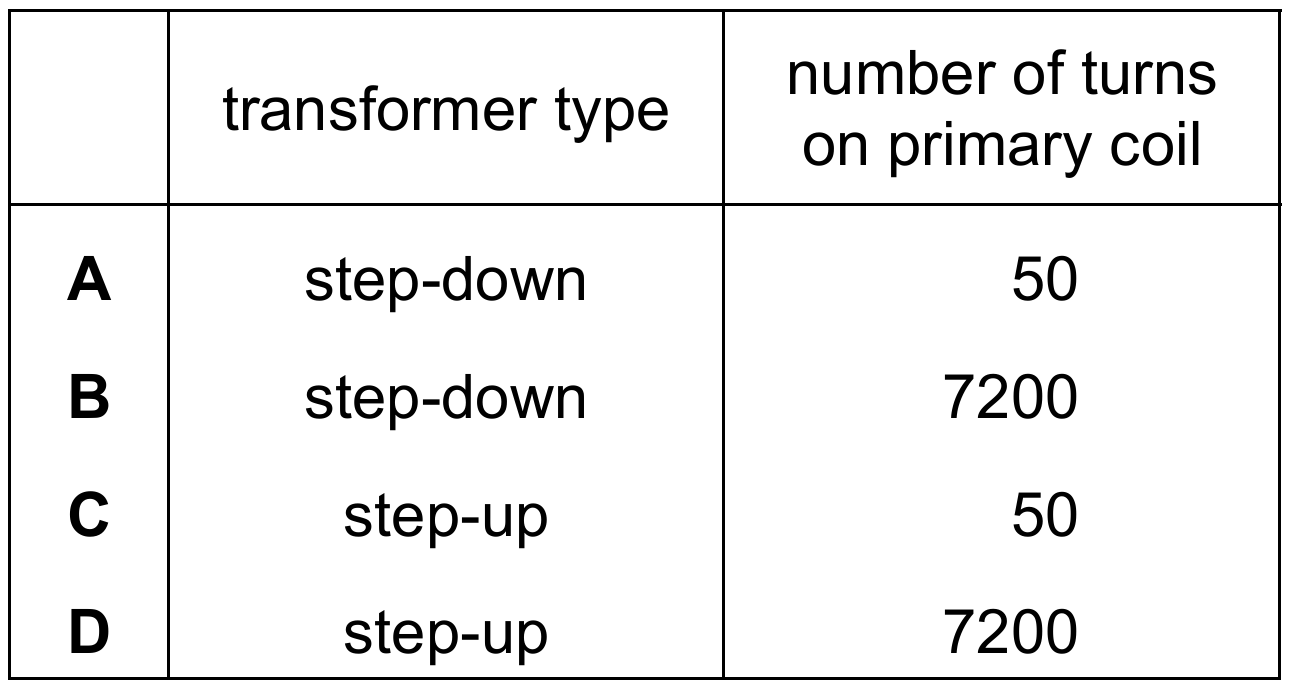
Since the voltage decreases from $240\text{ V}$ to $20\text{ V}$, it is a step-down transformer.
Using the transformer equation: $\frac{V_{p}}{V_{s}} = \frac{N_{p}}{N_{s}}$, where $V_{p} = 240\text{ V}$, $V_{s} = 20\text{ V}$, and $N_{s} = 600$.
Rearranging for the primary turns: $N_{p} = N_{s} \times \left(\frac{V_{p}}{V_{s}}\right) = 600 \times \left(\frac{240}{20}\right)$.
Calculation: $N_{p} = 600 \times 12 = 7200$ turns.
Thus, the transformer is a step-down type with $7200$ turns on the primary coil, matching Option B.
Question 33
Most-appropriate topic codes (Cambridge IGCSE Physics 0625):
▶️ Answer/Explanation
Detailed solution:
A neutral atom has an equal number of protons (charge $+1$) and electrons (charge $-1$).
A negatively charged ion has an excess of electrons compared to protons.
To return to a neutral state, the ion must remove this excess negative charge.
Since the number of protons defines the element and remains constant in chemical changes, only electrons are transferred.
Therefore, the loss of electrons reduces the negative charge until it equals the positive nuclear charge.
This transition results in a neutral oxygen atom, making option C the correct choice.
Question 34
What is the number of neutrons in this nuclide?
Most-appropriate topic codes (Cambridge IGCSE Physics 0625):
▶️ Answer/Explanation
Detailed solution:
In nuclide notation ${}_{Z}^{A}\text{X}$, $A$ represents the nucleon number (total protons and neutrons) and $Z$ represents the proton number.
For the given nuclide ${}_{7}^{15}\text{N}$, the nucleon number is $A = 15$ and the proton number is $Z = 7$.
The number of neutrons $N$ is calculated using the formula $N = A – Z$.
Substituting the values, we get $N = 15 – 7 = 8$.
Therefore, there are $8$ neutrons in this nitrogen nuclide, making option B the correct choice.
Question 35
Most-appropriate topic codes (Cambridge IGCSE Physics 0625):
▶️ Answer/Explanation
Detailed solution:
Background radiation consists of ionizing radiation present in the environment from natural and artificial sources.
Naturally occurring sources include radon gas in the air, cosmic rays from space, and radioactive isotopes in food, drink, rocks, and buildings.
Nuclear power stations and medical equipment are man-made sources, not naturally occurring.
Mobile phones emit non-ionizing electromagnetic radiation and are not considered a source of nuclear background radiation.
Option C is the only list containing exclusively natural sources: rocks, food/drink, and radon gas.
Other options are incorrect as they include artificial sources like nuclear power stations or non-ionizing sources like mobile phones.
Question 36
Most-appropriate topic codes (Cambridge IGCSE Physics 0625):
▶️ Answer/Explanation
Detailed solution:
Alpha particles ($\alpha$) consist of two protons and two neutrons, giving them a large mass and a charge of $+2e$, making them the most strongly ionising radiation.
Beta particles ($\beta$) are high-speed electrons with less ionising power than alpha but more than gamma, and they are not part of the electromagnetic spectrum.
Gamma rays ($\gamma$) are high-frequency electromagnetic waves; they have no charge or mass, making them the most penetrating but the least ionising.
Since $\alpha$-particles interact most strongly with matter due to their size and charge, statement A is correct.
Options B, C, and D are incorrect as $\gamma$ is the most penetrating, $\beta$ consists of particles (not waves), and $\gamma$ has no charge.
Question 37
Most-appropriate topic codes (Cambridge IGCSE Physics 0625):
▶️ Answer/Explanation
Detailed solution:
Lead is a very dense material with a high atomic number, making it highly effective at attenuating ionising radiation.
Radioactive sources may emit $\alpha$-particles, $\beta$-particles, or $\gamma$-radiation, all of which transfer energy to the material they encounter.
While $\alpha$ and $\beta$ are easily stopped, $\gamma$-rays are highly penetrating and require thick layers of dense material like lead to be significantly reduced.
The lead atoms interact with the incoming radiation, causing the radiation to lose its energy and be absorbed rather than passing through.
Radiation cannot be “neutralised,” “repelled,” or “dissolved”; it can only be blocked or shielded through absorption by a medium.
Therefore, lead-lined boxes ensure the safety of personnel by capturing the emissions within the container walls.
Question 38

Most-appropriate topic codes (Cambridge IGCSE Physics 0625):
▶️ Answer/Explanation
Detailed solution:
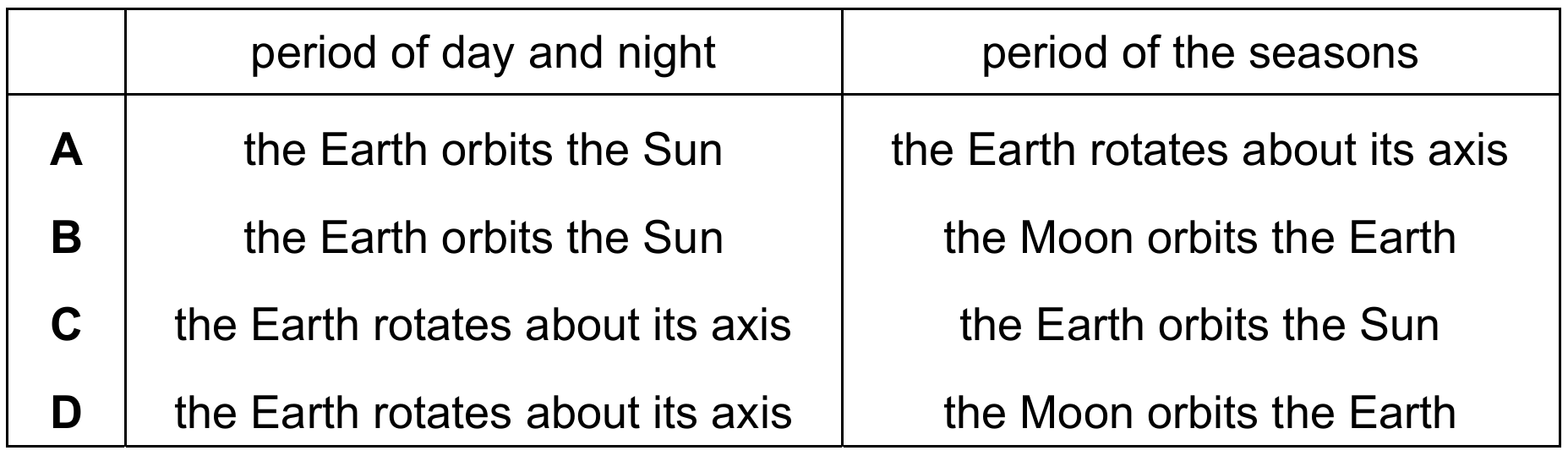
The Earth rotates on its axis once every $24$ hours, which creates the periodic cycle of day and night as different parts of the planet face the Sun. The cycle of the seasons is caused by the Earth orbiting the Sun once every $365$ days combined with the tilt of its axis. The Moon’s orbit around the Earth takes approximately $1$ month and relates to lunar phases, not the Earth’s day or seasons. Therefore, the correct relationship is that rotation causes day/night and the orbit around the Sun causes seasons. This corresponds exactly to the information provided in Row C.
Question 39
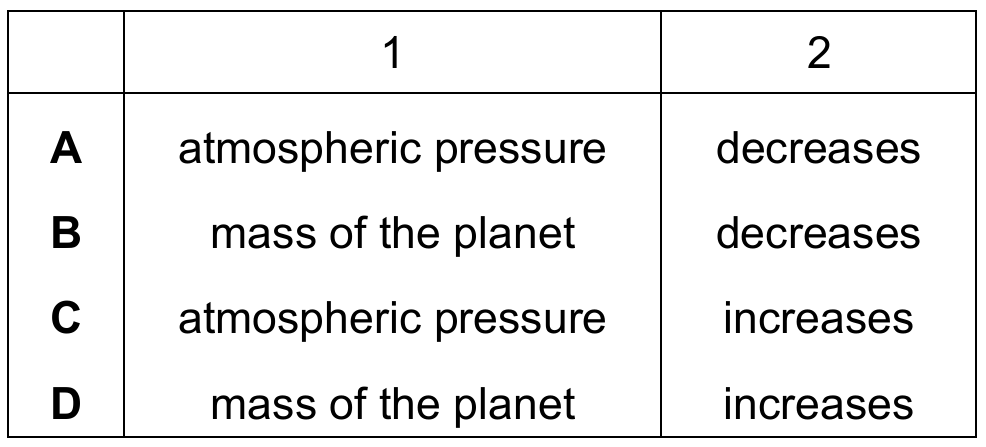
The strength of the gravitational field at the surface of a planet depends on the ……1…… .
The strength of the gravitational field ……2…… as the distance from the planet increases.
Which words correctly complete the sentences?

Most-appropriate topic codes (Cambridge IGCSE Physics 0625):
▶️ Answer/Explanation
Detailed solution:
The gravitational field strength g at the surface of a celestial body is directly proportional to its mass M.
Larger, more massive planets exert a stronger gravitational pull on objects at their surface compared to smaller ones.
As an observer moves away from the planet, the distance r from the center of the mass increases.
According to physical principles, the strength of the gravitational field follows an inverse relationship with distance.
Therefore, the field strength g decreases as the distance from the planet increases.
Combining these facts, the correct words for the blanks are “mass of the planet” and “decreases,” as shown in Row B.
Question 40

Most-appropriate topic codes (Cambridge IGCSE Physics 0625):
▶️ Answer/Explanation
Detailed solution:
The Sun is a medium-sized star that emits a broad spectrum of electromagnetic radiation.
According to the syllabus, the Sun radiates the vast majority of its energy in three specific regions: ultraviolet, visible light, and infrared.
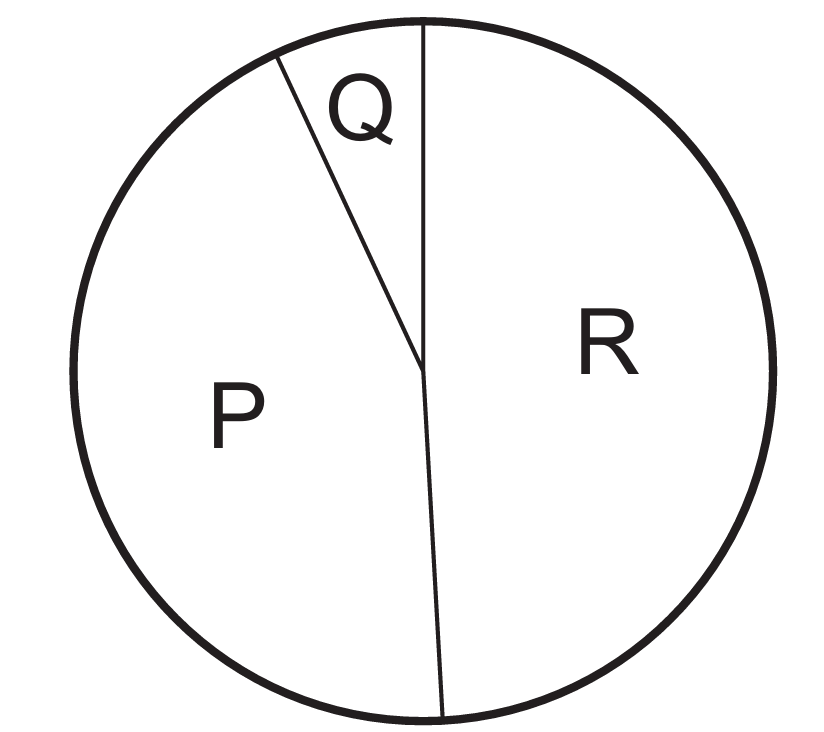
The provided pie chart identifies region $P$ as visible light and region $Q$ as ultraviolet radiation.
By process of elimination based on the known primary emissions of the Sun, the remaining large section, region $R$, must represent infrared radiation.
Infrared radiation accounts for a significant portion of the solar energy reaching Earth, primarily felt as heat.
Therefore, Option A is the correct identification for the missing region of the solar emission profile.