
Question 1
Most-appropriate topic codes (Cambridge IGCSE Physics 0625):
• Topic 1.2 — Motion
▶️ Answer/Explanation
(a)(i)
For the correct answer:
$9\text{ min}$
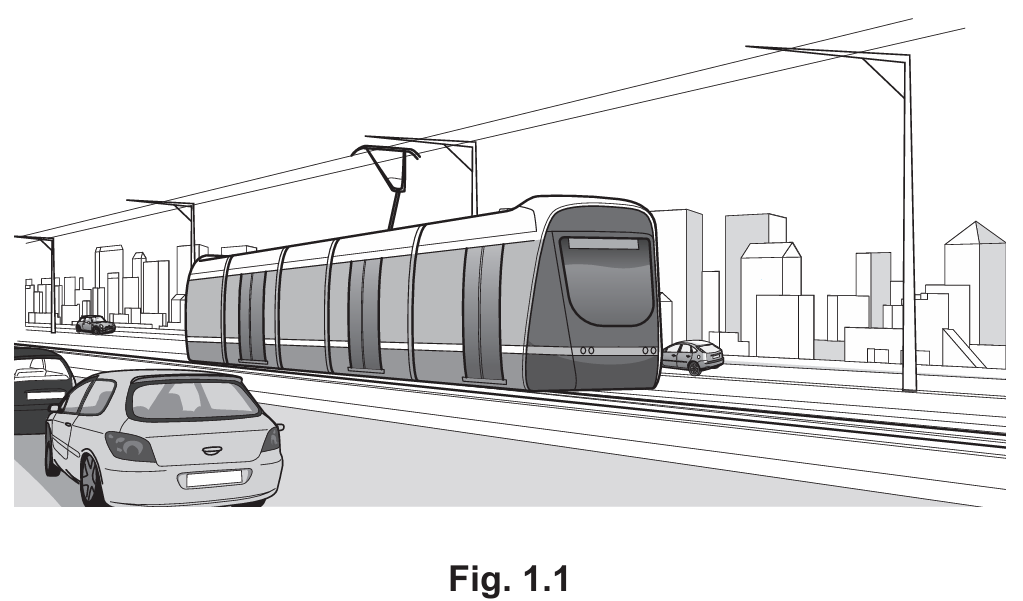
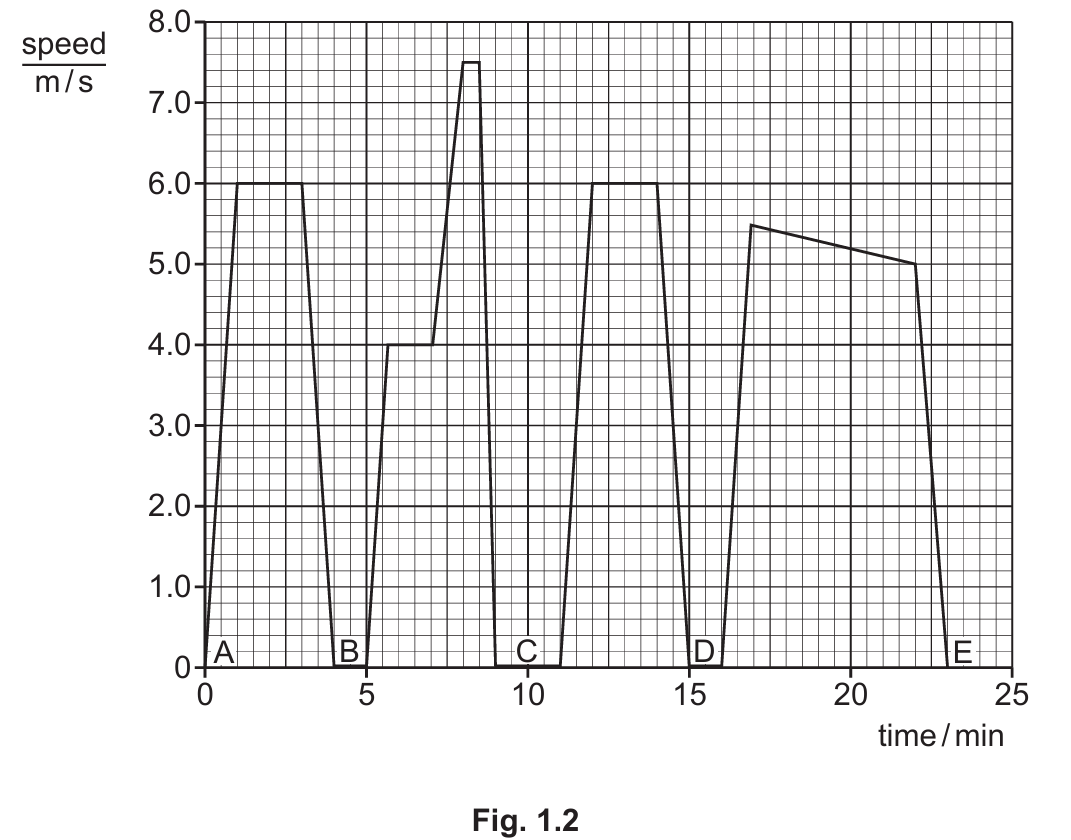
To determine the time between the tram leaving A and arriving at C, we read directly from the horizontal (time) axis of the speed–time graph in Fig. 1.2. The tram departs from A at time $= 0$, and the graph shows the speed dropping back to zero for the second time — indicating the tram has stopped at station C — at the $9$-minute mark. This total elapsed time of $9$ minutes therefore includes the journey from A to B, the stationary period at stop B, and the subsequent journey from B onwards until the tram comes to rest at C. Reading time values from a speed–time graph requires care to identify the correct stopping points, as each time the speed returns to zero it corresponds to the tram arriving at the next station along the route.
(a)(ii)
For the correct answer:
$7.5\text{ m/s}$
The maximum speed of the tram during the entire journey from A to E is found by identifying the highest point reached on the vertical (speed) axis of the speed–time graph throughout the whole journey. Scanning across the full graph from start to finish, the speed peaks at $7.5\text{ m/s}$, which occurs during the section of the journey between stops B and C. This is higher than the maximum speeds reached in any of the other sections between stops, making it the overall maximum speed for the journey. It is important to read this value carefully from the y-axis scale rather than estimating, as the question asks for a determined value from the graph.
(a)(iii)
For the correct answer:
The greatest deceleration occurs as the tram approaches stop C. Reason: this section of the graph has the steepest downward slope, meaning the greatest change in speed occurs over the shortest time interval.
On a speed–time graph, deceleration is represented by a downward-sloping line, and the magnitude of the deceleration is directly proportional to the steepness of that slope — a steeper downward slope means a greater rate of decrease in speed, and therefore a greater deceleration. Comparing all the downward-sloping sections of the graph as the tram approaches each of the stops B, C, D, and E, the section immediately before stop C has the steepest gradient. This means the tram loses speed more rapidly in that section than when braking for any other stop. Mathematically, deceleration is calculated as the change in speed divided by the time taken for that change, and the steepest slope gives the largest value of this ratio.
(b)
For the correct answer:
$\text{Average speed} = 3.8\text{ m/s}$
Calculation: $v = \dfrac{d}{t} = \dfrac{5200}{1380} = 3.768\ldots \approx 3.8\text{ m/s}$
Average speed is defined as the total distance travelled divided by the total time taken for the entire journey, regardless of any variations in speed or stops along the way. The formula is $v = d / t$, where $d$ is the total distance and $t$ is the total time. Substituting the values given in the question: $v = 5200\text{ m} \div 1380\text{ s} = 3.768\ldots\text{ m/s}$, which rounds to $3.8\text{ m/s}$ to two significant figures. It is worth noting that this average speed is considerably lower than the maximum speed of $7.5\text{ m/s}$ recorded on the graph, because the average takes into account all the time spent stationary at the intermediate stops B, C, and D, during which the tram covers no distance at all but time continues to pass.
Question 2
Most-appropriate topic codes (Cambridge IGCSE Physics 0625):
• Topic 1.4 — Density
• Topic 1.3 — Mass and weight
▶️ Answer/Explanation
(a)(i)
For the correct answer:
Ruler / metre rule / tape measure.
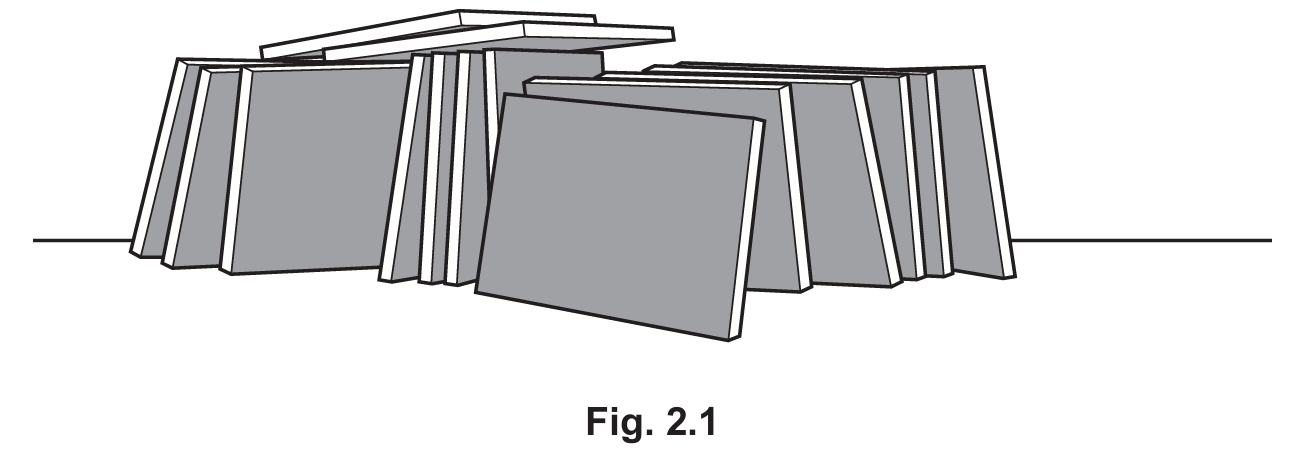
To measure the length (25 cm) and width (20 cm) of each tile, a standard ruler or metre rule is the most appropriate instrument. These dimensions are large enough to be read comfortably and accurately using the millimetre markings on a standard 30 cm ruler or a metre rule, both of which are readily available in a laboratory or workshop setting. A tape measure would also be acceptable, particularly if the tiles were even larger. It would not be appropriate to use a micrometer screw gauge or vernier callipers for these measurements, as those instruments are designed for measuring much smaller dimensions with very high precision, and the tiles are far too wide to fit between their jaws. A ruler placed flat alongside each edge of the tile allows a straightforward and sufficiently accurate reading to be taken.
(a)(ii)
For the correct answer:
Stack a number of tiles ($n \geq 10$) directly on top of one another, measure the total combined thickness of the stack using a ruler, then divide the total thickness by the number of tiles to obtain the average thickness of one tile.
The thickness of a single tile is only $0.30\text{ cm}$ (3 mm), which is very small. If you attempted to measure this directly with a ruler, even a tiny error in reading the scale would represent a large percentage of the actual value, making the result unreliable and inaccurate. To minimise this percentage error, the accepted technique is to stack a large number of tiles — ideally ten or more — neatly and squarely on top of each other so that all their faces are flush and aligned. The total height of the entire stack is then measured with a ruler. Dividing this total measurement by the number of tiles in the stack gives the average thickness of one tile, with a much smaller percentage error than a direct single measurement would produce. This method of stacking to reduce percentage error is a standard and important practical technique in physics measurements.
(b)(i)
For the correct answer:
Volume $= 150\text{ cm}^3$
Calculation: $V = l \times w \times h = 25 \times 20 \times 0.30 = 150\text{ cm}^3$
Since the tile is a rectangular block (a cuboid), its volume is calculated by multiplying its three dimensions together: length, width, and thickness. All three measurements are already given in the same unit (centimetres), so no unit conversion is necessary before substituting into the formula. Multiplying: $V = 25\text{ cm} \times 20\text{ cm} \times 0.30\text{ cm} = 150\text{ cm}^3$. It is important to ensure all dimensions are expressed in the same unit before multiplying, as mixing units — for example using centimetres for length and width but millimetres for thickness — would give an incorrect result. The volume of $150\text{ cm}^3$ tells us how much three-dimensional space the tile occupies, and this value will be used directly in the density calculation that follows.
(b)(ii)
For the correct answer:
Density $= 2.7\text{ g/cm}^3$
Calculation: $\rho = \dfrac{m}{V} = \dfrac{410}{150} = 2.7\overline{3}\text{ g/cm}^3 \approx 2.7\text{ g/cm}^3$
Density is defined as the mass per unit volume of a substance, and it is calculated using the formula $\rho = m / V$. Since the mass is given in grams and the volume was calculated in cubic centimetres, the density will come out in grams per cubic centimetre ($\text{g/cm}^3$), which is a perfectly acceptable unit and does not require conversion here. Substituting the values: $\rho = 410\text{ g} \div 150\text{ cm}^3 = 2.7\overline{3}\text{ g/cm}^3$, which rounds to $2.7\text{ g/cm}^3$ to two significant figures. This value is consistent with the density of ceramic or porcelain floor tiles, confirming the answer is physically reasonable. The unit must be included in the final answer as the question explicitly requires it.
(b)(iii)
For the correct answer:
Weight $= 4.1\text{ N}$
Calculation: $W = mg = 0.410\text{ kg} \times 10\text{ N/kg} = 4.1\text{ N}$
Weight is the gravitational force acting on an object due to the Earth’s gravitational field, and it is calculated using the formula $W = mg$, where $m$ is the mass in kilograms and $g$ is the gravitational field strength, taken as $10\text{ N/kg}$ at the Earth’s surface. The mass given in the question is $410\text{ g}$, which must first be converted into kilograms by dividing by 1000: $410\text{ g} = 0.410\text{ kg}$. Substituting into the formula: $W = 0.410\text{ kg} \times 10\text{ N/kg} = 4.1\text{ N}$. It is a very common mistake to forget to convert grams into kilograms before performing this calculation, which would give an answer 1000 times too large. Weight is always measured in newtons (N), not in grams or kilograms, and it is distinct from mass — mass is a measure of the amount of matter in an object, while weight is the force that gravity exerts on that mass.
Question 3
Most-appropriate topic codes (Cambridge IGCSE Physics 0625):
• Topic 1.7 — Energy, work and power
▶️ Answer/Explanation
(a)
For the correct answer:
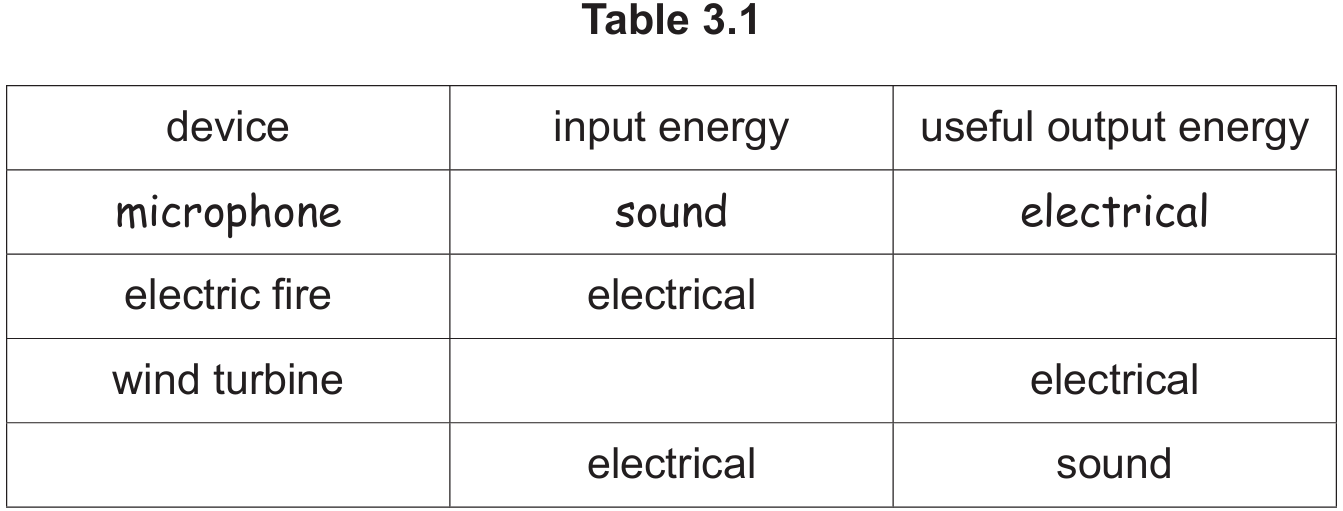
Electric fire: useful output energy = thermal (heat) energy. Wind turbine: input energy = kinetic energy. Last device (electrical input → sound output): loudspeaker / buzzer / bell / headphones.
Every energy-converting device takes in one form of energy and transforms it into a more useful form. An electric fire receives electrical energy from the mains supply as its input and its entire purpose is to release that energy as thermal (heat) energy into the surrounding room — so thermal energy is the correct useful output. A wind turbine works in the opposite direction: it harvests the kinetic energy of the moving wind as its input and converts it into electrical energy as its output. For the final row, the table shows electrical energy as the input and sound energy as the useful output — any device that converts electrical signals into audible sound fits this description, with a loudspeaker being the most common and recognisable example, though a buzzer, electric bell, or headphones are equally valid answers.
(b)(i)
For the correct answer:
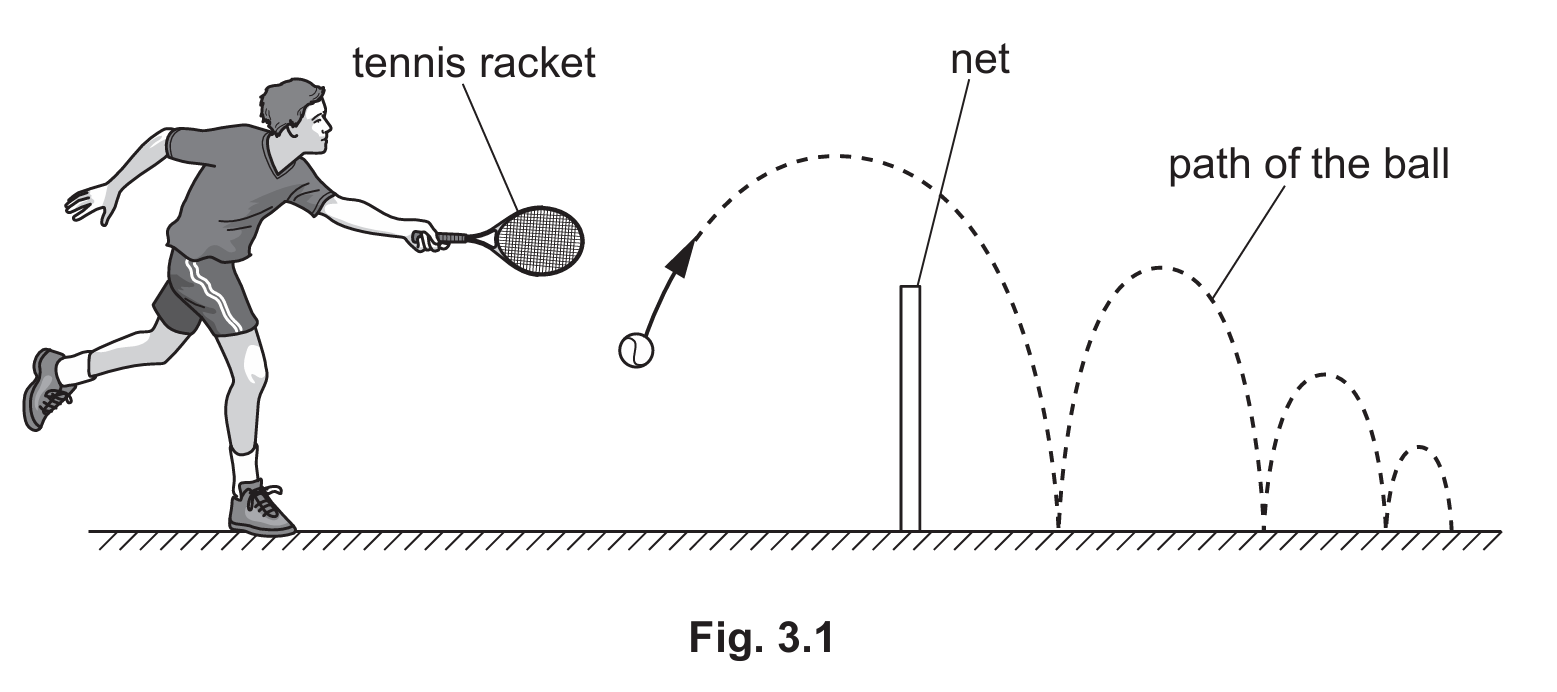
1. When the player swings the tennis racket, his body converts chemical energy to kinetic energy. 2. When the tennis ball is moving upwards, the ball gains gravitational potential energy.
The human body functions as a biological energy converter. The energy that powers all muscular movement — including swinging a tennis racket — comes from the chemical energy stored in food, which is released through metabolic processes in the muscles. This chemical energy is converted into the kinetic energy of the moving arm and racket, which is then transferred to the ball upon impact. Once the ball has been struck and is travelling upward through the air, it is moving against the force of gravity. As it rises, it slows down, meaning its kinetic energy is steadily decreasing. At the same time, because it is gaining height above the ground, it is storing more and more gravitational potential energy — the energy an object possesses by virtue of its position in a gravitational field.
(b)(ii)
For the correct answer:
At each bounce, some of the ball’s energy is transferred to the ground and surroundings as thermal (heat) energy and sound energy, so the ball has less total energy after each bounce and therefore rises to a lower height.
The law of conservation of energy tells us that energy cannot be created or destroyed, only transferred from one form to another. However, not all energy transfers are useful — when the tennis ball hits the ground at each bounce, some of its kinetic energy is converted into thermal energy (the ball, ground, and surrounding air warm up very slightly) and sound energy (you can hear the bounce). This energy is effectively lost to the surroundings and is no longer available to propel the ball upward. As a result, the ball has less total mechanical energy after each bounce than it had before, and since the height it reaches is directly determined by how much kinetic energy it has just after leaving the ground, a smaller amount of energy means a lower maximum height with every successive bounce. This process continues until all the mechanical energy has been dissipated and the ball comes to rest.
Question 4

Most-appropriate topic codes (Cambridge IGCSE Physics 0625):
• Topic 2.1.1 — States of matter
• Topic 2.2 — Thermal properties and temperature
▶️ Answer/Explanation
(a)(i)
For the correct answer:
Liquid.
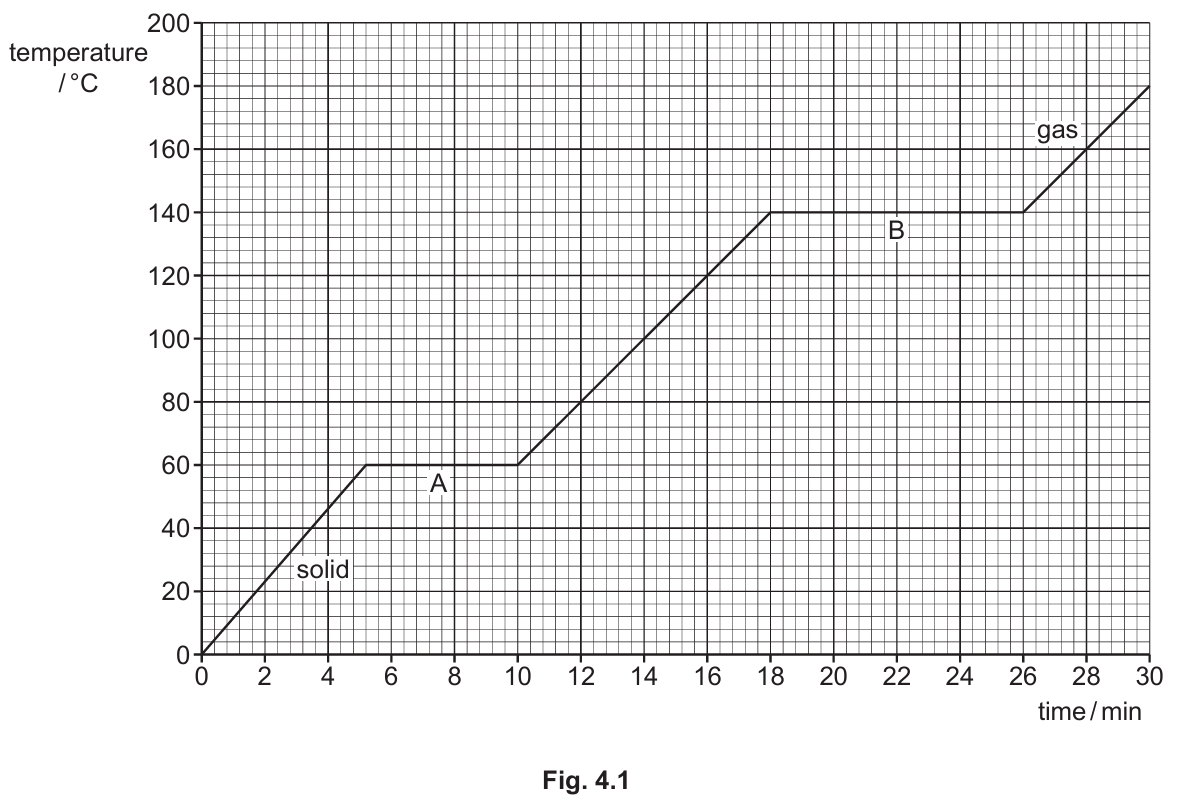
On the heating curve shown in Fig. 4.1, the two horizontal plateaus correspond to the points where the substance is undergoing a change of state rather than a change in temperature. The first plateau is at point A, and the second is at point B. Between these two flat sections, the graph shows the temperature rising again, which means the substance has completely finished its first change of state and is now absorbing energy purely to increase its temperature. Since A marks the end of melting (the solid has fully become a liquid) and B marks the beginning of boiling (where the liquid starts to become a gas), the substance between points A and B is entirely in the liquid state.
(a)(ii)
For the correct answer:
At A: melting (fusion). At B: boiling (vaporisation).
The horizontal sections of a heating curve are the fingerprint of a phase change. At point A, the temperature stops rising even though the heater continues to supply energy — this tells us that the energy being absorbed is being used entirely to break the intermolecular bonds holding the solid structure together, rather than to increase the kinetic energy of the molecules. This process of a solid converting to a liquid at a fixed temperature is called melting. Similarly at point B, the temperature plateaus again at a higher value while the liquid converts into a gas — this process is called boiling. The temperature at which each of these occurs is a fixed physical property of the substance, known as its melting point and boiling point respectively.
(b)
For the correct answer:
The new line on Fig. 4.1 should be steeper (rising more steeply) in the non-plateau sections, should reach the same melting and boiling temperatures as the original, have shorter horizontal plateau sections, and complete the entire journey from solid to gas in less total time than the original.
Using a heater with a greater power output means that thermal energy is being supplied to the substance at a faster rate than before. In the sections where the temperature is rising (before A, between A and B, and after B), the substance heats up more quickly because more energy is delivered per second, so the graph climbs more steeply. However, the temperatures at which melting and boiling occur — the melting point and boiling point — are fixed physical properties of the substance itself and do not change regardless of the heater’s power. The horizontal plateaus therefore remain at exactly the same temperature values, but they are shorter in duration because the phase changes are completed more quickly when energy is supplied at a higher rate. The overall shape is the same, just compressed along the time axis.
(c)
For the correct answer:
Solid — Arrangement: molecules are closely and regularly packed together in a fixed lattice structure. Movement: molecules vibrate about fixed positions but do not move from place to place.
Gas — Arrangement: molecules are very widely and randomly spaced, far apart from one another. Movement: molecules move rapidly and randomly in all directions, frequently colliding with each other and the walls of their container.
The kinetic particle model describes matter in terms of the positions and motions of its molecules. In a solid, the molecules are held very close together by strong intermolecular forces, arranged in a regular, ordered lattice pattern. They do not have enough energy to break free from their positions, so they can only vibrate back and forth about their fixed equilibrium points. In a gas, by contrast, the molecules have absorbed enough energy to completely overcome the intermolecular attractive forces. They are now extremely far apart — the average separation between gas molecules is many times greater than in a solid — and they move rapidly and randomly in all directions, with no fixed positions or regular arrangement whatsoever. This fundamental difference in molecular arrangement and motion explains all the observable differences in the physical properties of solids and gases, such as their very different densities and compressibilities.
Question 5
The angles of the prism are 45°, 90° and 45°.
The critical angle for the glass is 42°.
Most-appropriate topic codes (Cambridge IGCSE Physics 0625):
• Topic 3.2 — Light
• Topic 3.2.1 — Reflection of light
▶️ Answer/Explanation
(a)(i)
For the correct answer:
The ray continues in a straight line through the glass without bending, travelling to the hypotenuse (the slanted internal face) of the prism.
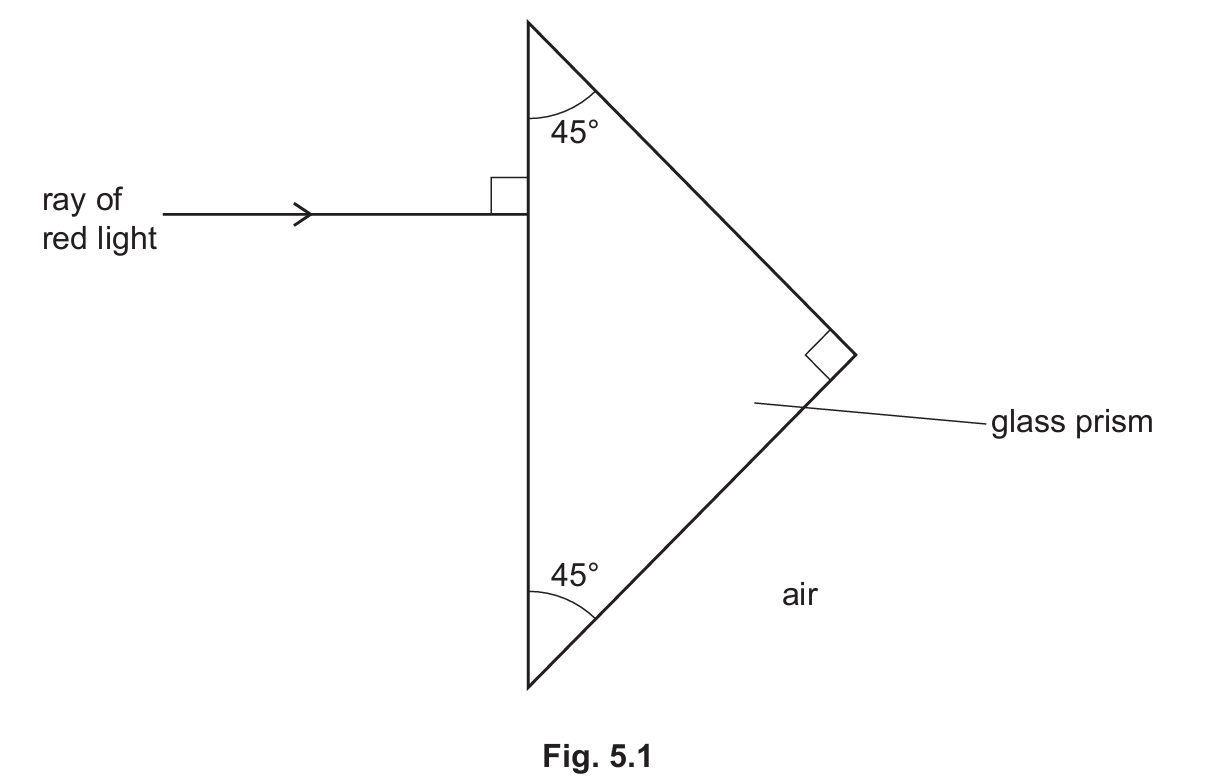
When the incoming ray of red light strikes the first flat vertical face of the prism, it hits the glass surface at exactly $90°$ — that is, it is travelling perpendicular to that surface and therefore hits it at an angle of incidence of $0°$ with respect to the normal. Because the angle of incidence is zero, there is no bending at this first surface and the ray passes straight through into the glass without any change in direction. It then continues in a perfectly straight line through the interior of the prism until it reaches the next boundary — the hypotenuse, which is the slanted internal face inclined at $45°$ to the horizontal. This is where the more interesting optical behaviour takes place.
(a)(ii)
For the correct answer:
A dashed normal line drawn perpendicular to the hypotenuse surface at the exact point where the ray meets it, labelled “normal”.
At the point where the ray inside the glass reaches the hypotenuse, a normal must be constructed perpendicular to that slanted surface in order to measure the angle of incidence correctly. Since the hypotenuse is inclined at $45°$ to the vertical, the normal to it will be inclined at $45°$ to the horizontal — pointing away from the surface on both sides. The angle of incidence at this boundary is the angle between the incoming ray travelling through the glass and this normal line. Because the ray is travelling horizontally and the normal to the hypotenuse is at $45°$ to the horizontal, the angle of incidence at this internal boundary is $45°$. This normal should be drawn as a dashed line and clearly labelled to identify it in the diagram.
(a)(iii)
For the correct answer:
The ray undergoes total internal reflection at the hypotenuse and travels vertically downward, exiting straight out through the bottom face of the prism without bending.
The critical angle for this glass is given as $42°$. At the hypotenuse, the ray strikes the glass–air boundary at an angle of incidence of $45°$, which is greater than the critical angle of $42°$. Whenever the angle of incidence exceeds the critical angle at an internal glass–air boundary, total internal reflection occurs — the ray cannot escape into the air and is instead reflected back into the glass, obeying the law of reflection (angle of incidence equals angle of reflection). The reflected ray therefore bounces off the hypotenuse at $45°$ and travels vertically downward through the glass. It then strikes the bottom horizontal face of the prism at $0°$ (perpendicular to the surface), so it passes straight through without bending and emerges into the air below travelling vertically downward. This is how a $45°$–$90°$–$45°$ prism is used to turn a light ray through exactly $90°$.
(b)(i)
For the correct answer:
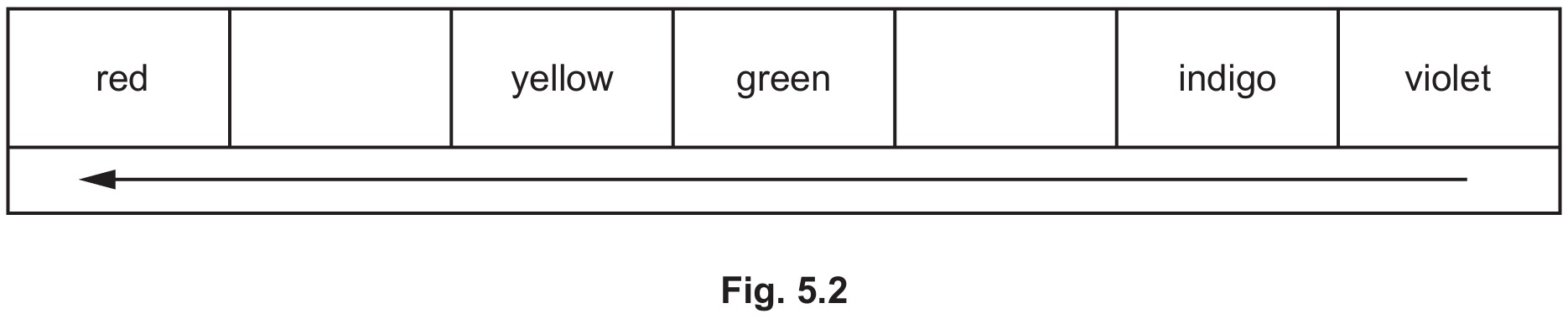
The missing colour between red and yellow is orange. The missing colour between green and indigo is blue.
The visible spectrum follows a fixed and universally recognised sequence of seven colours, conveniently remembered using the mnemonic ROYGBIV: Red, Orange, Yellow, Green, Blue, Indigo, Violet. Looking at Fig. 5.2, the colours that are already filled in allow us to identify which two are absent by their positions in the sequence. The gap between red and yellow must be orange, since orange always sits between these two colours in the spectrum. The gap between green and indigo must be blue, since blue occupies that position in the ROYGBIV sequence. These are not arbitrary — the order reflects the actual physical arrangement of colours by wavelength, from the longest wavelengths at the red end to the shortest at the violet end.
(b)(ii)
For the correct answer:
Frequency.
The arrow in Fig. 5.2 points from the red end of the spectrum towards the violet end. As we move in this direction across the visible spectrum, the wavelength of the light decreases — from the relatively long wavelengths of red light (around $700\text{ nm}$) down to the much shorter wavelengths of violet light (around $400\text{ nm}$). Since the speed of all electromagnetic waves in a vacuum is constant at $3 \times 10^8\text{ m/s}$, and speed equals frequency multiplied by wavelength ($v = f\lambda$), a decrease in wavelength must correspond to an increase in frequency. Therefore, the physical property of visible light that increases in the direction of the arrow — from red towards violet — is frequency. Higher frequency also means greater energy per photon, which is why ultraviolet radiation beyond the violet end is more damaging to living tissue than infrared radiation beyond the red end.
Question 6
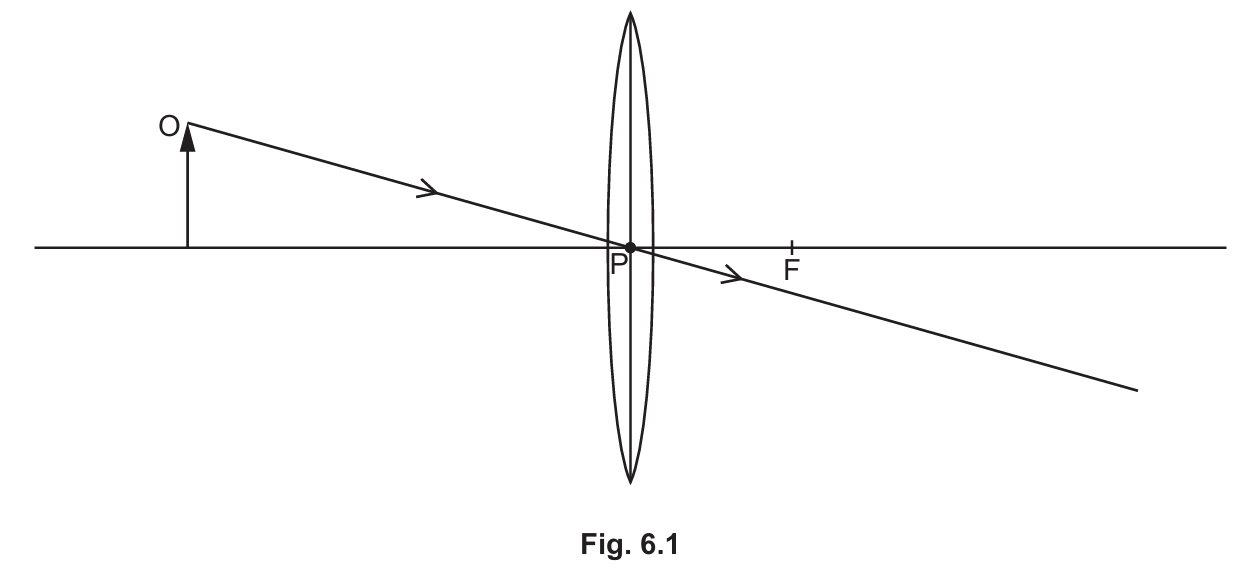
Most-appropriate topic codes (Cambridge IGCSE Physics 0625):
• Topic 3.2.3 — Thin Lenses
▶️ Answer/Explanation
(a)
For the correct answer:
Focal length.
The distance labelled PF in Fig. 6.1 — measured from the optical centre of the lens (P) to the principal focus (F) — is called the focal length of the lens. It is one of the most fundamental properties of any lens, as it determines how strongly the lens converges or diverges light rays passing through it. A shorter focal length means the lens bends light more sharply and brings parallel rays to a focus over a shorter distance, while a longer focal length indicates a more gently curved lens with weaker converging power. The focal length is always measured along the principal axis, and for a converging lens there is a principal focus on each side of the lens at equal distances from the optical centre P.
(b)
For the correct answer:
A ray drawn from the top of the object O, travelling parallel to the principal axis until it reaches the lens, then refracting downward through the principal focus F on the opposite side of the lens.
To locate the image of the object using a ray diagram, we need at least two rays from the same point on the object whose paths after the lens are both known, so that their intersection can be found. One standard ray that is always straightforward to draw is a ray that leaves the top of the object travelling parallel to the principal axis. The rule for a converging lens states that any ray arriving at the lens parallel to the principal axis will, after refraction, pass through the principal focus F on the far side of the lens. Drawing this ray — straight and horizontal from the top of O to the lens, then bending to pass through F — provides the second ray needed. Where this ray crosses the first ray already shown in the diagram is the location of the top of the image.
(c)
For the correct answer:
A vertical arrow drawn from the principal axis down to the point where the two rays intersect, labelled I, pointing downward to show it is inverted.
Once both rays have been drawn and their point of intersection found on the right-hand side of the lens, the image can be constructed. The image of the top of the object is located at the point where the two rays cross. Since the object arrow O stands upright from the principal axis, its base is on the principal axis and its tip points upward. The image of the tip is at the intersection point found from the ray diagram, and the image of the base remains on the principal axis. Drawing a vertical arrow from the principal axis to this intersection point — and labelling it I — completes the image. The arrow for I should point downward (toward the axis from below or from above depending on the geometry), clearly indicating that the image is inverted relative to the object.
(d)
For the correct answer:
Diminished and inverted.
By examining the completed ray diagram, the characteristics of the image I can be read off directly. The image is inverted because it forms on the opposite side of the principal axis from the object — while the object arrow O points upward, the image arrow I points downward, meaning the image is upside down relative to the object. The image is also diminished, meaning it is smaller in size than the original object. This can be seen by comparing the lengths of the arrows O and I in the diagram; the image arrow is shorter than the object arrow. This situation — a real, inverted, diminished image — is produced by a converging lens whenever the object is placed at a distance greater than twice the focal length from the lens, which is consistent with the geometry shown in Fig. 6.1.
Question 7
Most-appropriate topic codes (Cambridge IGCSE Physics 0625):
• Topic 3.4 — Sound
▶️ Answer/Explanation
(a)(i)
For the correct answer:
Echo.
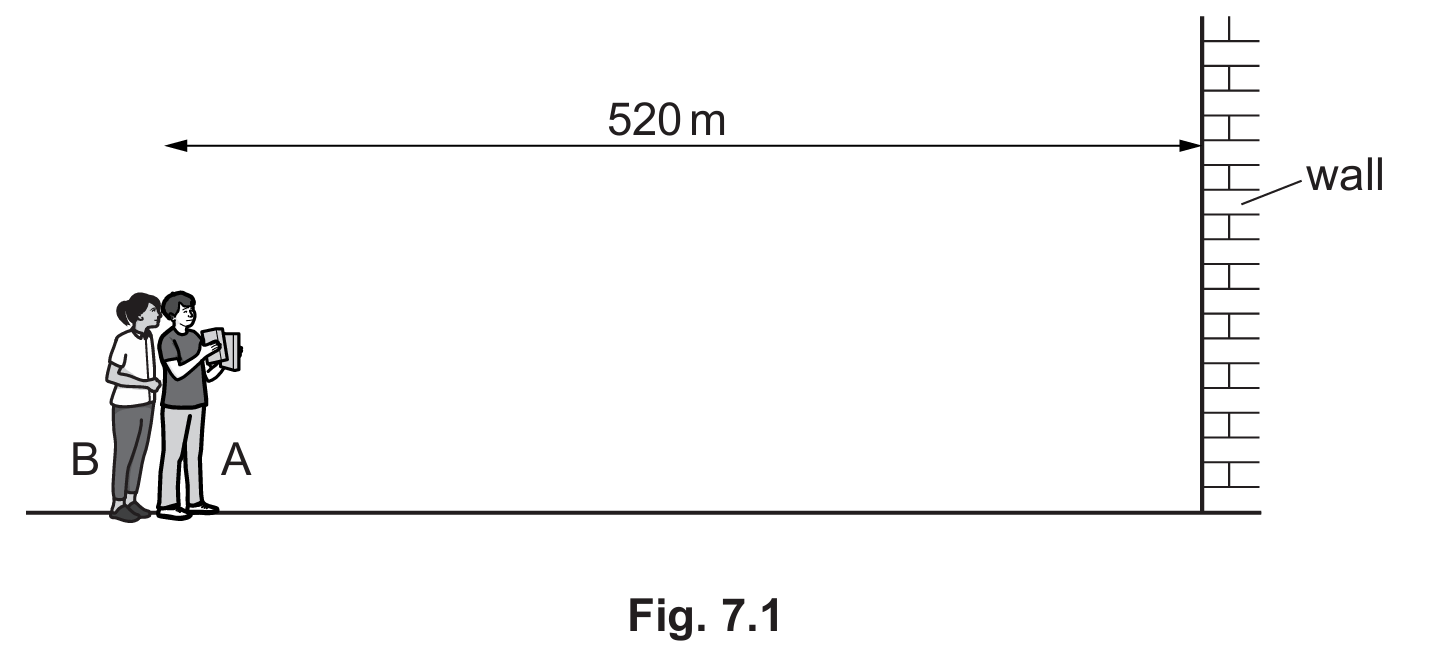
When sound waves travel through the air and strike a hard, flat surface such as a wall, they bounce back in the same way that light reflects off a mirror. The reflected sound wave that returns to the listener is specifically called an echo. An echo is only perceived as a distinct, separate sound from the original if the reflecting surface is far enough away — generally at least about 17 metres — so that the reflected sound returns more than one tenth of a second after the original, giving the human ear enough time to distinguish the two sounds as separate events. In this experiment, the wall is 520 m away, so the sound takes over a second to return, making the echo very clearly distinguishable from the original bang.
(a)(ii)
For the correct answer: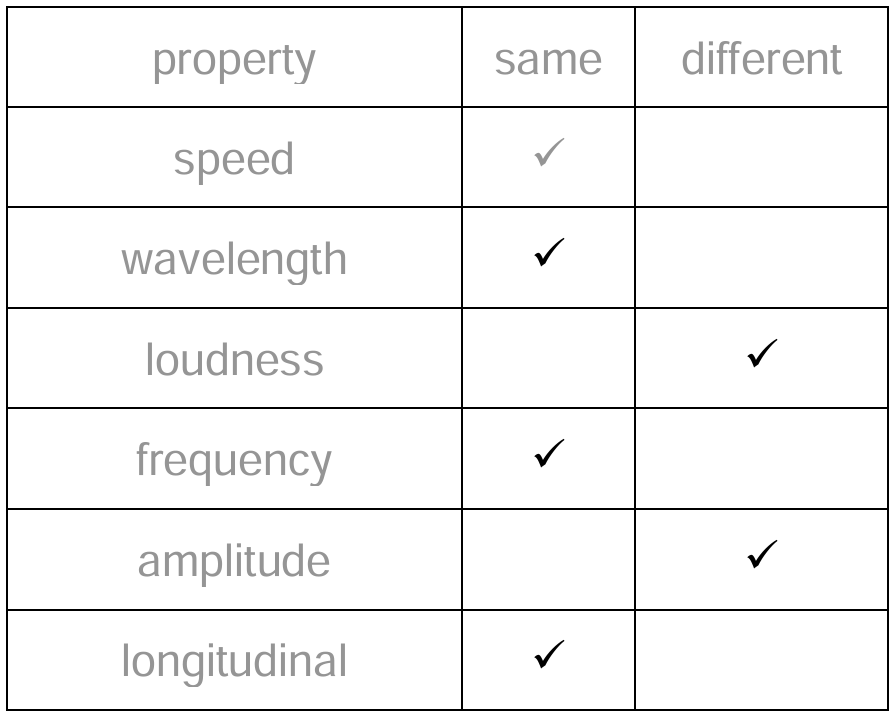
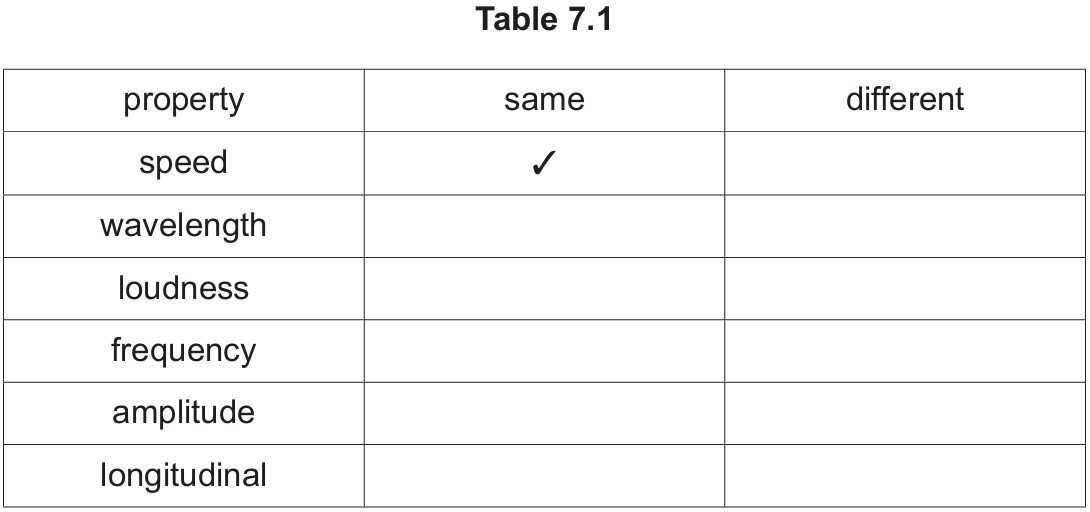
When a sound wave reflects off a surface, it remains in the same medium (air) throughout its entire journey — it simply changes direction at the wall. Because the medium does not change, the speed of sound remains the same for both the original and the reflected wave. Similarly, the frequency of the wave is entirely determined by the source (the banging of the wooden blocks) and cannot be altered by reflection, so the frequency of the echo is identical to that of the original sound. Since both speed and frequency are unchanged, the wavelength — which is determined by the relationship $\lambda = v/f$ — must also remain the same. The one property that does change is the amplitude: some energy is absorbed by the wall during reflection and some is lost as the wave spreads out over a greater distance, so the reflected sound has a smaller amplitude and therefore sounds quieter than the original.
(b)(i)
For the correct answer:
Stopwatch.
To measure the time interval of 3.1 seconds between hearing the original sound and hearing its echo, a stopwatch is the most suitable and practical instrument. A stopwatch can be started the instant the original bang is heard and stopped as soon as the echo is detected, directly giving the elapsed time to a precision of at least one tenth of a second, which is more than adequate for this experiment. A digital stopwatch would be preferable to an analogue one for slightly greater precision. It is worth noting that in practice, student B would need to be highly attentive and have quick reflexes to start and stop the stopwatch accurately in response to sound rather than a visual cue, so multiple trials and averaging would help reduce the effect of human reaction time errors.
(b)(ii)
For the correct answer:
Speed of sound $= 340\text{ m/s}$
Calculation: Total distance $= 2 \times 520 = 1040\text{ m}$; $v = d/t = 1040 / 3.1 = 335.4\ldots \approx 340\text{ m/s}$
The key insight in this calculation is recognising that the sound has not just travelled 520 m — it has travelled from the students to the wall and then back again, covering the same 520 m distance twice. The total distance travelled by the sound is therefore $2 \times 520\text{ m} = 1040\text{ m}$. Using the standard speed formula $v = d / t$ and substituting the total distance and the measured time interval: $v = 1040\text{ m} \div 3.1\text{ s} = 335.5\text{ m/s}$, which rounds to approximately $340\text{ m/s}$. This result is very close to the accepted value for the speed of sound in air at room temperature ($\approx 340\text{ m/s}$), confirming that the experimental method is sound. Forgetting to double the distance is the most common error in echo-based speed of sound calculations and must always be carefully avoided.
Question 8
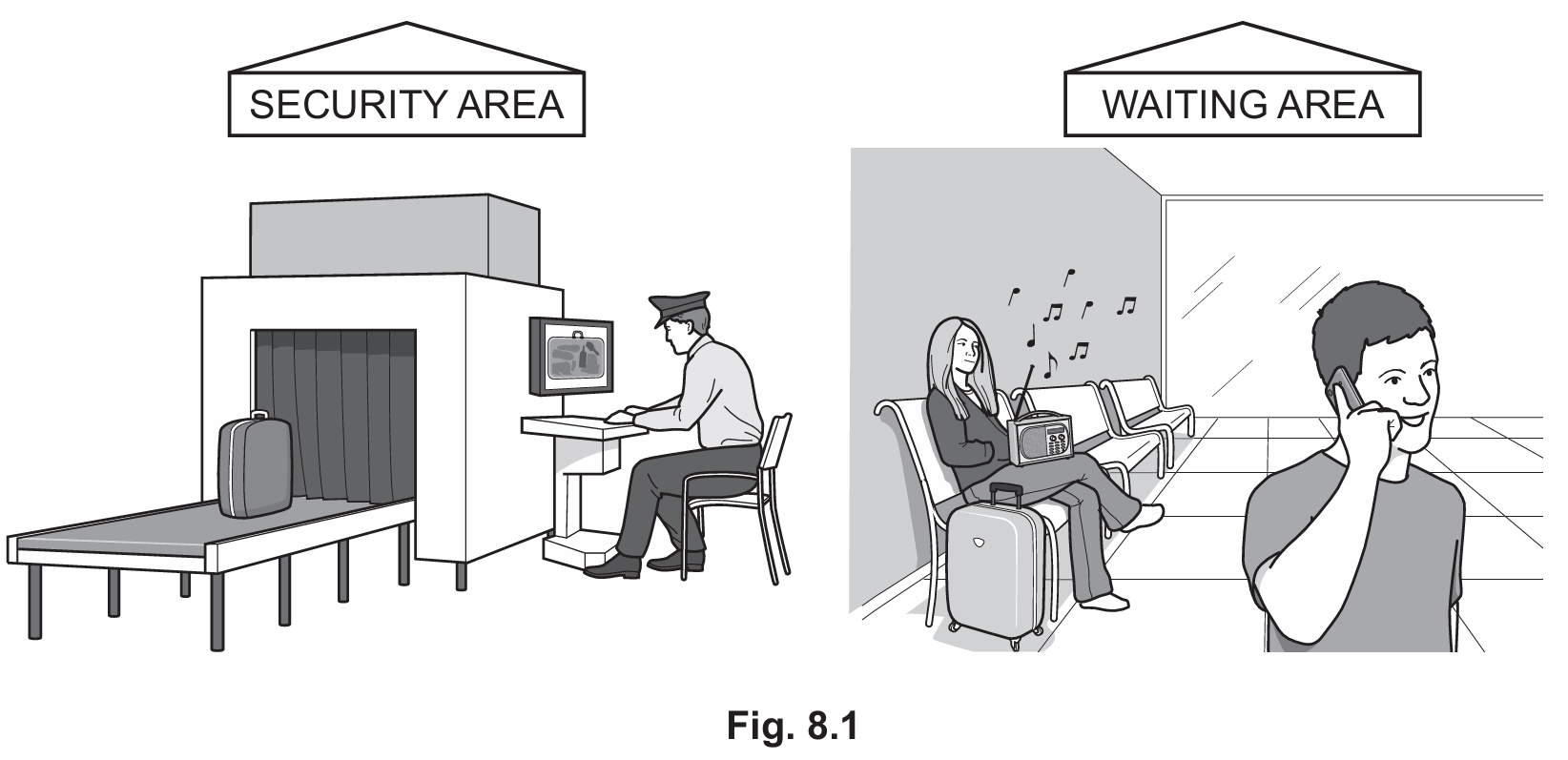

Most-appropriate topic codes (Cambridge IGCSE Physics 0625):
• Topic 3.1 — General wave properties
• Topic 5.2 — Radioactivity
▶️ Answer/Explanation
(a)
For the correct answer:
Situation 1: Radio waves. Situation 2: Microwaves (or radio waves). Situation 3: X-rays.
Different regions of the electromagnetic spectrum are chosen for specific applications based on their wavelength, frequency, and penetrating properties. In situation 1, the airport radio communication system transmits and receives signals using radio waves, which have very long wavelengths and can travel large distances, making them ideal for communication between aircraft and ground control. In situation 2, mobile phones and wireless devices in the waiting area operate using microwaves, which are the frequency band allocated for cellular and Wi-Fi communication networks worldwide. In situation 3, the security baggage scanner uses X-rays because they have sufficient energy and penetrating power to pass through soft materials such as clothing and fabric luggage, while being absorbed or reflected by denser objects like metals and electronics, allowing security staff to see the contents of bags on a screen.
(b)
For the correct answer (any two):
1. All electromagnetic waves can travel through a vacuum (they do not require a medium). 2. All electromagnetic waves travel at the same speed in a vacuum ($3 \times 10^8\text{ m/s}$). 3. All electromagnetic waves are transverse waves.
Beyond the wave behaviours of reflection, refraction, and diffraction that all waves share, electromagnetic waves have several additional properties that are unique and important. Most significantly, unlike mechanical waves such as sound, all electromagnetic waves are able to travel through a complete vacuum — they do not need any physical medium of particles to propagate. This is what allows sunlight and other radiation to reach the Earth across the emptiness of space. Another key shared property is that all electromagnetic waves, regardless of their frequency or wavelength, travel at exactly the same speed in a vacuum: approximately $3 \times 10^8\text{ m/s}$, known as the speed of light. Furthermore, all electromagnetic waves are transverse waves, meaning their oscillations (of electric and magnetic fields) are perpendicular to the direction of energy travel.
(c)
For the correct answer (any two):
1. Minimise the time spent near the source / limit exposure time. 2. Use tongs, a robotic arm, or stand at a distance from the source to maximise separation between the body and the radiation. 3. Use dense lead shielding, a lead apron, or lead gloves to absorb the gamma radiation before it reaches the body.
Gamma radiation is the most penetrating and most ionising form of radiation in the radioactive decay series — it can pass straight through the human body, damaging DNA and living cells, which can lead to radiation sickness, cancer, or death with sufficient exposure. For this reason, strict safety precautions must always be followed when working with gamma sources. The first and most important principle is to minimise exposure time: the less time spent near the source, the less total radiation dose the body receives. The second principle is to maximise distance — gamma radiation obeys an inverse square law, so doubling the distance from a source reduces the intensity to one quarter; using long tongs or remote handling equipment keeps the source as far from the body as possible. The third precaution is to interpose dense shielding — typically thick lead or concrete — between the source and the operator, as these materials are highly effective at absorbing gamma rays before they can reach the body.
Question 9
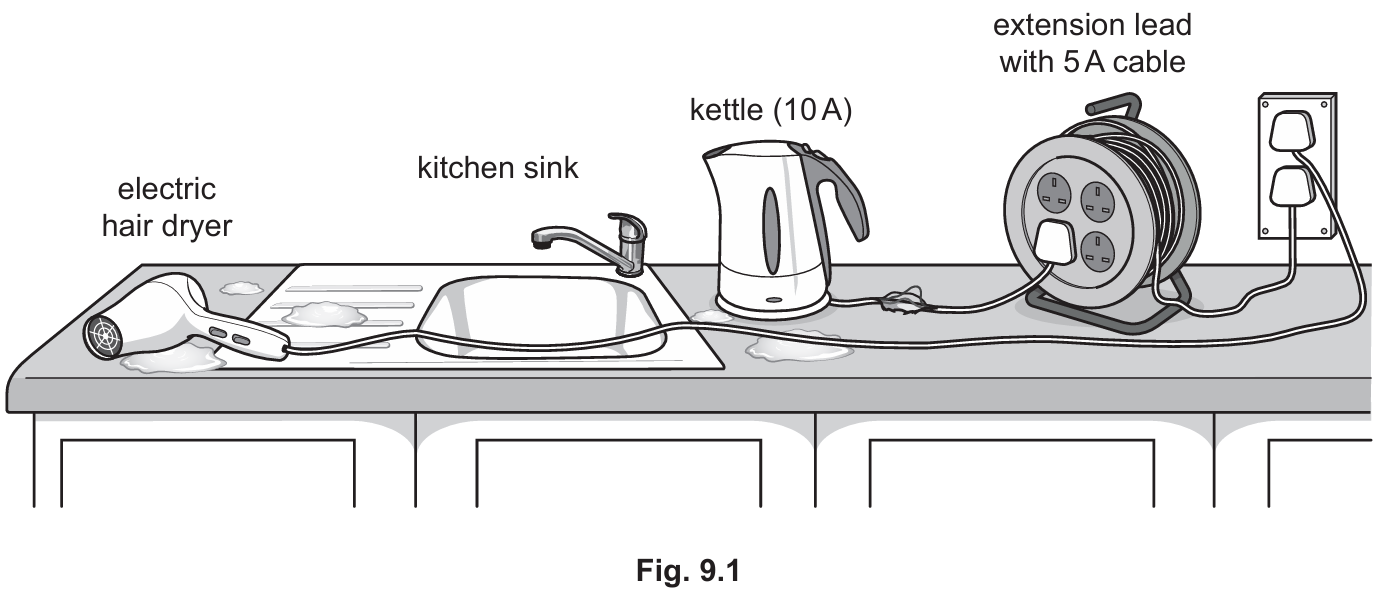
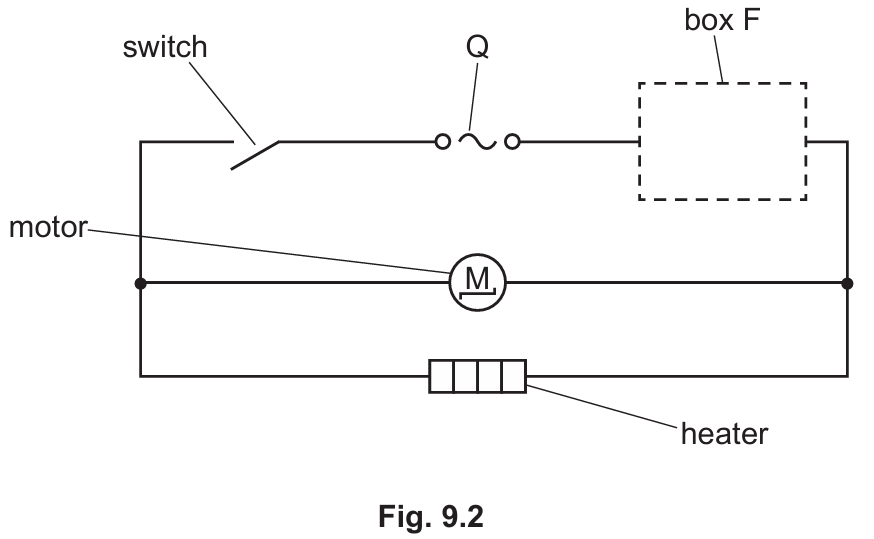
When the hair dryer is used on the high heat setting, the current in the hair dryer is 8.9 A.
Most-appropriate topic codes (Cambridge IGCSE Physics 0625):
• Topic 4.3 — Electrical circuits
• Topic 4.4 — Electrical safety
▶️ Answer/Explanation
(a)(i)
For the correct answer (any three):
1. Damaged/frayed insulation on the kettle cable. 2. Wet or damp conditions near the sink in close proximity to electrical appliances. 3. An extension cable rated for only 5 A being used to power a kettle that draws 10 A.
There are several clear electrical hazards visible in the kitchen scene in Fig. 9.1. First, the cable connecting the kettle shows signs of damaged insulation — when the protective plastic covering around a wire is worn away or cut, the live conductor underneath becomes exposed and can be touched accidentally, creating a direct risk of electrocution. Second, the proximity of water at the sink to electrical appliances and sockets is extremely dangerous, as water conducts electricity and a splash or drip onto a live component can instantly create a short circuit and a fatal shock. Third, connecting a high-powered appliance like a 10 A kettle through a cable or extension lead that is only rated to carry 5 A means the cable is being asked to carry twice its safe current capacity, which will cause it to overheat dangerously.
(a)(ii)
For the correct answer (any two):
1. Overheating of cables, leading to a fire. 2. Electric shock to a person touching an exposed live wire or a wet appliance.
The electrical hazards identified in Fig. 9.1 can lead to two serious and potentially fatal consequences. When a cable is forced to carry a current far beyond its rated capacity — as in the case of the undersized extension lead — the resistance of the wire causes it to heat up excessively. If this overheating is severe enough, the cable’s insulation can melt or ignite surrounding materials, starting an electrical fire that can spread rapidly through a kitchen. The second major consequence is electric shock: if a person touches an exposed live wire with damaged insulation, or if water bridges the gap between a live component and a person’s body, a large current will flow through the person. Depending on its magnitude and duration, this electric shock can cause burns, cardiac arrest, or death.
(b)(i)
For the correct answer:
A.C. (alternating current) power supply.
The component labelled Q in Fig. 9.2 is the a.c. power supply — the mains electricity source that powers the hair dryer. In standard circuit diagram notation, an alternating current supply is represented by a circle containing a wavy or sinusoidal line, which distinguishes it from a d.c. cell or battery symbol. Mains electricity is always alternating current because it is generated by rotating generators at power stations and distributed through the national grid in this form. The frequency of mains a.c. is 50 Hz in most countries (including the UK), meaning the current reverses direction 50 times per second. This a.c. supply is what drives the motor and heating element inside the hair dryer.
(b)(ii)
For the correct answer:
A rectangle with a continuous straight line passing through its centre from one end to the other, drawn inside the dashed box F.
The standard circuit symbol for a fuse consists of a small rectangle (representing the glass or ceramic casing of the fuse) with a straight, unbroken line running through it from one terminal to the other, representing the thin wire filament inside. This symbol must be drawn clearly within the dashed box F on Fig. 9.2, connected into the circuit in series with the other components. It is important that the line passes straight through the centre of the rectangle and exits at both ends to connect to the rest of the circuit, and that the rectangle is clearly distinguishable as the fuse casing rather than any other component. The fuse must always be placed in series in a circuit so that all current flowing to the appliance must pass through it.
(b)(iii)
For the correct answer:
To protect the circuit and the appliance by melting and breaking the circuit if the current exceeds a safe level.
A fuse is a deliberate weak point in an electrical circuit, designed to sacrifice itself in order to protect the rest of the circuit and the appliance connected to it. Inside a fuse is a thin wire made of a metal with a low melting point. Under normal operating conditions, the current flowing through this wire is within the fuse’s rated value and the wire remains intact. However, if a fault develops — such as a short circuit or an overload — and the current rises above the fuse’s rating, the thin wire heats up rapidly and melts, physically breaking the circuit and stopping all current flow. This prevents the excess current from damaging the appliance, overheating the cables, or causing a fire. Once a fuse has blown, it must be replaced before the circuit can work again.
(b)(iv)
For the correct answer:
A circuit breaker can be easily reset by flicking a switch, whereas a blown fuse must be replaced entirely — making a circuit breaker more convenient and reusable.
A circuit breaker performs the same protective function as a fuse — it detects excess current and breaks the circuit to prevent damage — but it does so using an electromagnetic or bimetallic switch mechanism rather than a wire that melts and is destroyed. The key practical advantage of a circuit breaker over a fuse is that once the fault has been identified and corrected, the circuit breaker can be reset simply by flicking it back to the on position, restoring the circuit to full operation in seconds. A blown fuse, by contrast, is permanently destroyed and must be physically removed and replaced with a new one of the correct rating. This makes circuit breakers far more convenient, quicker to restore after a trip, and ultimately more cost-effective in the long run since they do not need to be replaced each time they operate.
(c)
For the correct answer:
13 A
To select the correct fuse rating for the hair dryer, we must identify the maximum current it will ever draw during normal operation, which occurs on the high heat setting at 8.9 A. The correct fuse must satisfy two conditions: it must be rated high enough that it does not blow during normal use, and it must be rated low enough that it will blow quickly if a dangerous fault causes the current to rise above a safe level. A 5 A fuse would be too low — it would blow immediately even on the low heat setting (5.2 A). A 10 A fuse would also be insufficient, as the high heat setting draws 8.9 A which is close to 10 A and a small surge could blow it unnecessarily. A 13 A fuse is the correct choice: it is comfortably above the maximum operating current of 8.9 A so it will not blow during normal use, but it is low enough to provide meaningful protection against a serious fault. Ratings of 15 A or 30 A would be far too high to offer adequate protection.
Question 10
Most-appropriate topic codes (Cambridge IGCSE Physics 0625):
• Topic 5.2 — Radioactivity
• Topic 5.1.1 — Atomic model
▶️ Answer/Explanation
(a)(i)
For the correct answer:
Gamma / γ
Among the three main types of radioactive emissions, gamma rays are pure electromagnetic waves with no mass or charge. This allows them to pass through materials far more easily than alpha or beta particles, often requiring several centimeters of lead or meters of concrete to be stopped. Their high frequency and short wavelength give them this exceptional penetrating power.
(a)(ii)
For the correct answer:
Alpha / α
Alpha particles are relatively large and heavy, consisting of two protons and two neutrons. Because they carry a double positive charge and move much more slowly through matter, they interact very strongly with atoms along their path. This intense interaction strips electrons from many nearby atoms, making alpha particles by far the most ionising form of radiation.
(a)(iii)
For the correct answer:
Alpha / α
The charge of a radioactive emission determines how it will be deflected by electric and magnetic fields. An alpha particle is essentially a helium nucleus, containing two protons and no electrons. This gives it an overall charge of +2, which is the positive charge referred to in this part of the question. Beta particles, in contrast, are negatively charged, and gamma rays have no charge.
(b)(i)
For the correct answer:
53
The nuclide notation ${}^{131}_{53}\text{I}$ provides the atomic number as the bottom number. This atomic number is the defining characteristic of an element and tells us the number of protons found in the nucleus. Since the bottom number is 53, there must be exactly 53 protons in the nucleus of this iodine isotope.
(b)(ii)
For the correct answer:
78
The top number in the nuclide notation, 131, represents the mass number, which is the total count of both protons and neutrons in the nucleus. To find the number of neutrons alone, we simply subtract the atomic number from the mass number. Performing this calculation, 131 − 53 gives us 78, telling us the nucleus contains 78 neutrons.
(c)
For the correct answer:
200 counts/s
First, we determine how many half-lives have passed by dividing the total time by the half-life period: 24 days ÷ 8 days = 3 half-lives. The activity of a radioactive sample halves with each half-life. We start at 1600 counts/s, and after one half-life it drops to 800 counts/s. After the second half-life, it becomes 400 counts/s, and after the third half-life, the activity falls to a final value of 200 counts/s.