
Question 1
Most-appropriate topic codes (Cambridge IGCSE Physics 0625):
• Topic 1.4 — Density (Part (a))
• Topic 1.7.1 — Energy (Part (b))
• Topic 1.8 — Pressure (Part (c))
▶️ Answer/Explanation
(a)
For the correct answer:
depth = 0.211 m
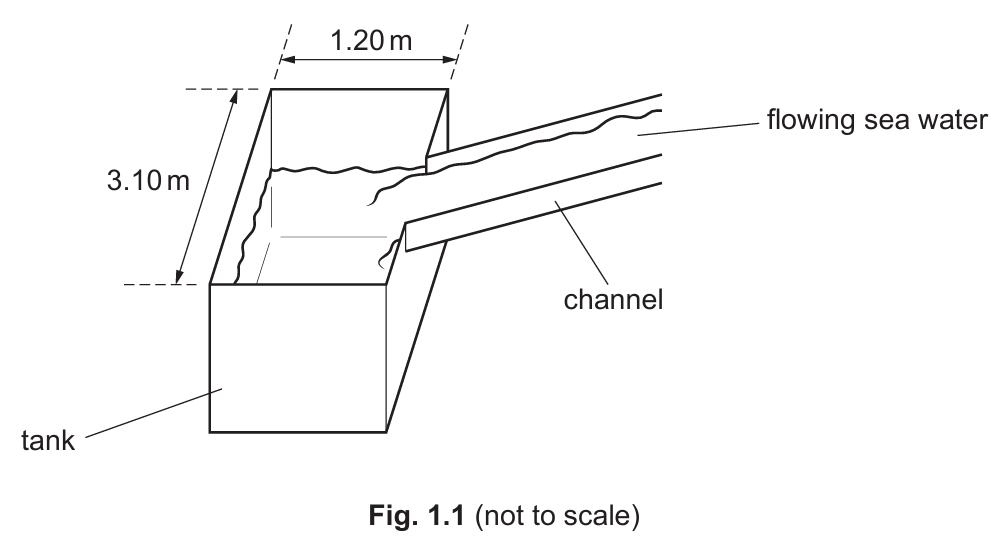
We need to find how deep the water is after 1 minute. First, we know the mass flow rate is 800 kg/min, so in 1 minute, 800 kg of water flows in. Using the density of seawater (1020 kg/m³), we find the volume of this water via \( V = \frac{m}{\rho} = \frac{800}{1020} \approx 0.7843 \, \text{m}^3 \). The tank has a base area of \( 3.10 \times 1.20 = 3.72 \, \text{m}^2 \). The depth is simply the volume divided by this base area: \( d = \frac{0.7843}{3.72} \approx 0.211 \, \text{m} \).
(b)
For the correct answer:
decrease in gravitational potential energy = 56(.0) J
Gravitational potential energy (GPE) lost per second is what we’re after. The mass of water flowing per second is \( \frac{800 \, \text{kg}}{60 \, \text{s}} = 13.33 \, \text{kg/s} \). The change in GPE for this mass each second is given by \( \Delta E_p = mg\Delta h = 13.33 \times 10 \times 0.420 \). Doing the math, \( 13.33 \times 4.2 = 56.0 \, \text{J} \). So, every second, 56 Joules of gravitational potential energy are converted to other forms as the water falls.
(c)
For the correct answer:
pressure = 8200 Pa
The pressure at the bottom of a liquid column depends on the liquid’s density, gravity, and the height of the column. We can use the formula \( \Delta p = \rho g \Delta h \) directly. Plugging in the values: \( \Delta p = 1020 \, \text{kg/m}^3 \times 10 \, \text{m/s}^2 \times 0.800 \, \text{m} \). This gives \( 1020 \times 8 = 8160 \, \text{Pa} \), which is 8200 Pa when rounded to two significant figures to match the given depth.
Question 2
digital balance measuring cylinder metre rule micrometer screw gauge stop-watch thermocouple
Most-appropriate topic codes (Cambridge IGCSE Physics 0625):
• Topic 1.1 — Physical quantities and measurement techniques (Parts (a), (b))
▶️ Answer/Explanation
(a)
For the correct answer:
Time multiple oscillations, use a fiducial aid, divide total time by number of oscillations.
The pendulum’s period is about one second, which is too fast for human reaction time to measure directly. So, we let it swing, say, 20 times and measure the total time for those 20 complete swings. To improve accuracy, we use a fiducial marker (like a vertical line behind the string) at the centre of the swing to judge the start and end of a cycle. The period is then simply the measured total time divided by 20.
(b)
For the correct answer:
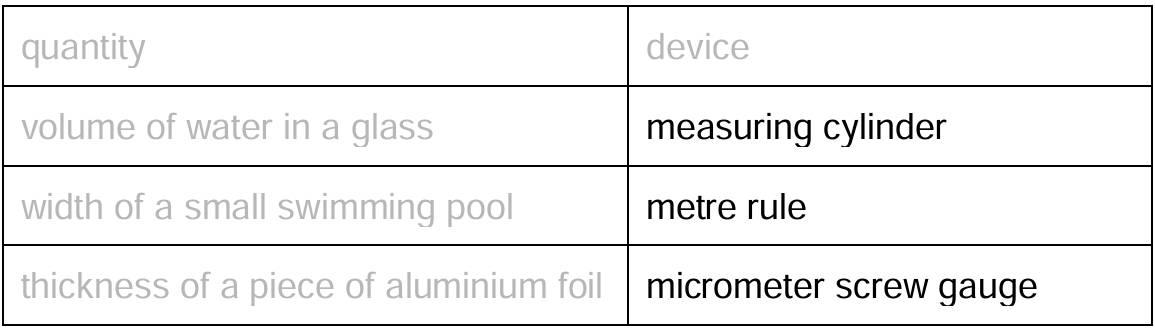
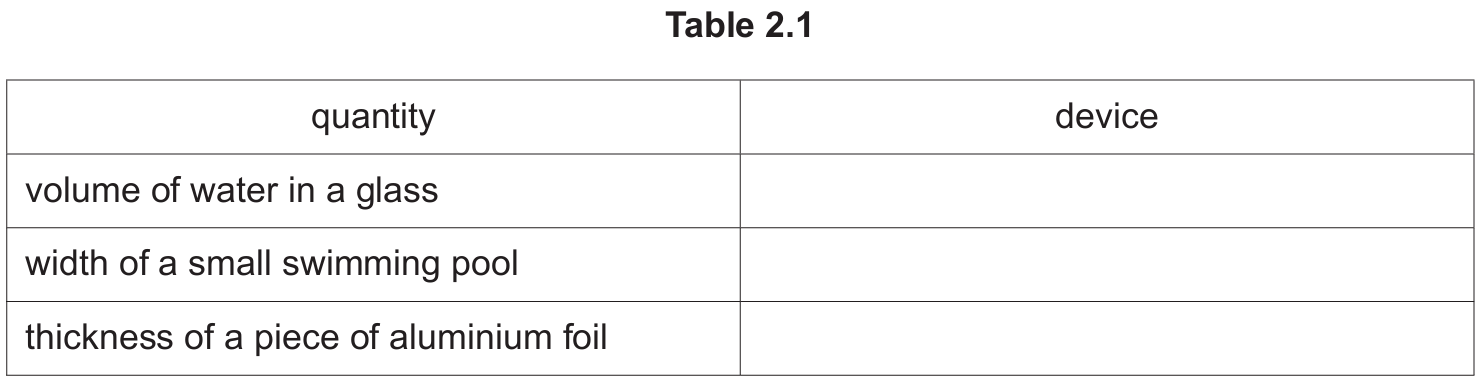
A measuring cylinder is designed to accurately measure the volume of liquids. For the width of a small pool, a metre rule is the most practical and correctly scaled instrument. Aluminium foil is extremely thin, so we need the high precision of a micrometer screw gauge to measure its thickness accurately down to fractions of a millimetre.
Question 3
Most-appropriate topic codes (Cambridge IGCSE Physics 0625):
• Topic 1.7.3 — Energy resources (Parts (a)(i), (a)(ii), (b)(i))
• Topic 1.7.4 — Power (Part (b)(ii))
▶️ Answer/Explanation
(a)(i)
For the correct answer (any one):
fossil fuel / named fossil fuel, biofuel / wood / crops, hydro, wave, wind, solar cell / panel.
The Sun is the ultimate source for many energy types. For example, solar panels convert sunlight directly, while wind and wave power are created by weather patterns driven by solar heating of the atmosphere.
(a)(ii)
For the correct answer:
geothermal OR nuclear
These two sources do not rely on the Sun. Geothermal energy comes from radioactive decay and residual heat deep inside the Earth. Nuclear power originates from the energy stored within atomic nuclei, which is a fundamentally different source.
(b)(i)
For the correct answer:
Yes, it is renewable. Tides are continuous, happen every day and are an unlimited resource.
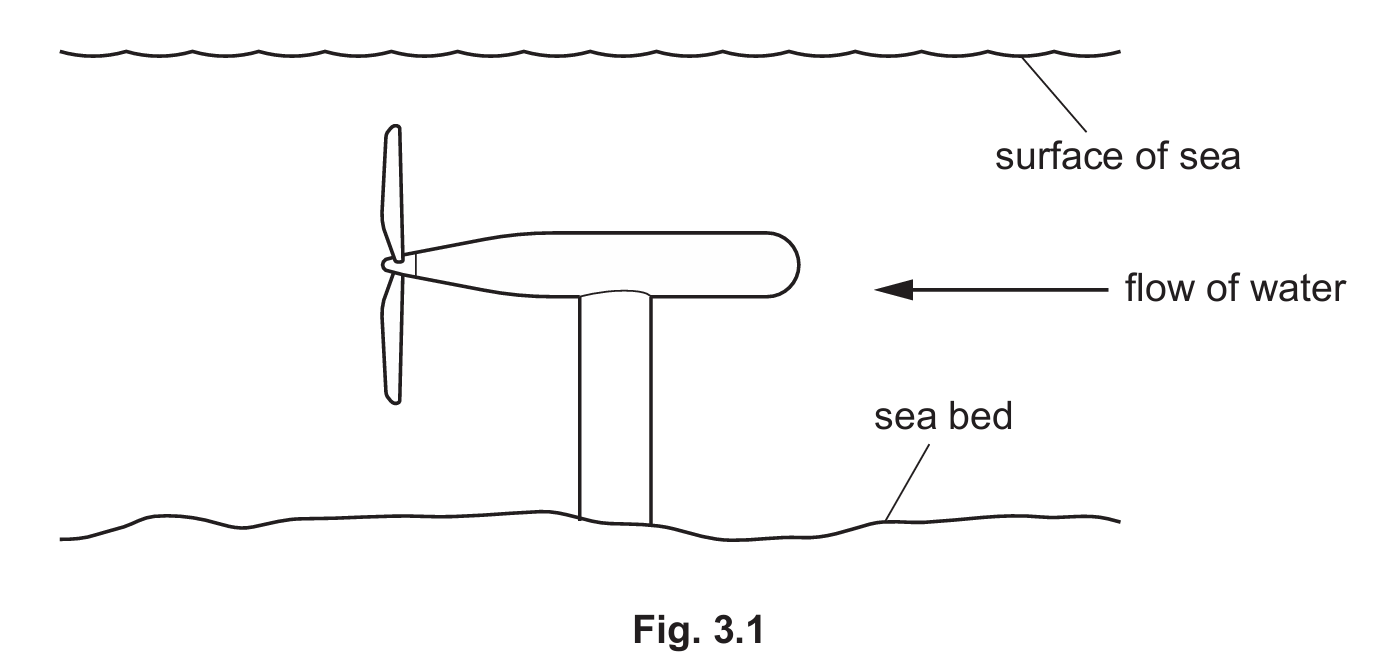
A renewable source is one that is naturally replenished on a human timescale and won’t run out. Tidal power fits this perfectly because the gravitational pull of the Moon and Sun, which drives the tides, is a constantly repeating and practically inexhaustible phenomenon.
(b)(ii)
For the correct answer:
power = 4800 W
Power is the energy converted per second. The kinetic energy of water passing through each second is \( \frac{1}{2}mv^2 = 0.5 \times 6.0 \times 10^3 \times (2.0)^2 = 12000 \, \text{J/s} \). Since only 40% is converted to electrical energy, the electrical power output is \( 0.40 \times 12000 = 4800 \, \text{W} \).
Question 4
Most-appropriate topic codes (Cambridge IGCSE Physics 0625):
• Topic 2.1.2 — Particle model (Parts (a), (b))
• Topic 2.1.3 — Gases and the absolute scale of temperature (Part (c))
▶️ Answer/Explanation
(a)
For the correct answer (any three):
Moving particles have momentum and hit walls. Momentum changes when particles hit walls. A force is exerted due to rate of change of momentum. Pressure is total force per unit area.
Gas particles are in constant, random motion, meaning they have mass, velocity, and thus momentum. When they collide with the container walls, their momentum changes direction. This change in momentum per unit time is equal to a force, as described by Newton’s second law. The combined effect of countless collisions per second across the inner surface area of the container is what we measure as pressure.
(b)
For the correct answer:
Pressure increases. Particles move faster and have more kinetic energy, leading to a greater change of momentum upon collision.
Increasing the temperature of a gas gives its particles more kinetic energy, so they move faster. With the volume fixed, these faster-moving particles hit the walls more frequently and with greater force. Each collision involves a larger change in momentum, which increases the overall force and therefore the pressure on the container walls.
(c)
For the correct answer:
pressure = 1.5 × 10⁵ Pa
For a fixed mass of gas at constant temperature, Boyle’s law tells us that \(p_1V_1 = p_2V_2\). The initial volume is 170 cm³, and it decreases by 70 cm³, making the new volume 100 cm³. We rearrange to solve for the new pressure: \(p_2 = \frac{p_1V_1}{V_2} = \frac{9.0 \times 10^4 \times 170}{100} = 1.53 \times 10^5 \, \text{Pa}\). This rounds to \(1.5 \times 10^5 \, \text{Pa}\).
Question 5
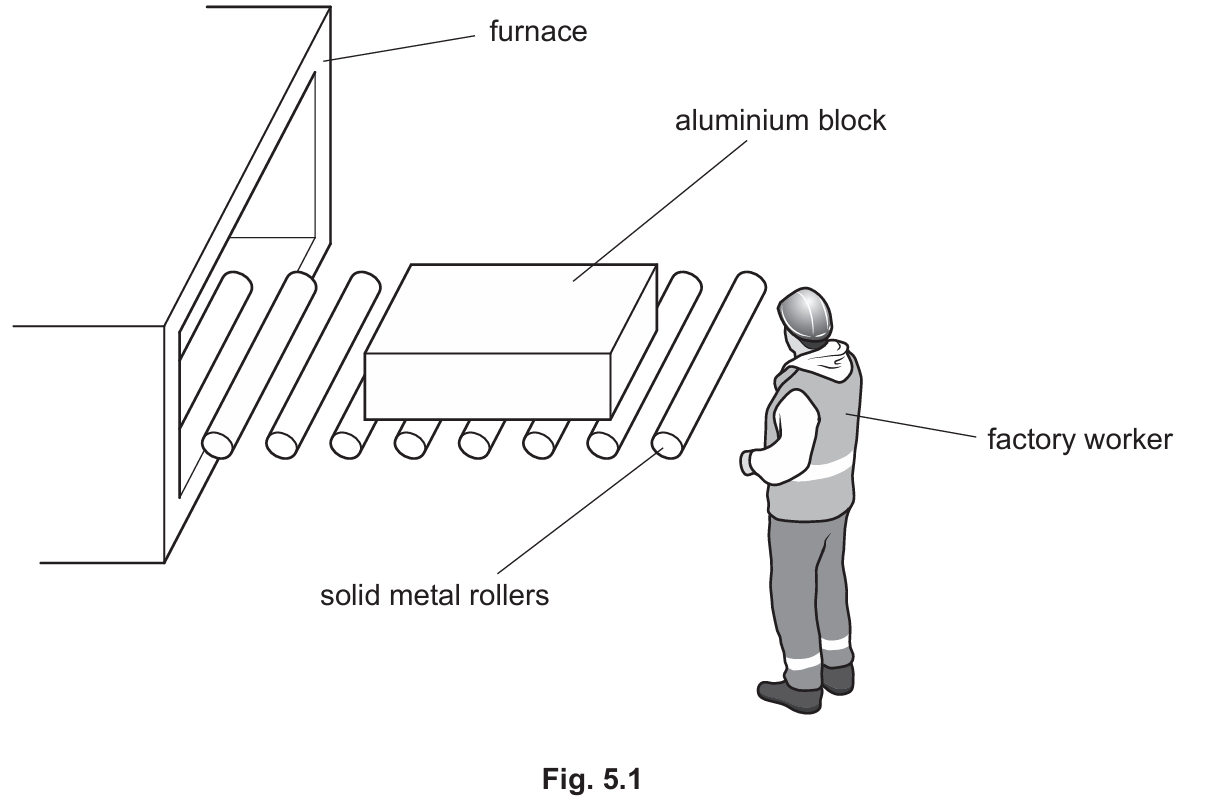
Most-appropriate topic codes (Cambridge IGCSE Physics 0625):
• Topic 2.2.2 — Specific heat capacity (Part (a))
• Topic 2.3.3 — Radiation (Part (b))
• Topic 2.3.1 — Conduction (Part (c))
▶️ Answer/Explanation
(a)
For the correct answer:
E = 410 000 000 J OR 410 MJ OR 4.1 × 10⁸ J
The thermal energy gained is calculated using the formula for specific heat capacity: \(\Delta E = mc\Delta T\). The temperature change, \(\Delta T\), is \(380 – 20 = 360^{\circ}\text{C}\). Multiplying the mass (1200 kg), the specific heat capacity (960 J/(kg°C)), and the temperature change (360°C) gives us \(1200 \times 960 \times 360 = 414,720,000 \, \text{J}\). Rounded, this is \(4.1 \times 10^8 \, \text{J}\) or 410 MJ.
(b)
For the correct answer:
Thermal radiation. Electromagnetic/infrared/IR radiation is emitted from the block, travels to the worker without needing a medium, and is absorbed by the worker.
The block is extremely hot and emits a significant amount of thermal radiation, which is in the infrared part of the electromagnetic spectrum. Unlike conduction or convection, radiation doesn’t require a medium and can travel through the air (or vacuum) directly to the worker standing 3 meters away, where it is absorbed, increasing the worker’s internal energy.
(c)
For the correct answer:
Conduction in metals is primarily due to the movement of delocalised/free electrons, which travel through the solid, collide with distant particles, and transfer energy rapidly.
Metals have a sea of free electrons that are not bound to specific atoms. When one part of the metal is heated, these electrons gain kinetic energy and move faster. They quickly diffuse through the metal lattice, colliding with cooler atoms and other electrons, thereby transferring the thermal energy throughout the material much faster than the slower process of lattice vibration alone.
Question 6
Most-appropriate topic codes (Cambridge IGCSE Physics 0625):
• Topic 3.2.3 — Thin lenses (Part (a)(i), (a)(ii))
• Topic 3.2.4 — Dispersion of light (Part (b))
▶️ Answer/Explanation
(a)(i)
For the correct answer:
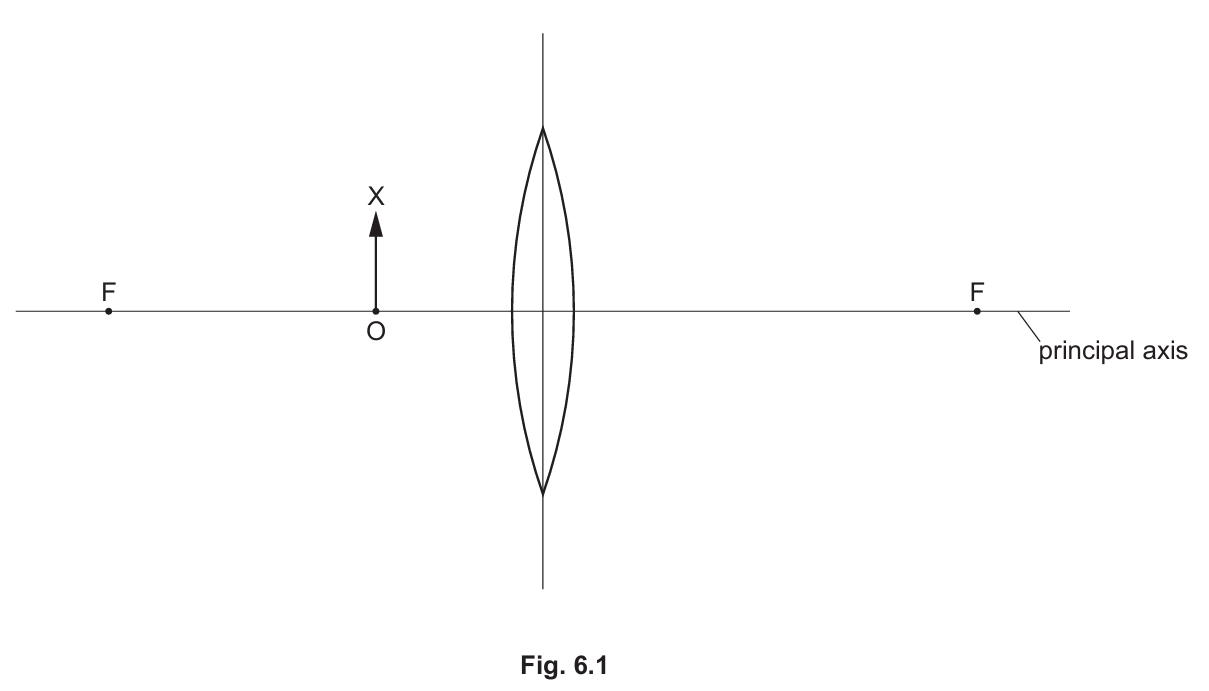
Two correct rays drawn from X, correct image IY drawn, distance = 36 mm to 44 mm.
To locate a virtual image in a converging lens, the object must be inside the focal length. We draw one ray from X straight through the centre of the lens, which doesn’t bend. A second ray from X travels parallel to the principal axis and refracts through the far focal point F. When we extend these two refracted rays backwards with dotted lines, they appear to come together at a point on the same side as the object, forming the virtual, upright, and magnified image IY.
(a)(ii)
For the correct answer (any two):
Object is closer to lens than one focal length, actual rays do not meet at the image, image cannot be formed on a screen, object and image are on the same side of the lens.
A virtual image has two key properties. Firstly, it is formed by the apparent intersection of light rays, not the actual convergence of light, so you can’t project it onto a screen. Secondly, it’s only possible because the object distance is less than the focal length of the lens, which causes the refracted rays to diverge, making them appear to originate from behind the lens.
(b)
For the correct answer:
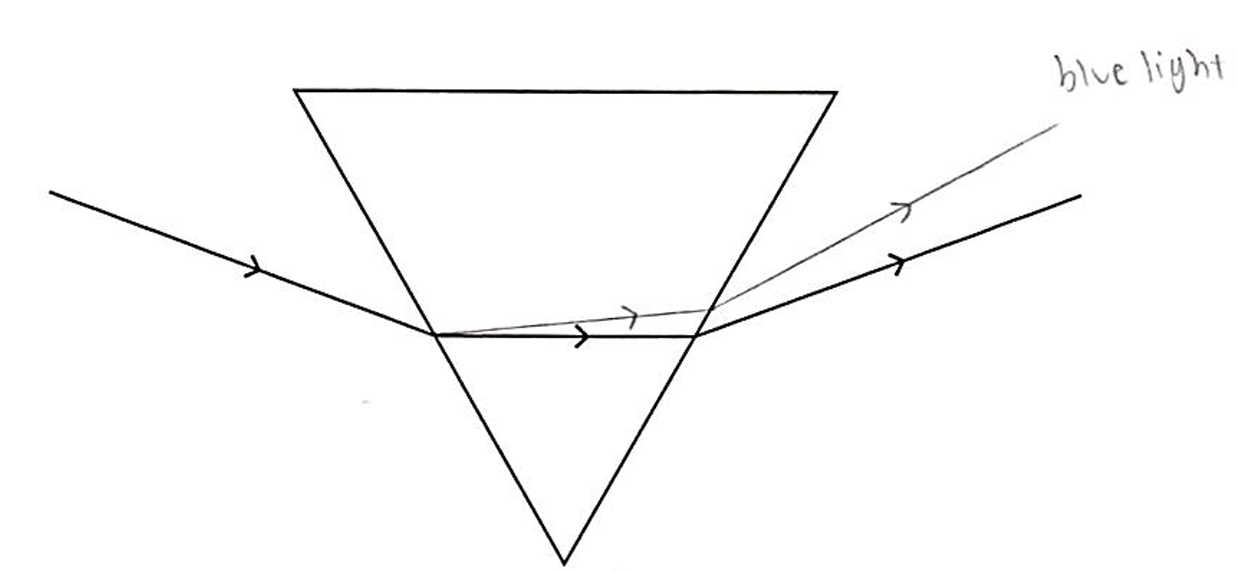
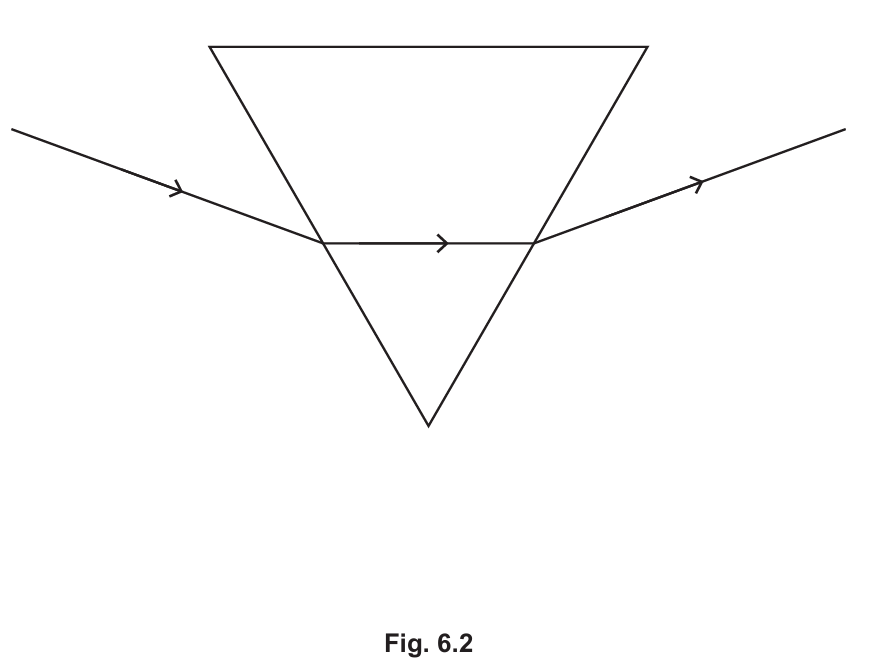
Blue light has a shorter wavelength and therefore a higher frequency than green light. This means it travels more slowly through glass and experiences a greater change in speed, leading to more refraction. When entering the prism, the blue ray bends more towards the normal. When exiting, it bends more away from the normal. Its overall path through and out of the prism will be deviated more than the green ray.
Question 7
Most-appropriate topic codes (Cambridge IGCSE Physics 0625):
• Topic 4.1 — Simple phenomena of magnetism (Parts (a), (b), (c)(i), (c)(ii))
▶️ Answer/Explanation
(a)
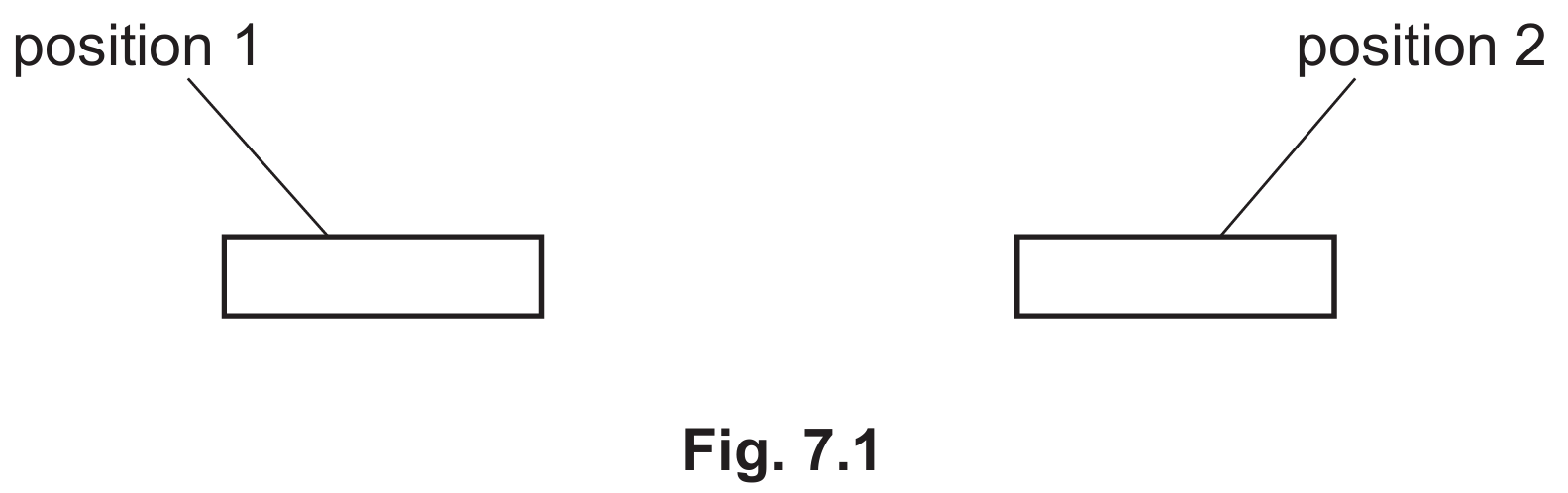
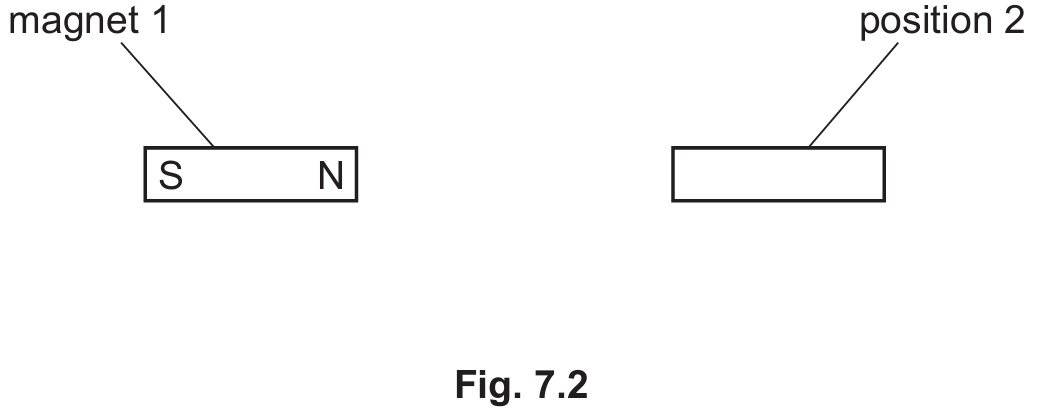
For the correct answer:
At least one complete loop above and below the magnet, with arrows from N to S.
Magnetic field lines are an imaginary way to visualize the magnetic field. They always form closed loops, exiting the north pole and entering the south pole. Around a simple bar magnet, you’d draw loops that curve from the ‘N’ end around to the ‘S’ end, with arrows pointing away from the N pole and towards the S pole to show the direction of force on a north pole.
(b)
For the correct answer:
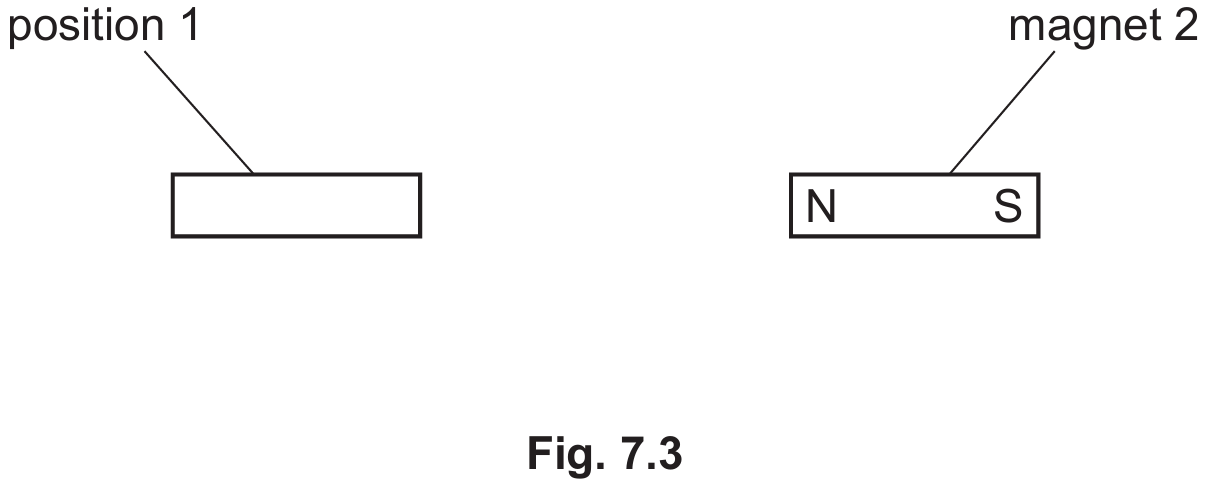
A line with an arrow pointing to the left.
Magnet 2’s field lines will point away from its North pole and towards its South pole. Position 1 is located to the left of magnet 2’s North pole, meaning the field lines at that point are pointing directly away from the North pole, which is to the left.
(c)(i)
For the correct answer:
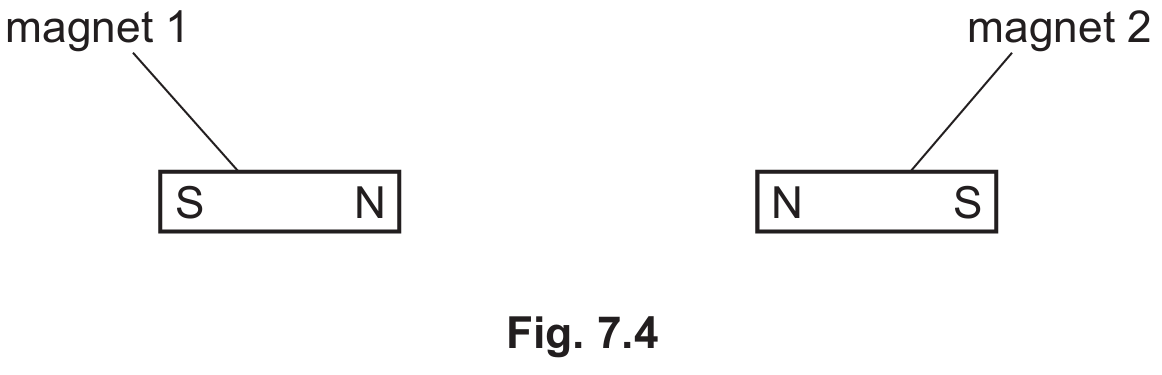
To the left, away from magnet 2 (or towards magnet 1).
Like poles repel. Since the North pole of magnet 2 is near the North pole of magnet 1, the force between them is one of repulsion. This force pushes magnet 1 directly away from magnet 2.
(c)(ii)
For the correct answer:
The force on a North pole is in the direction of the magnetic field.
The fundamental definition of a magnetic field is that it exerts a force on a magnetic pole. The direction of this force on a North pole is, by convention, the direction of the magnetic field itself. At position 1, the field from magnet 2 points to the left, so that’s the direction of the repulsive force on magnet 1’s North pole.
Question 8
Most-appropriate topic codes (Cambridge IGCSE Physics 0625):
• Topic 4.3.1 — Circuit diagrams and circuit components (Part (a))
• Topic 4.2.2 — Electric current (Part (b)(i))
• Topic 4.2.5 — Electrical energy and electrical power (Part (b)(ii))
▶️ Answer/Explanation
(a)
For the correct answer:
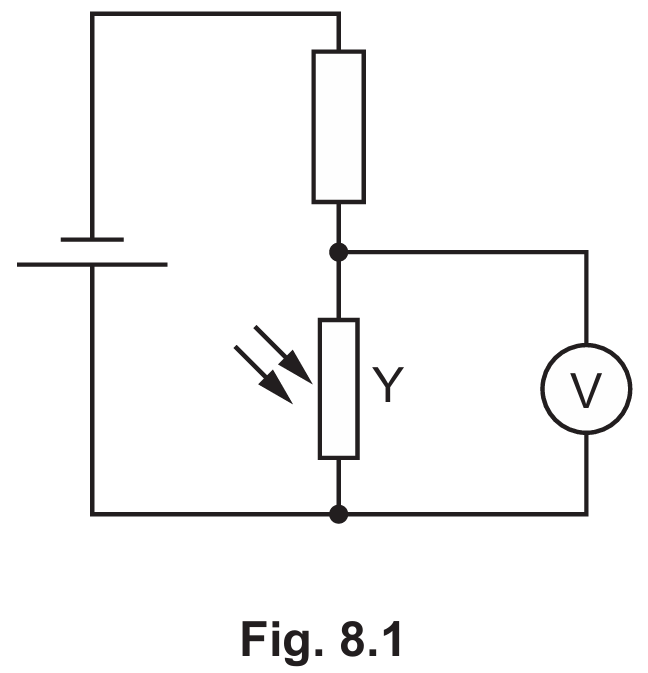
Resistance of Y decreases. Voltmeter reading decreases because the share of the total p.d. across Y decreases as its resistance decreases.
Component Y is a Light-Dependent Resistor (LDR). Its resistance is high in the dark and falls as light intensity increases. The circuit is a simple potential divider. When the resistance of Y drops, it takes a smaller proportion of the total voltage from the battery, so the voltmeter reading across it falls. The fixed resistor’s voltage share would increase to make up the difference.
(b)(i)
For the correct answer:
n = 1.9 × 10¹⁹
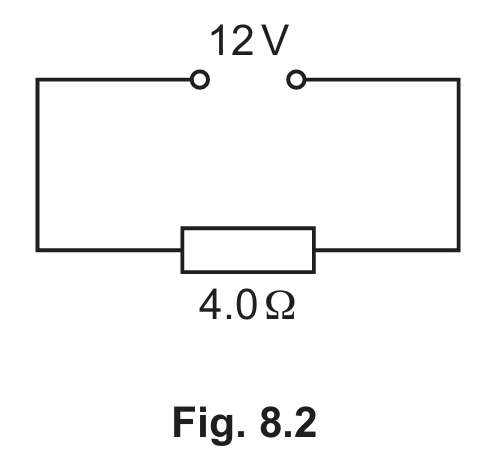
We know current is the rate of flow of charge, \(I = \frac{Q}{t}\). In 1 second, the total charge flowing is 3.0 C. The charge on a single electron is a tiny \(1.6 \times 10^{-19} \, \text{C}\). The number of electrons is simply the total charge divided by the charge per electron: \( n = \frac{3.0}{1.6 \times 10^{-19}} = 1.875 \times 10^{19} \), which rounds to \(1.9 \times 10^{19}\).
(b)(ii)
For the correct answer:
P = 36 W
Power dissipated by a resistor is the rate at which it converts electrical energy to heat. We can use the formula \(P = IV\). The current is given as 3.0 A, and the potential difference across the 4.0 Ω resistor can be found from Ohm’s law, \(V = IR = 3.0 \times 4.0 = 12 \, \text{V}\). The power dissipated is therefore \(3.0 \times 12 = 36 \, \text{W}\).
Question 9
▶️ Answer/Explanation
(a)(i)
For the correct answer: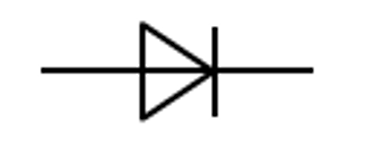
The standard circuit symbol for a diode is a triangle (representing the direction of conventional current flow) butting up against a single vertical line (the barrier). It shows that current can only pass through the component in one direction.
(a)(ii)
For the correct answer:
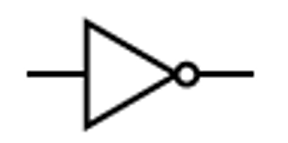
A NOT gate, or an inverter, is represented by a triangle shape pointing towards the output, with a small circle (a bubble) right at the output end. The bubble signifies the logical inversion, meaning the output is the opposite of the input.
(b)(i)
For the correct answer: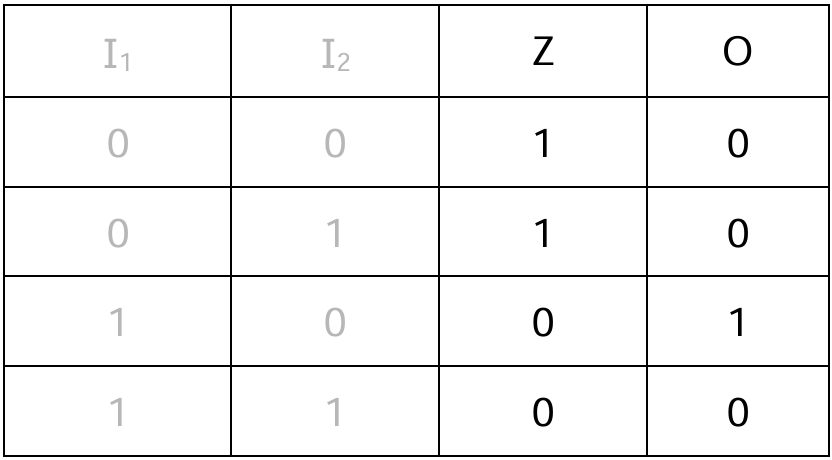
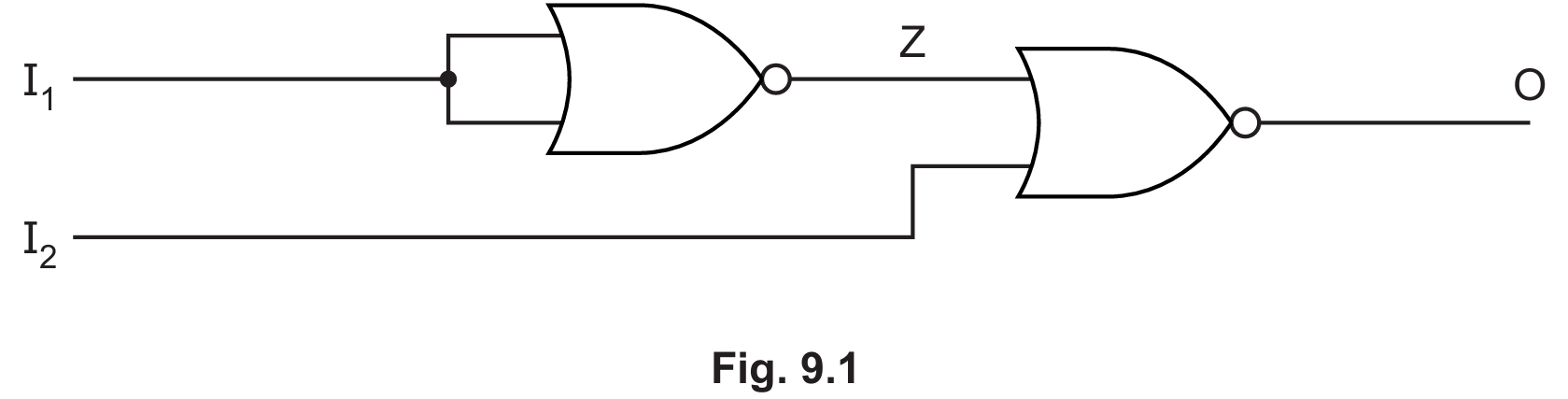
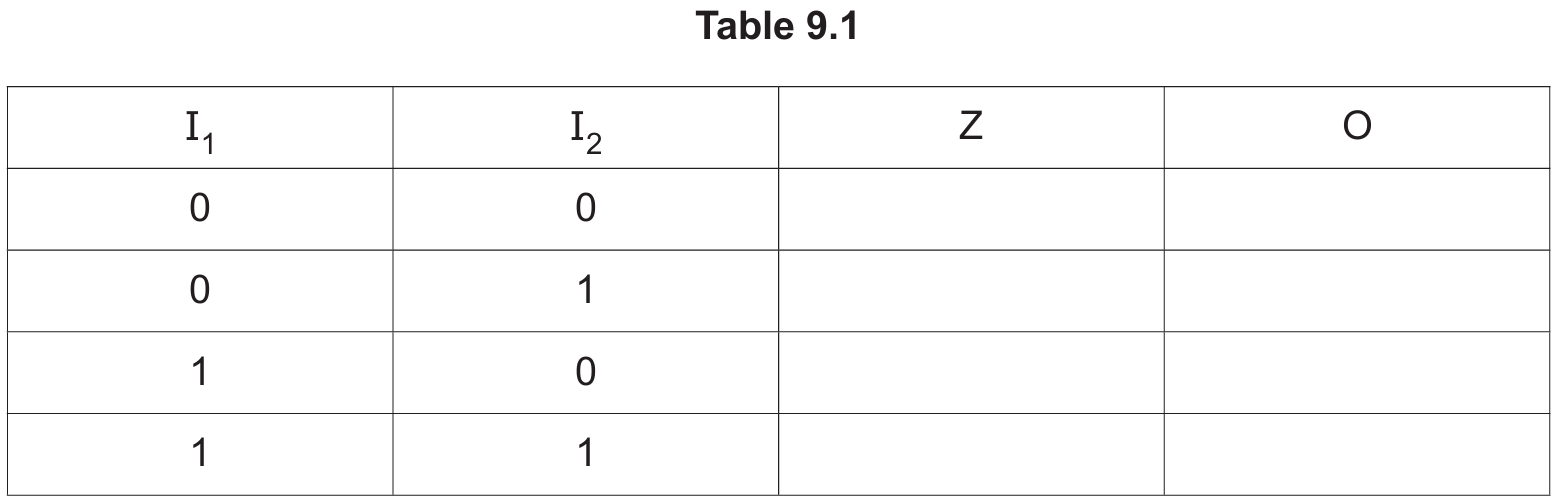
The circuit is a NAND gate (I₁ and I₂) followed by a NOT gate to get output O. The middle output Z is just the NAND output: it’s 0 only when both inputs are 1. The final output O is the inverse of Z, so it’s 1 only when Z is 0. This makes the final truth table an AND function, except when I₁=1 and I₂=1, O=0.
(b)(ii)
For the correct answer:
NOT
The part of the circuit between I₁ and Z is a single NAND gate. However, looking at the truth table, the connection from I₁ to Z involves two NOT gates in series, which double-invert the signal, effectively just producing an output equal to the original input. So, the equivalent gate is a NOT gate.
(c)
For the correct answer:
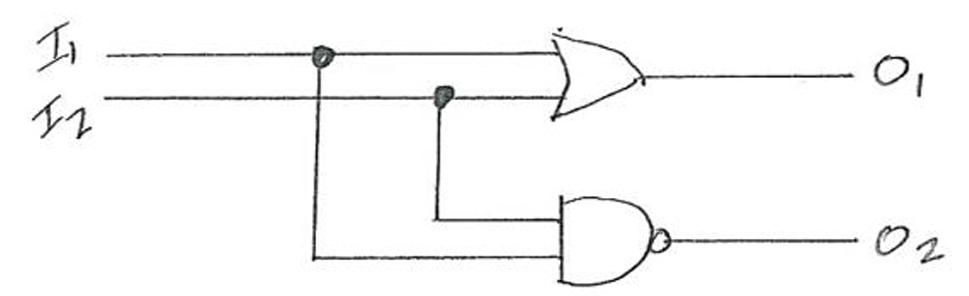
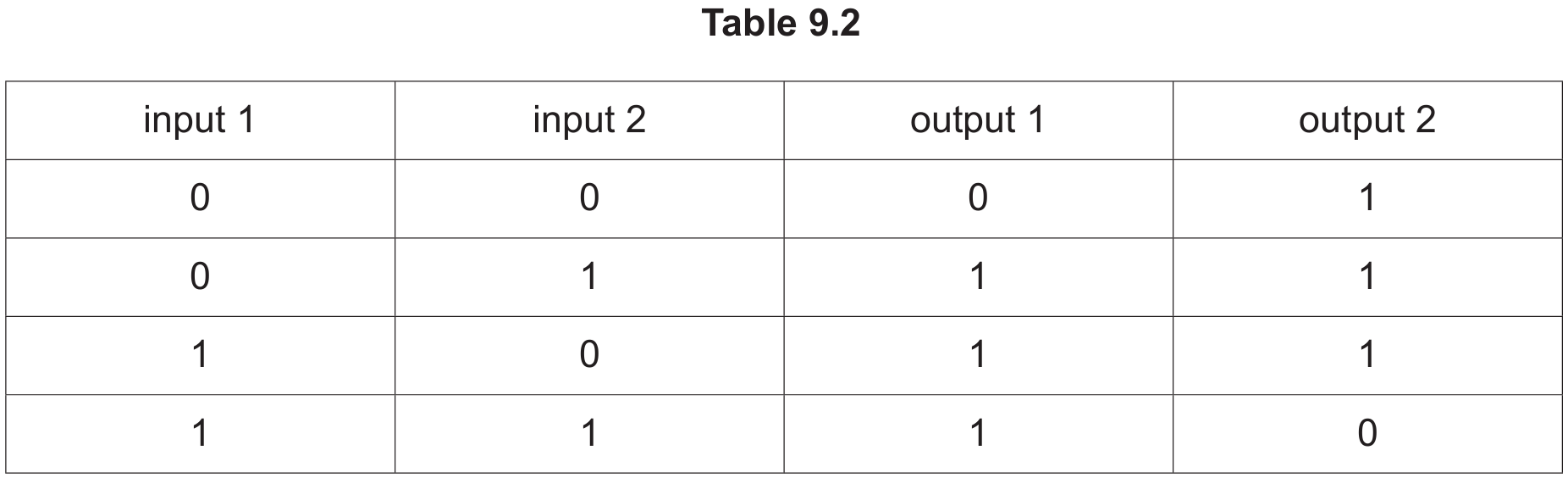
We need to design a circuit that matches the given truth table. By inspecting the columns for output 1 and output 2, we can see that output 1 is a logical OR function of the two inputs. Output 2 is a logical NAND function. The circuit can therefore be built with two gates: an OR gate and a NAND gate, both connected to the same two inputs (input 1 and input 2).
Question 10
Most-appropriate topic codes (Cambridge IGCSE Physics 0625):
• Topic 5.1.2 — The nucleus (Part (a)(i))
• Topic 5.2.2 — The three types of nuclear emission (Part (a)(ii))
• Topic 5.2.3 — Radioactive decay (Part (b))
• Topic 5.2.4 — Half-life (Part (c))
▶️ Answer/Explanation
(a)(i)
For the correct answer:
proton number: 2
nucleon number: 4
An alpha particle is identical to a helium nucleus. It consists of 2 protons (which determines its proton, or atomic, number as 2) and 2 neutrons. Adding protons and neutrons gives us a total of 4 nucleons, which is the nucleon (or mass) number.
(a)(ii)
For the correct answer:
charge = 3.2 × 10⁻¹⁹ C
A beta particle has a charge of magnitude \(1.6 \times 10^{-19} \text{C}\), which is the charge of one electron or proton. Since an alpha particle contains 2 protons and no electrons, its total positive charge is simply twice the elementary charge: \(2 \times 1.6 \times 10^{-19} = 3.2 \times 10^{-19} \, \text{C}\).
(b)
For the correct answer:
²³⁰₈₈Ra → ²³⁰₈₉Ac + ⁰₋₁β
In beta-minus decay, a neutron inside the radium nucleus turns into a proton and emits a beta particle (an electron). The nucleon number (top number) stays the same at 230, as a neutron is simply replaced by a proton. The proton number (bottom number), however, increases by 1 from 88 to 89, changing the element from radium (Ra) to actinium (Ac). The emitted beta particle is written as ⁰₋₁β.
(c)
For the correct answer:
mass = 1.2 × 10⁻¹² g
The total time elapsed is 279 minutes, and the half-life is 93 minutes. The number of half-lives that have passed is \(\frac{279}{93} = 3\). After each half-life, the mass of the substance halves. So, we divide the initial mass by two, three times: \(9.6 \times 10^{-12} \div 2^3 = 9.6 \times 10^{-12} \div 8 = 1.2 \times 10^{-12} \, \text{g}\).