
Question 1
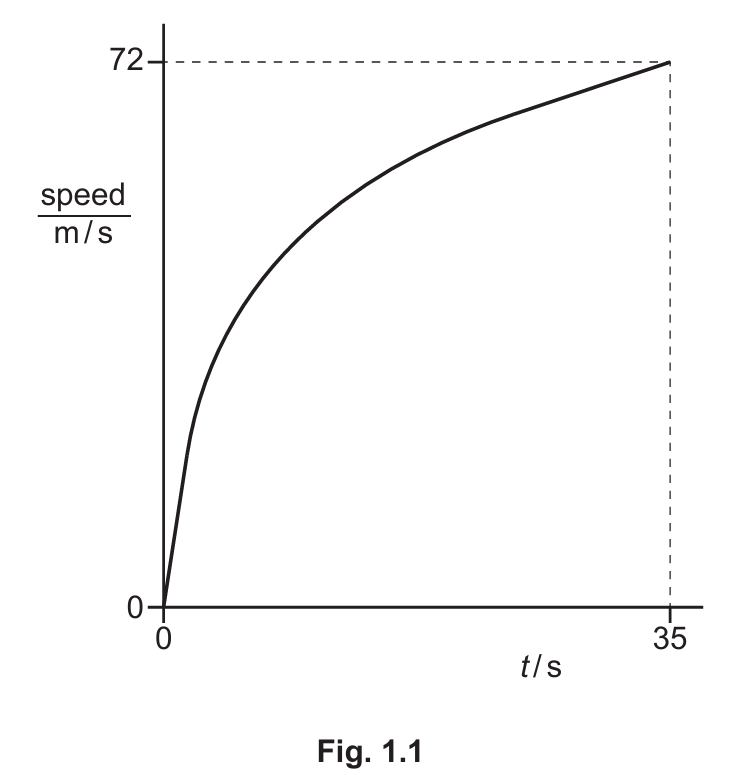
Calculate the average resultant force on the aeroplane between \(t = 0\) and \(t = 35 \mathrm{~s}\).
Give one possible explanation for the change in acceleration of the aeroplane between \(t = 0\) and \(t = 35 \mathrm{~s}\).
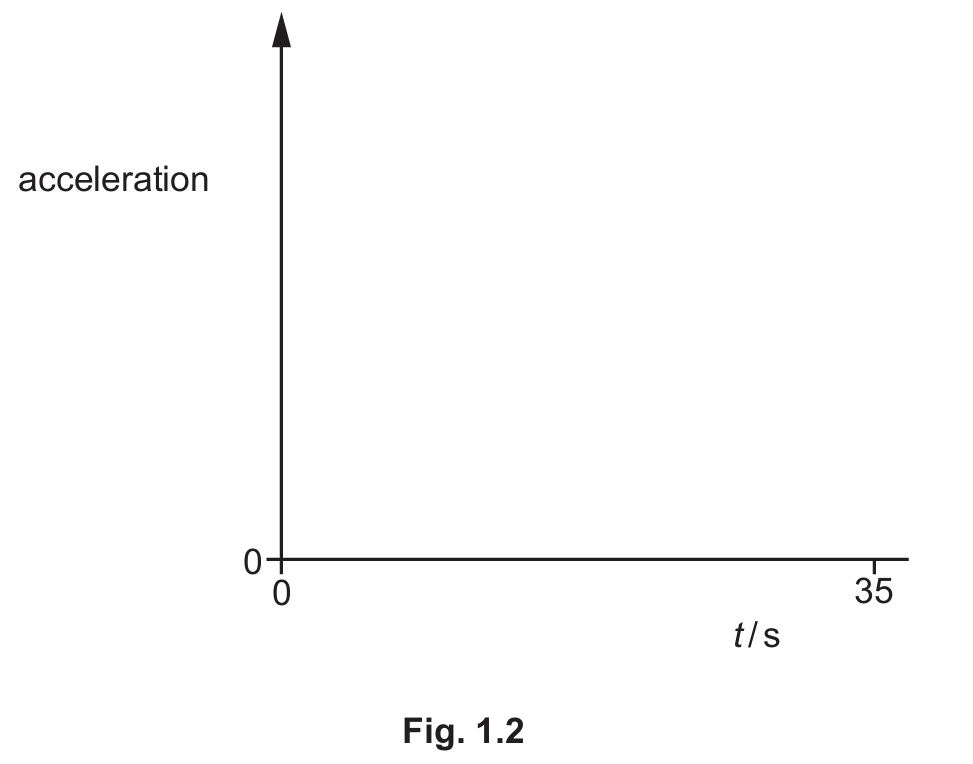
(b) (iv) On Fig. 1.2, sketch a graph to show how the acceleration of the aircraft varies between \(t = 0\) and \(t = 35 \mathrm{~s}\).
Most-appropriate topic codes (Cambridge IGCSE Physics 0625):
• Topic 1.2 — Motion (Parts (a), (b)(i), (b)(iv))
• Topic 1.5.1 — Effects of forces (Parts (b)(ii), (b)(iii))
▶️ Answer/Explanation
(a)
For the correct answer:
change of velocity per unit time or \(\frac{v-u}{t}\)
Acceleration describes how quickly the velocity of an object is changing. It’s not just about speeding up; it’s the rate at which the velocity changes over a specific time interval. Mathematically, you take the difference between the final and initial velocity and divide it by the time taken for that change.
(b)(i)
For the correct answer:
\(2.1 \mathrm{~m} / \mathrm{s}^{2}\)
The initial speed is \(0 \mathrm{~m/s}\) and the final speed is \(72 \mathrm{~m/s}\) over \(35 \mathrm{~s}\). The average acceleration is calculated as \(a = \frac{\Delta v}{\Delta t} = \frac{72 – 0}{35}\). Performing this division gives an average acceleration of approximately \(2.057…\), which rounds to \(2.1 \mathrm{~m/s^2}\).
(b)(ii)
For the correct answer:
\(230000 \mathrm{~N}\) OR \(230 \mathrm{kN}\)
Newton’s second law states that the resultant force is the product of mass and acceleration (\(F = ma\)). Using the mass of \(1.1 \times 10^{5} \mathrm{~kg}\) and the acceleration from part (i) of \(2.1 \mathrm{~m/s^2}\), the calculation is \(1.1 \times 10^{5} \times 2.1 = 231000 \mathrm{~N}\), which is correctly given as \(230000 \mathrm{~N}\) or \(230 \mathrm{kN}\).
(b)(iii)
For the correct answer (any one):
• (increase / change in) air resistance
• (increase / change in) wind
As the aeroplane accelerates, its speed increases, which means it collides with air molecules more frequently and with greater force. This causes a significant increase in air resistance (drag), which opposes the engine’s thrust and reduces the net resultant force, thus decreasing the acceleration.
(b)(iv)
For the correct answer (any three):
• initial acceleration highest value AND horizontal line
• curved or straight line downwards
• curved or straight line downwards AND line not reaching zero by 35 s
• horizontal line before and up to 35 s.
The acceleration graph starts at its highest value because the opposing air resistance is initially low. As the plane speeds up, air resistance increases, reducing the resultant force and thus the acceleration decreases over time, shown by a line sloping downwards. The acceleration doesn’t reach zero as the plane is still speeding up at take-off, and the graph should extend until exactly \(35 \mathrm{~s}\).
Question 2

Most-appropriate topic codes (Cambridge IGCSE Physics 0625):
• Topic 1.6 — Momentum (Parts (a)(i), (a)(ii), (a)(iii))
• Topic 1.7.1 — Energy (Part (b))
▶️ Answer/Explanation
(a)(i)
For the correct answer:
\(4.5 \mathrm{~kg} \mathrm{~m} / \mathrm{s}\)
Momentum is mass times velocity (\(p=mv\)). We must choose one direction as positive. If the initial direction is positive, the final velocity is negative. The change in momentum is \((0.058 \times 52) – (0.058 \times -26) = 3.016 + 1.508 = 4.524\), which rounds to \(4.5 \mathrm{~kg~m/s}\).
(a)(ii)
For the correct answer:
(impulse =) force × time OR (impulse =) \(Ft\)
Impulse is defined as the effect of a force acting over a period of time. It is simply the product of the average force and the duration for which it acts.
(a)(iii)
For the correct answer:
\(0.013 \mathrm{~s}\)
The impulse-momentum theorem states that impulse equals change in momentum (\(Ft = \Delta p\)). Using the force of \(350 \mathrm{~N}\) and the change in momentum from part (i) of \(4.5 \mathrm{~kg~m/s}\), the time is \(t = \frac{4.5}{350} = 0.01285… \mathrm{~s}\), which rounds to \(0.013 \mathrm{~s}\).
(b)
For the correct answer:
\(59 \mathrm{~J}\)
Kinetic energy is calculated using \(\frac{1}{2}mv^2\). The initial KE is \(\frac{1}{2} \times 0.058 \times 52^2 = 78.416 \mathrm{~J}\). The final KE is \(\frac{1}{2} \times 0.058 \times 26^2 = 19.604 \mathrm{~J}\). The difference, representing energy lost (mostly to heat and sound), is \(78.416 – 19.604 = 58.812 \mathrm{~J}\), which rounds to \(59 \mathrm{~J}\).
Question 3
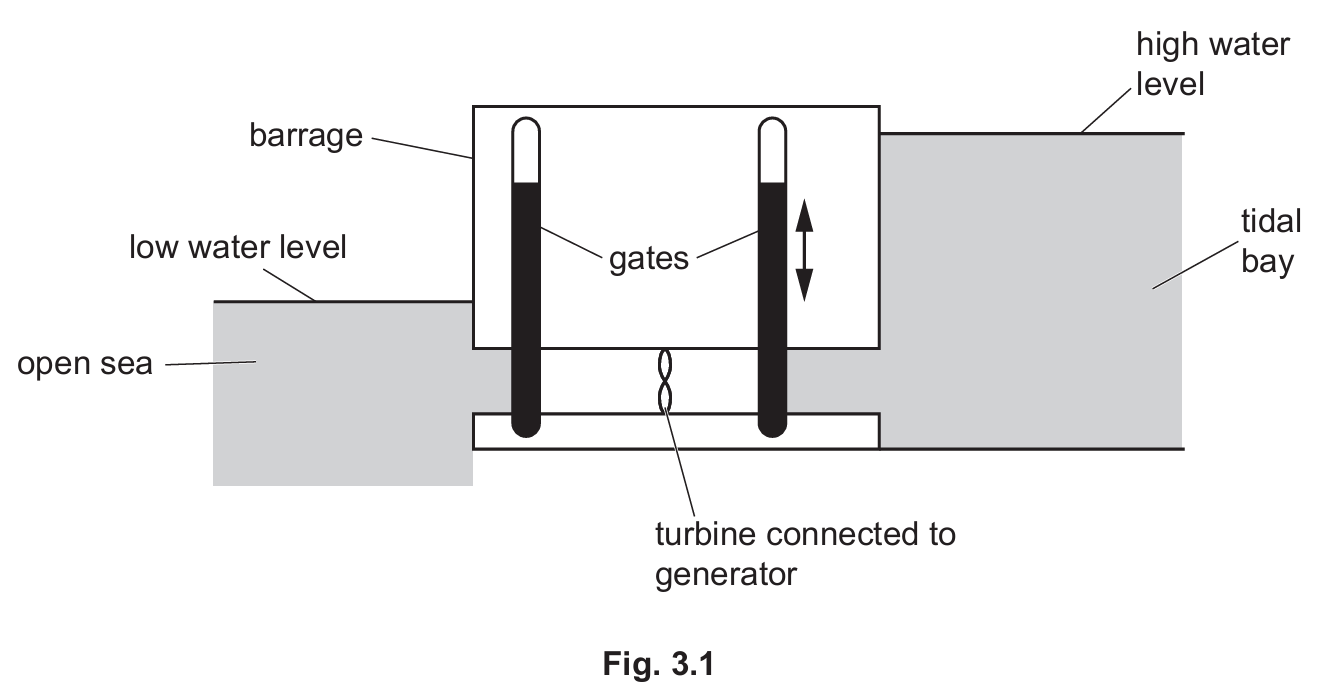
Use words from the list.
Most-appropriate topic codes (Cambridge IGCSE Physics 0625):
• Topic 1.7.3 — Energy resources (Parts (a), (b), (c))
▶️ Answer/Explanation
(a)
For the correct answer:
gravitational potential water (tidal) bay kinetic turbines
At high tide, the water trapped in the tidal bay is held at a height, storing gravitational potential energy. When the gates open, this water flows down towards the lower sea level, and the stored potential energy converts to kinetic energy of the moving water. This kinetic energy then turns the blades of the turbines.
(b)
For the correct answer (any one advantage from):
• renewable
• reliable or predictable
• running cost low
• does not produce (harmful) pollution.
For the correct answer (any one disadvantage from):
• (high) cost of construction
• possible effects on (marine) life
• not available all day
• power produced doesn’t always match with peak demand
• limited number of sites
• maintenance difficult/increased corrosion (because underwater).
A key advantage is that tides are driven by the moon’s gravity, making them a renewable and highly predictable energy source. A significant disadvantage is that building large barrages is very expensive and can disrupt marine habitats and fish migration patterns in the estuary.
(c)
For the correct answer:
Moon
The primary source of tidal energy is the gravitational pull of the Moon on the Earth’s oceans. The Sun also plays a role, but the Moon’s influence is dominant and responsible for the cyclical rise and fall of the tides.
Question 4
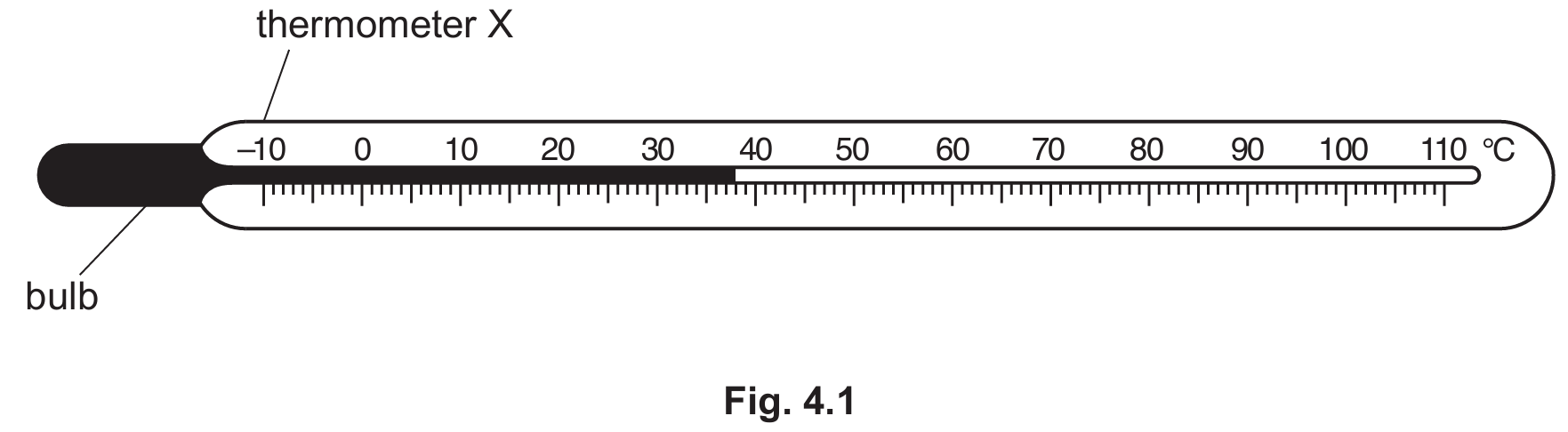
State and explain how the sensitivity of thermometer Y compares with the sensitivity of thermometer X.
Most-appropriate topic codes (Cambridge IGCSE Physics 0625):
• Topic 2.2.1 — Thermal expansion of solids, liquids and gases (Parts (a)(i), (a)(ii), (a)(iii))
• Topic 4.2.3 — Electromotive force and potential difference (Part (b))
▶️ Answer/Explanation
(a)(i)
For the correct answer (any one):
• volume (of liquid)
• length (of thread / liquid in tube).
A liquid-in-glass thermometer works because the liquid inside expands when heated. This expansion causes its volume to increase, which we observe as a change in the length of the liquid thread inside the narrow tube.
(a)(ii)
For the correct answer:
more OR greater (sensitivity)
volume of liquid/length of thread increases more per °C / unit temperature (because greater volume of liquid present) OR (more liquid to expand so) gives a larger change in the level of the liquid per °C / unit temperature
If thermometer Y has twice the volume of liquid, there is more liquid to expand for the same temperature rise. This larger volume expansion will push the liquid thread further up the tube for each degree, making it easier to see small temperature changes, hence it is more sensitive.
(a)(iii)
For the correct answer, e.g.:
longer (capillary) tube
liquid can expand further so to a higher temperature
To measure higher temperatures (increase the range), the liquid needs room to expand without breaking the thermometer. A longer capillary tube provides a greater total volume for the liquid to expand into, allowing the thermometer to reach higher temperatures on its scale before the liquid reaches the end.
(b)
For the correct answer:
e.m.f.
At very high temperatures like \(1300^{\circ} \mathrm{C}\), a thermocouple thermometer is often used. It relies on the principle that a junction of two different metals produces a temperature-dependent electromotive force (e.m.f.), which can be measured and calibrated to indicate temperature.
Question 5
Dish A is outside in sunlight and experiences no wind during the day.
Dish B is outside in sunlight and experiences a strong wind during the day.
Dish C is in a dark room.
Water evaporates from each dish. After 12 hours, a student measures the volume of water in each dish. Dish C contains the largest volume of water and dish B contains the smallest volume of water.
Explain, in terms of particles, why the three dishes have different volumes of water.
(c) Fig. 5.1 shows an insulating beaker, crushed ice, an immersion heater and a thermometer.
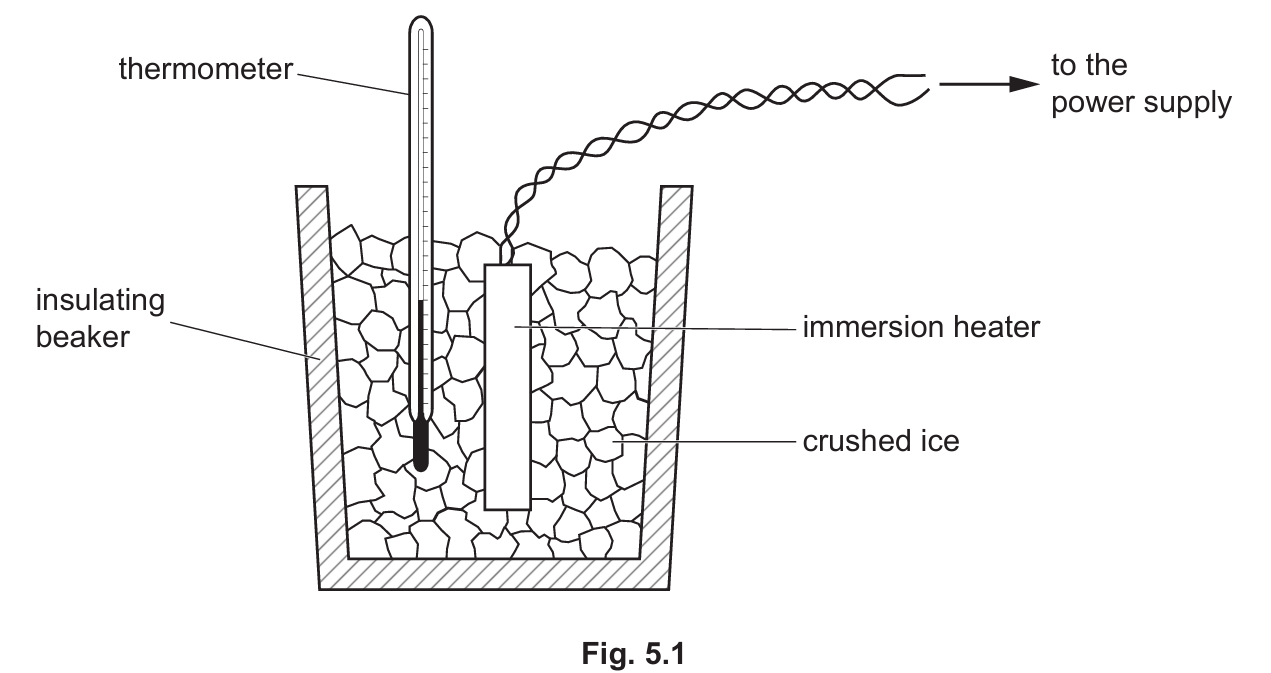
The initial temperature of the ice is \(-60^{\circ} \mathrm{C}\).
The immersion heater is switched on and the temperature is recorded at equal intervals of time.
Fig. 5.2 shows the temperature-time graph.
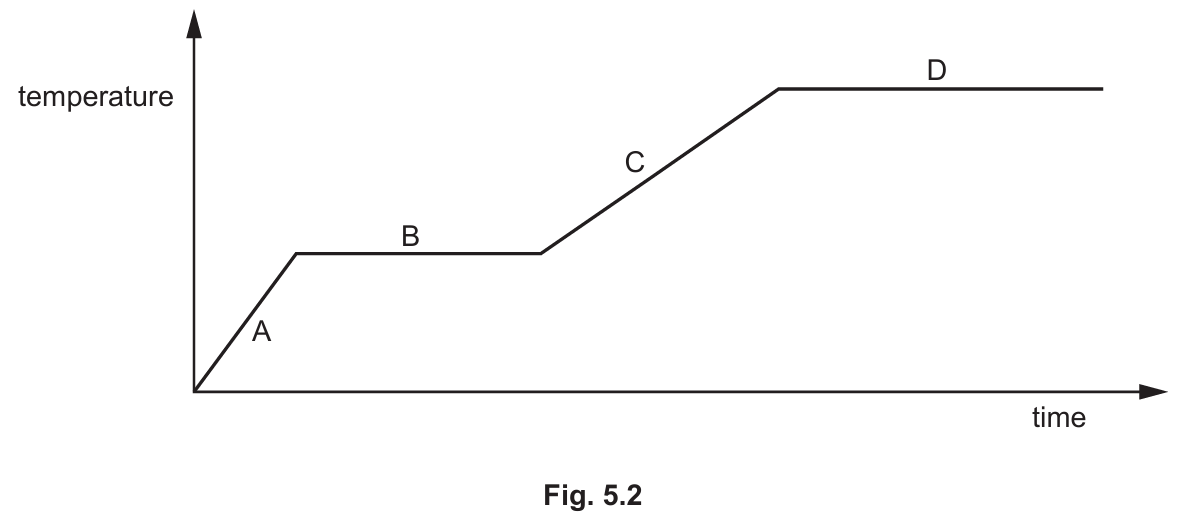
Describe what occurs in each of the sections A, B, C and D.
Most-appropriate topic codes (Cambridge IGCSE Physics 0625):
• Topic 2.2.3 — Melting, boiling and evaporation (Part (a))
• Topic 2.2.2 — Specific heat capacity (Part (b))
• Topic 2.2.3 — Melting, boiling and evaporation (Part (c))
▶️ Answer/Explanation
(a)
For the correct answer:
energy from the Sun transfers to / is absorbed by (water) molecules, (so KE of (water) molecules increases)
molecules with high(er) energy / KE / fast(er) moving molecules escape (from the surface)
wind removes molecules when they have left the surface (so they do not re-enter the liquid)
any one from:
• wind increases the rate of evaporation
• (absorption of) energy from the Sun increases the rate of evaporation
• least/less water evaporates / lower rate of evaporation from dish C
• most/more water evaporates / higher rate of evaporation from dish B
Evaporation happens when the most energetic particles overcome attractive forces and escape the liquid’s surface. Sunlight gives particles energy, speeding this up. Wind blows escaped particles away, preventing them from returning, which further increases the evaporation rate. Dish C, in the dark, has the least energy input, so its evaporation rate is the lowest.
(b)
For the correct answer:
energy to change 1 kg / unit mass from liquid to gas / gas to liquid (without changing its temperature)
This is the amount of thermal energy required to change the state of a substance from a liquid to a vapor at its boiling point, per unit mass. The temperature stays constant during this process because all the energy is used to break the intermolecular bonds rather than increase kinetic energy.
(c)
For the correct answer:
A: temperature (of solid / ice) increases
B: solid / ice changes to liquid / water OR solid / ice melts (at constant temperature)
C: temperature (of liquid / water) increases
D: liquid / water changes to gas / steam OR liquid / water boils (at constant temperature)
In section A, the ice is warming up. At B, the temperature plateaus as the ice absorbs energy to melt into water. Once all melted, the water’s temperature rises again in section C. Finally, D shows another plateau where the water boils and turns into steam at a constant temperature.
Question 6
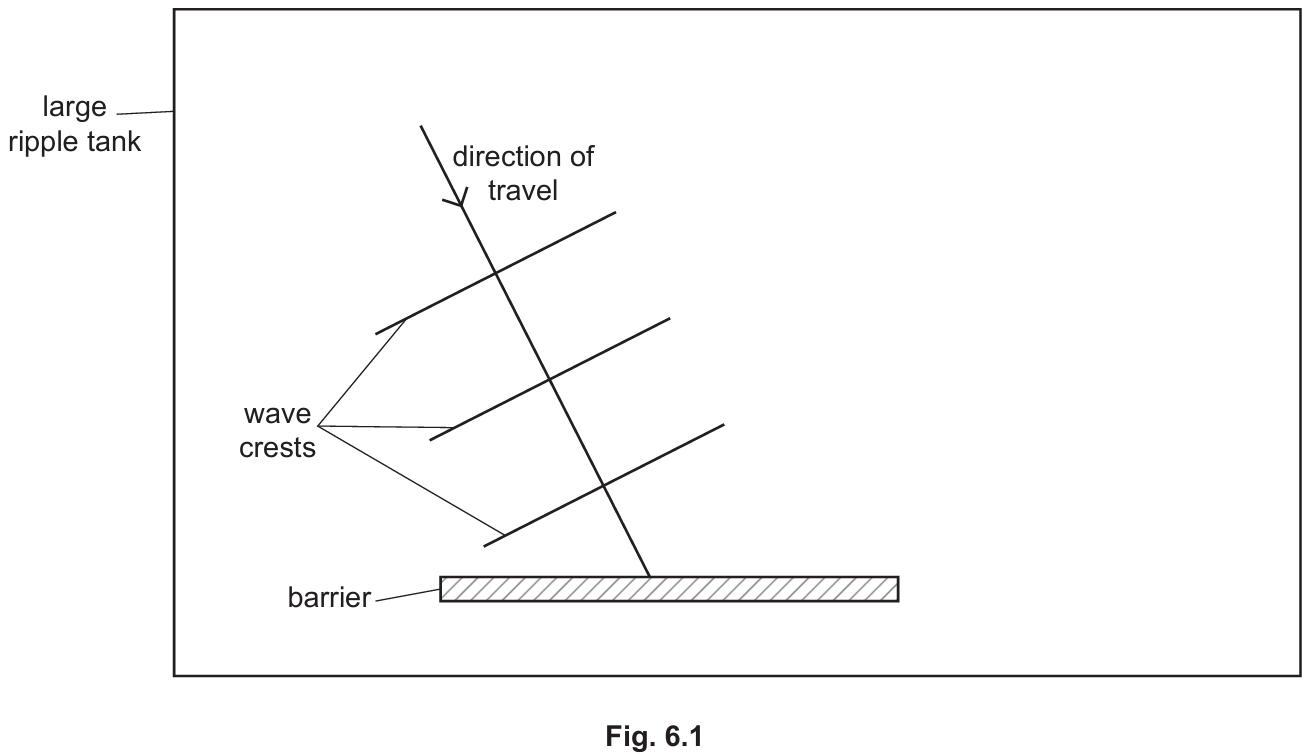
(i) the direction of travel of the reflected wave
(ii) three successive reflected wave crests.
(b) Fig. 6.2 shows an identical wave approaching a barrier with a gap of \(1.3 \mathrm{~cm}\).

On Fig. 6.2, draw three successive wave crests after they pass through the gap in the barrier.
Calculate the speed of the wave.
Most-appropriate topic codes (Cambridge IGCSE Physics 0625):
• Topic 3.1 — General properties of waves (Parts (a), (b), (c))
▶️ Answer/Explanation
(a)(i)
For the correct answer:
correct direction, with angle made with surface correct
The law of reflection states the angle of incidence equals the angle of reflection. The reflected wave’s direction arrow should be drawn on the opposite side of the normal to the incident wave, making the same angle with the barrier.
(a)(ii)
For the correct answer:
three wavefronts perpendicular to their answer to (a)(i)
wavelength 1.6 cm / same as incident wave
The reflected wave crests are drawn as lines parallel to the barrier, spaced exactly \(1.6 \mathrm{~cm}\) apart, which is the same wavelength as the incident waves. The three lines should be perpendicular to the direction arrow drawn in part (a)(i).
(b)
For the correct answer:
at least two correct arcs (after the gap in the barrier)
three circular arcs (after the gap on the barrier) centred on gap
wavelength same as wavelength of incident wavefronts
Since the gap (\(1.3 \mathrm{~cm}\)) is smaller than the wavelength (\(1.6 \mathrm{~cm}\)), significant diffraction occurs. The wavefronts passing through the gap will spread out as nearly perfect semicircles centred on the gap, while maintaining their original wavelength of \(1.6 \mathrm{~cm}\).
(c)
For the correct answer:
\(6.4 \mathrm{~cm} / \mathrm{s}\) OR \(0.064 \mathrm{~m} / \mathrm{s}\)
The wave speed is found using the equation \(v = f\lambda\). Substituting the given frequency of \(4.0 \mathrm{~Hz}\) and the wavelength of \(1.6 \mathrm{~cm}\) (which is \(0.016 \mathrm{~m}\)), the calculation is \(v = 4.0 \times 1.6 = 6.4 \mathrm{~cm/s}\), or equivalently \(0.064 \mathrm{~m/s}\).
Question 7
(b) Fig. 7.1 shows a ray of light from a light source in a tank containing a liquid.
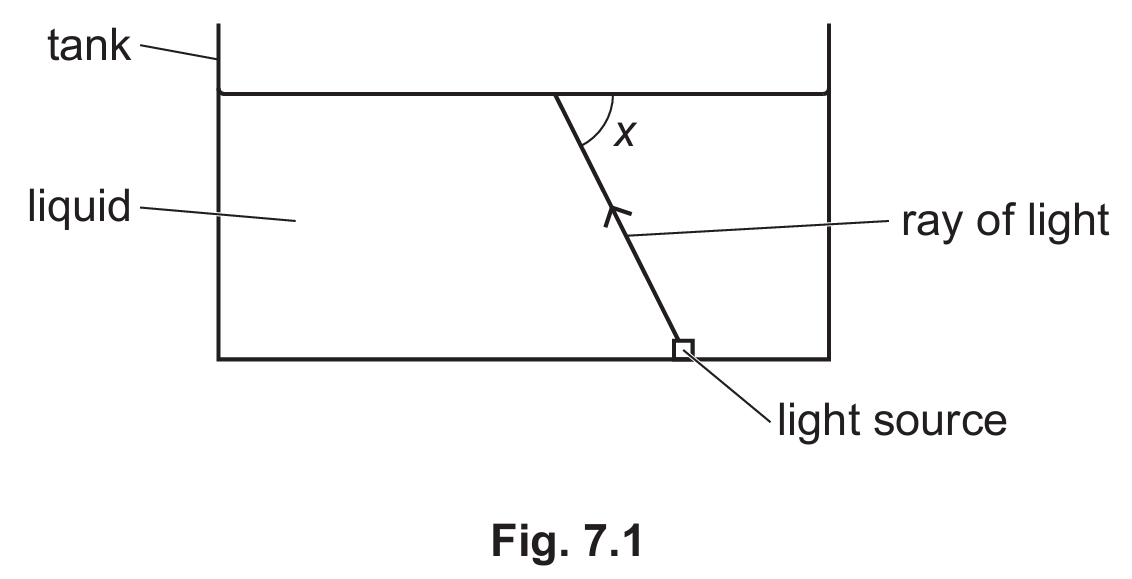
The ray of light strikes the surface of the liquid at an angle \(x\).
Calculate the largest value of \(x\) for which total internal reflection can occur.
Calculate the speed of light in the liquid.
Most-appropriate topic codes (Cambridge IGCSE Physics 0625):
• Topic 3.2.2 — Refraction of light (Parts (a), (b)(i), (b)(ii))
▶️ Answer/Explanation
(a)
For the correct answer (any two):
• all light is reflected
• no light is refracted
• (occurs) when light travels in a more dense medium towards a (boundary with a) less dense medium
Total internal reflection happens inside a denser medium like water or glass. When light hits the boundary with a less dense medium like air at a sufficiently large angle, the boundary acts like a perfect mirror, reflecting all the energy back inside.
(b)(i)
For the correct answer:
\(x = 48^{\circ}\)
The largest angle \(x\) for refraction to occur is the critical angle \(c\). Using Snell’s law, \(\sin c = \frac{1}{n} = \frac{1}{1.5}\). Therefore, \(c = \sin^{-1}(0.666…)\). This calculation gives a critical angle of approximately \(41.8^{\circ}\). The angle \(x\) is measured from the surface, not the normal, so \(x = 90^{\circ} – 41.8^{\circ} = 48.2^{\circ}\), rounded to \(48^{\circ}\).
(b)(ii)
For the correct answer:
\(2.0 \times 10^{8} \mathrm{~m} / \mathrm{s}\)
Refractive index \(n\) is the ratio of the speed of light in a vacuum (or air) to its speed in the medium: \(n = \frac{c}{v}\). Rearranging for the speed in the liquid gives \(v = \frac{3.0 \times 10^{8}}{1.5}\). This yields a speed of \(2.0 \times 10^{8} \mathrm{~m/s}\), which is slower than in air, as expected.
Question 8
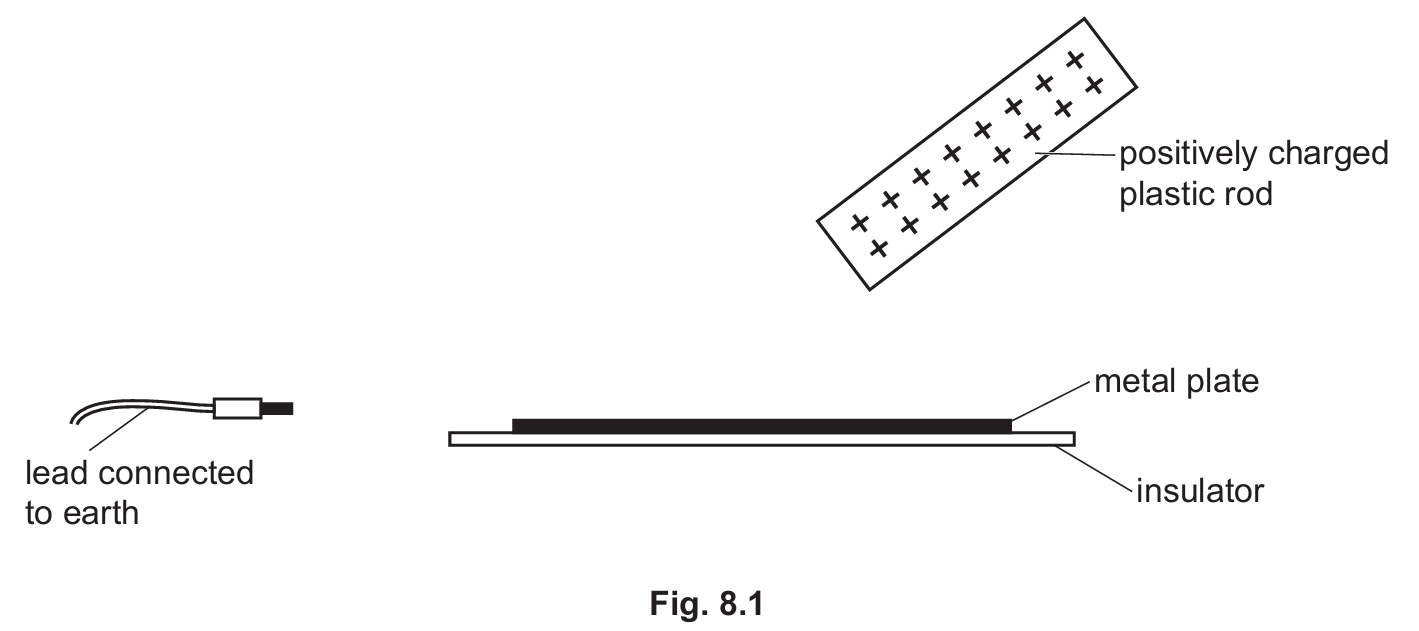
(b) Fig. 8.2 shows an electric circuit.
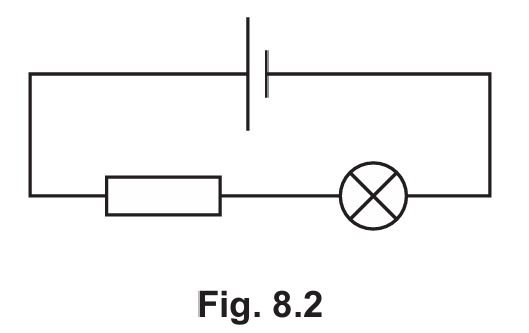
On Fig. 8.2, draw an arrow to show the direction of flow of electrons and explain how you determined the direction.
Most-appropriate topic codes (Cambridge IGCSE Physics 0625):
• Topic 4.2.1 — Electric charge (Part (a))
• Topic 4.2.2 — Electric current (Part (b))
▶️ Answer/Explanation
(a)
For the correct answer:
positively charged / plastic rod is brought close to metal plate
negative charges / electrons (from metal plate) move to top of metal plate / close(r) to rod
earth lead connected to (metal) plate AND negative charges / electrons move on to plate
(at the end of the process) earth lead removed (before charged rod removed) OR (at the end of the process) metal plate has (net) negative charge
A positively charged rod is brought near the plate, attracting the plate’s free electrons to the top. While the rod is still near, the bottom of the plate is momentarily earthed, allowing extra electrons to flow from the ground onto the plate to neutralize the positive charge at the bottom. Removing the earth connection traps this surplus of electrons, leaving the whole plate with a net negative charge.
(b)
For the correct answer:
correct direction – pointing away from negative terminal / clockwise arrow
AND current flow in opposite direction to flow of electrons
Electrons are negatively charged, so they are repelled from the negative terminal of the battery and attracted to the positive terminal. In this circuit, that means the electrons flow from the negative terminal around the circuit in a clockwise direction. Conventional current, however, is defined as the flow of positive charge, which goes from positive to negative.
Question 9
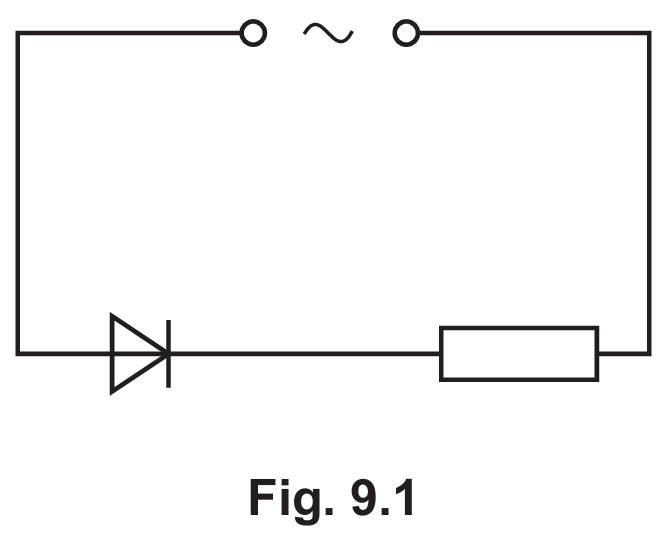
(b) The peak potential difference (p.d.) across the resistor is \(340 \mathrm{~V}\).

On Fig. 9.2:
(i) sketch a graph to show how the p.d. across the resistor varies with time for two cycles
(ii) label the p.d. axis with the value of p.d. at the peak
(iii) label the time axis with two values of time.
Most-appropriate topic codes (Cambridge IGCSE Physics 0625):
• Topic 4.2.2 — Electric current (Part (a))
• Topic 4.3.1 — Circuit diagrams and circuit components (Parts (b)(i), (b)(ii), (b)(iii))
▶️ Answer/Explanation
(a)
For the correct answer:
\(0.02 \mathrm{~s}\)
The time period \(T\) is the reciprocal of the frequency \(f\), given by \(T = \frac{1}{f}\). For a \(50 \mathrm{~Hz}\) supply, one complete cycle takes \(T = \frac{1}{50} = 0.02\) seconds.
(b)(i)
For the correct answer:
correct shape shown with rectification for two cycles
The diode only allows current to flow in one direction, so it cuts off the negative half of the a.c. cycle. The graph across the resistor will show only the positive-going ‘bumps’ of a sine wave, flatlining at zero for the periods where the supply voltage would be negative.
(b)(ii)
For the correct answer:
340 marked
The peak potential difference across the resistor is given as \(340 \mathrm{~V}\). This value should be clearly labeled on the vertical (p.d.) axis at the very top of the sketched waveform’s humps.
(b)(iii)
For the correct answer:
one correct time value marked on time axis
a second correct time value marked on time axis
With a time period of \(0.02 \mathrm{~s}\), the graph for two cycles should end at \(0.04 \mathrm{~s}\). The time axis should be labeled with values such as \(0.02\) and \(0.04\), or equally correct subdivisions like \(0.01\) and \(0.03\), corresponding to the half-cycle points.
Question 10
Fig. 10.1 shows the tracks when a source of \(\alpha\)-particles and \(\beta\)-particles is present in the cloud chamber.
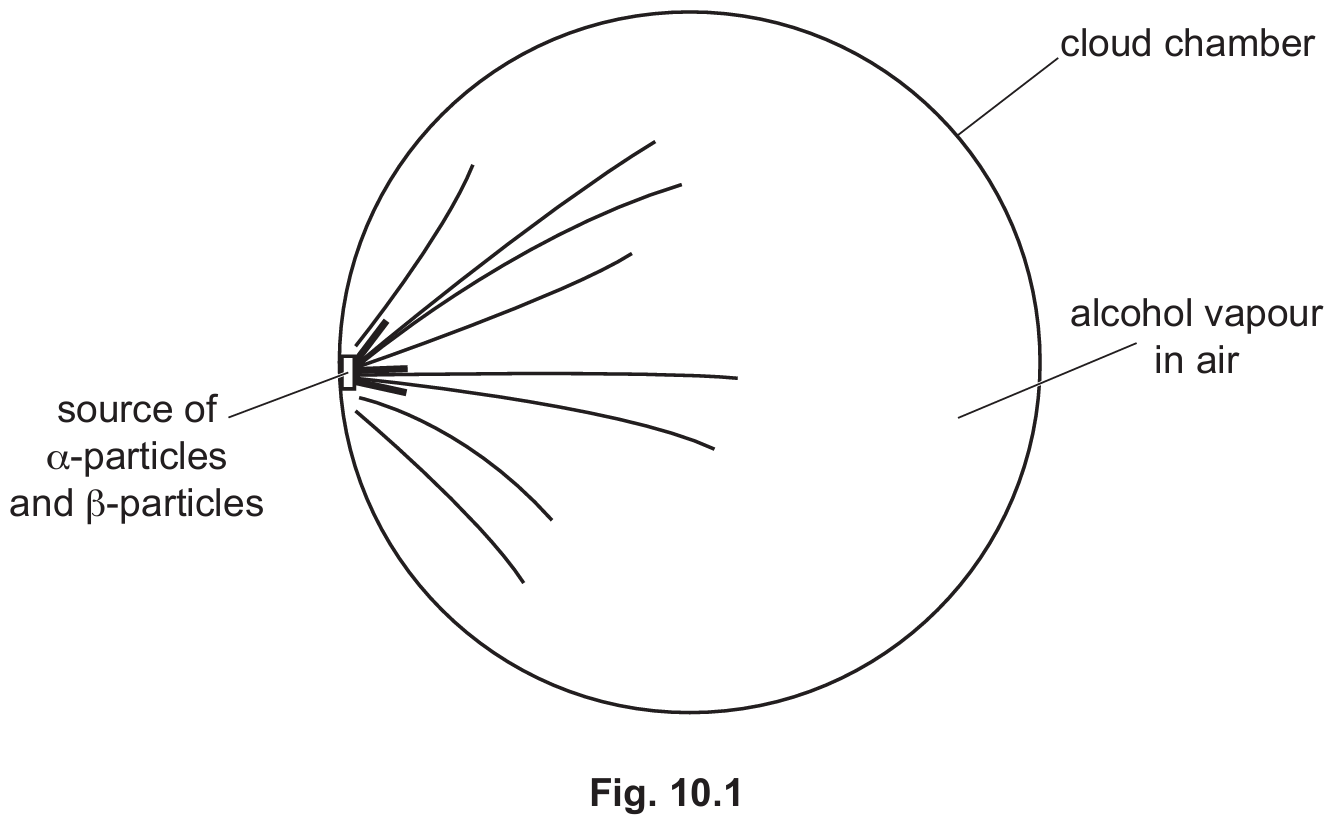
State and explain which tracks are produced by \(\alpha\)-particles and which tracks are produced by \(\beta\)-particles.
(i) Describe what is meant by an isotope.
(ii) Write the nuclide equation for the decay of this isotope of sodium.
(iii) This isotope of sodium has a half-life of 15 hours. The isotope of magnesium is stable and does not undergo radioactive decay.
Suggest why these properties of the isotope of sodium and the isotope of magnesium make this isotope of sodium suitable to detect leaks from water pipes.
Most-appropriate topic codes (Cambridge IGCSE Physics 0625):
• Topic 5.2.2 — The three types of nuclear emission (Part (a))
• Topic 5.1.2 — The nucleus (Part (b)(i))
• Topic 5.2.3 — Radioactive decay (Part (b)(ii))
• Topic 5.2.4 — Half-life (Part (b)(iii))
▶️ Answer/Explanation
(a)
For the correct answer:
\(\alpha\)-particles are short and thick / \(\beta\)-particles are long and thin
any two from:
• \(\alpha\)-particles are more ionising / \(\beta\)-particles are less ionising
• \(\alpha\)-particles are less penetrating or have shorter range / \(\beta\)-particles are more penetrating or have longer range
• \(\alpha\)-particles have more energy / \(\beta\)-particles have less energy
Alpha particles are heavy and cause fierce ionisation along a short path, creating dense, thick tracks before they quickly stop. Beta particles are much lighter and faster, causing sparse ionisation over a longer, winding path, resulting in long, thin tracks.
(b)(i)
For the correct answer:
(element with) same number of protons
(element with) different number of neutrons
Isotopes are varieties of the same chemical element. They sit in the same place on the periodic table because they have the identical proton number, but their nuclei contain different numbers of neutrons, leading to different mass numbers.
(b)(ii)
For the correct answer:
\({}^{24}_{11}\mathrm{Na} \rightarrow {}^{24}_{12}\mathrm{Mg} + {}^{0}_{-1}\beta\)
Na on left with correct proton and nucleon number
\(\beta\) on right with correct proton and nucleon number
Mg on right with correct proton and nucleon number
The parent sodium nucleus has 11 protons and 13 neutrons, so its nuclide notation is \({}^{24}_{11}\mathrm{Na}\). In beta-minus decay, a neutron turns into a proton, emitting a beta particle (\({}^{0}_{-1}\beta\)). This increases the proton number by 1 to form magnesium (Mg), while the mass number stays at 24.
(b)(iii)
For the correct answer:
half life (of Na 24) long enough (to allow detection of leaks)
negligible amount (of Na 24) remains in liquid after a few days
(so) less hazardous (to human health)
OR
decays to something stable/magnesium (is stable)
AND (so) less hazardous (to human health)
A 15-hour half-life provides enough time to trace a leak before the radiation drops too low to detect. Crucially, it decays into a stable magnesium isotope, meaning the radioactivity naturally disappears from the water supply after a few days, preventing long-term radioactive contamination.
Question 11
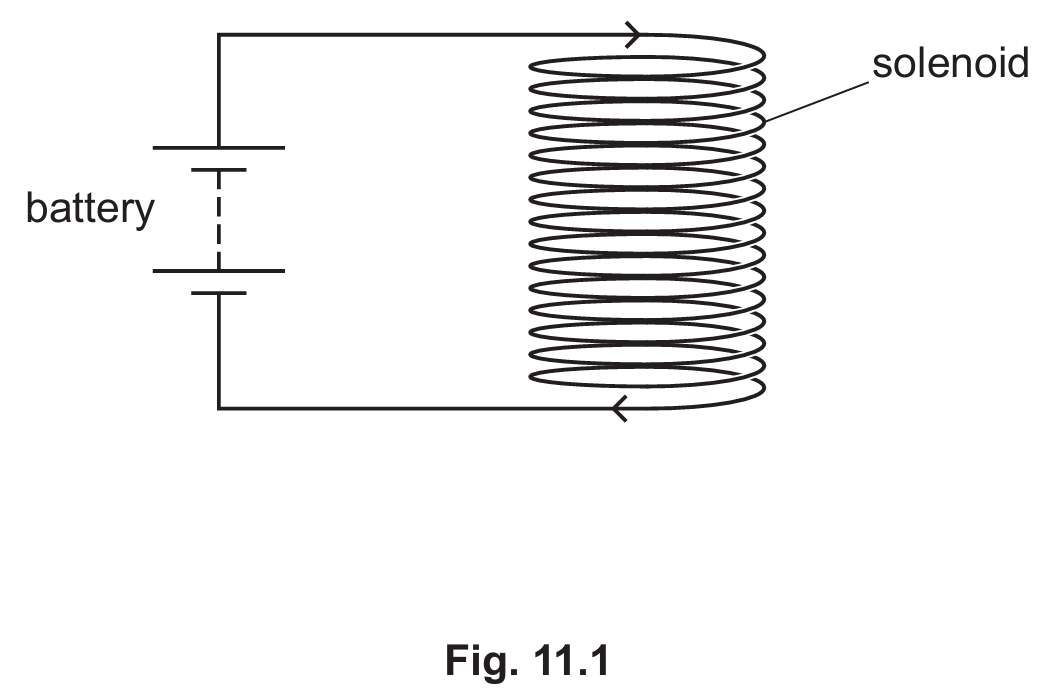
Calculate the number of turns on the secondary coil of the transformer.
Most-appropriate topic codes (Cambridge IGCSE Physics 0625):
• Topic 4.5.3 — Magnetic effect of a current (Part (a))
• Topic 4.5.6 — The transformer (Part (b))
▶️ Answer/Explanation
(a)
For the correct answer:
at least one line on the left and one line on the right, outside coil
AND
curved back over the top and under the base of the coil, towards the central core of the coil
at least two (straight vertical) lines inside coil
direction of arrow correct on at least one line and none wrong
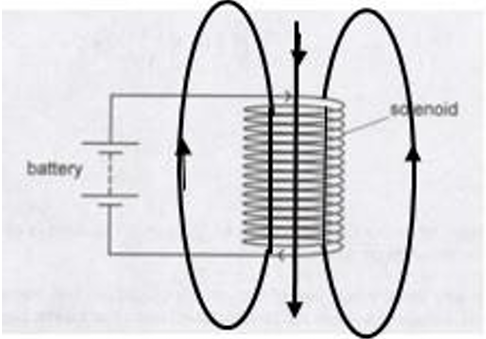
A solenoid carrying current acts like a bar magnet. The magnetic field lines are concentrated inside, running as straight, parallel lines from the south to north pole. Outside, they spread out, looping from the north pole, curving around, and returning to the south pole. The right-hand grip rule helps determine the direction.
(b)
For the correct answer:
910
The transformer equation relates the voltages and the number of turns: \(\frac{N_p}{N_s} = \frac{V_p}{V_s}\). Here, the primary coil has \(N_p = 11000\) turns and \(V_p = 400 \mathrm{~kV}\). The secondary voltage is \(V_s = 33 \mathrm{~kV}\). All units cancel out, giving \(N_s = N_p \times \frac{V_s}{V_p} = 11000 \times \frac{33000}{400000} = 907.5\), which rounds to 910 turns.