
1.8 Gas Volume Calculations
Balanced chemical equations can also be used to calculate the volume of gases involved in reactions. These calculations use the concepts of amount of substance (moles), the molar volume of gases, and the ideal gas equation.
Amount of Substance and Gas Volumes
The number of moles of a gas can be calculated using its volume if the molar volume is known.
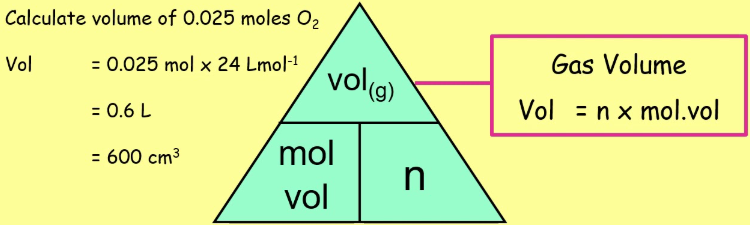
For gases at room temperature and pressure (RTP), one mole of gas occupies a volume of:
\( 24\ \mathrm{dm^3\ mol^{-1}} \)
This value is called the molar volume of a gas.
\( n = \dfrac{V}{24} \)
where:
- \( n \) = number of moles
- \( V \) = gas volume \( (\mathrm{dm^3}) \)
Gas Volumes in Chemical Equations
In reactions involving gases, the coefficients in the balanced equation represent the ratio of moles of gases reacting.
Because equal numbers of moles of gases occupy equal volumes at the same temperature and pressure, these ratios can also be used to compare gas volumes.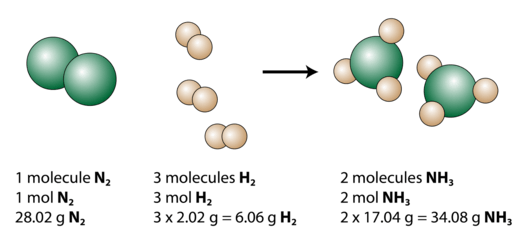
Example
For the reaction:
\( \mathrm{N_2(g) + 3H_2(g) \rightarrow 2NH_3(g)} \)
The ratio of gas volumes is:
\( 1 : 3 : 2 \)
The Ideal Gas Equation
The behaviour of gases and volatile liquids can be described using the ideal gas equation:
\( pV = nRT \)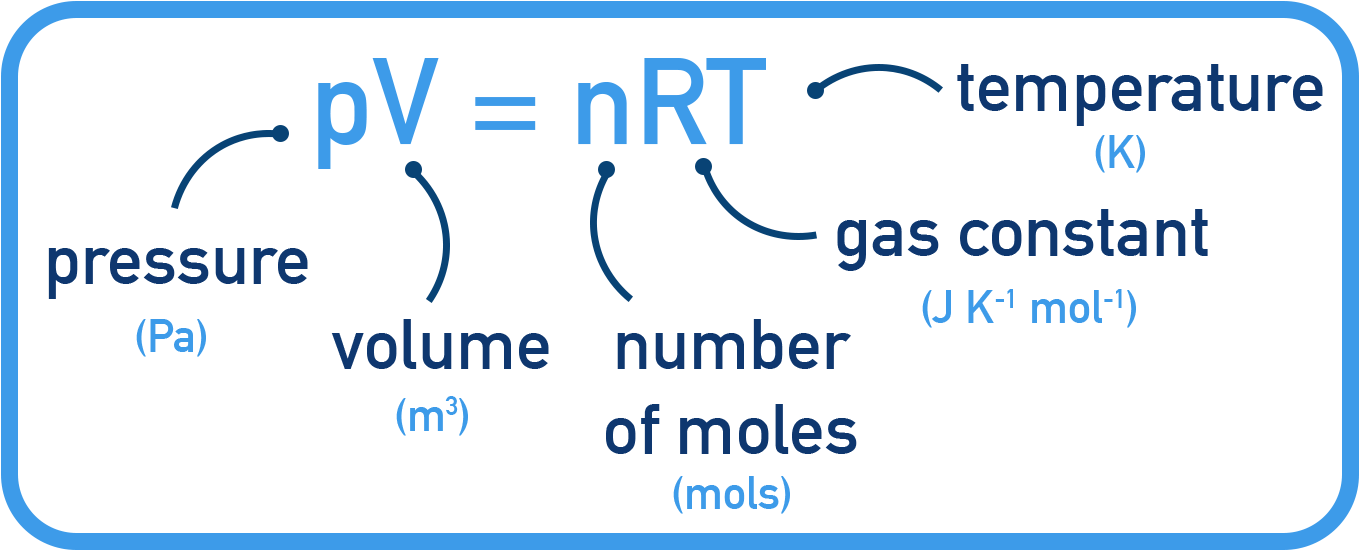
where:
- \( p \) = pressure (Pa)
- \( V \) = volume \( (\mathrm{m^3}) \)
- \( n \) = number of moles
- \( R \) = gas constant
- \( T \) = temperature (K)
This equation allows the relationship between pressure, volume, temperature, and amount of gas to be calculated.
Example 1
What volume of hydrogen gas is produced at RTP when \( 0.50\ \mathrm{mol} \) of hydrogen is formed?
▶️ Answer/Explanation
Use the molar volume at RTP:
\( 1\ \mathrm{mol} = 24\ \mathrm{dm^3} \)
Volume \( = 0.50 \times 24 \)
Volume \( = 12\ \mathrm{dm^3} \)
Therefore the volume of hydrogen gas produced is \( 12\ \mathrm{dm^3} \).
Example 2
A gas occupies \( 0.024\ \mathrm{m^3} \) at a pressure of \( 100000\ \mathrm{Pa} \) and temperature of \( 298\ \mathrm{K} \). Calculate the number of moles of gas using the ideal gas equation.
▶️ Answer/Explanation
Use
\( pV = nRT \)
Rearrange the equation:
\( n = \dfrac{pV}{RT} \)
Substitute the values:
\( n = \dfrac{(100000)(0.024)}{(8.31)(298)} \)
\( n \approx 0.97\ \mathrm{mol} \)
Therefore the amount of gas is approximately \( 0.97\ \mathrm{mol} \).