Home / jee-main-26-june-2022-paper-shift-1_physics

Physics Section-A

Question 1

An expression for a dimensionless quantity P is given by \( P = \frac{\alpha}{\beta} \log_e \left( \frac{kt}{\beta x} \right) \); where \(\alpha\) and \(\beta\) are constants, \(x\) is distance ; \(k\) is Boltzmann constant and t is the temperature. Then the dimensions of \(\alpha\) will be :
(A) \([M^0 L^{-1} T^0]\)
(B) \([ML^0 T^{-2}]\)
(C) \([MLT^{-2}]\)
(D) \([ML^2 T^{-2}]\)
▶️ Answer/Explanation
Detailed solution

\(P = \frac{\alpha}{\beta} \log_e \left( \frac{kt}{\beta x} \right)\)

Since \(P\) is dimensionless, the argument of the logarithm must also be dimensionless. Therefore, \(\frac{kt}{\beta x}\) is dimensionless.

Dimensions of \(kt\): \([ML^2T^{-2}K^{-1}] \times [K] = [ML^2T^{-2}]\)

Dimensions of \(x\): \([L]\)

So, dimensions of \(\beta\): \(\frac{[kt]}{[x]} = \frac{[ML^2T^{-2}]}{[L]} = [MLT^{-2}]\)

Since \(P\) is dimensionless, \(\frac{\alpha}{\beta}\) must also be dimensionless. Therefore, \([\alpha] = [\beta] = [MLT^{-2}]\).

Answer: (C)

Question 2

A person is standing in an elevator. In which situation, he experiences weight loss ?
(A) When the elevator moves upward with constant acceleration
(B) When the elevator moves downward with constant acceleration
(C) When the elevator moves upward with uniform velocity
(D) When the elevator moves downward with uniform velocity
▶️ Answer/Explanation
Detailed solution


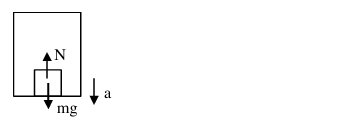
Weight experienced by the person is the normal reaction \(N\) from the elevator floor.

Using Newton’s second law for a downward accelerating elevator: \(mg – N = ma \Rightarrow N = m(g – a)\)

Since \(N < mg\), the person experiences weight loss when the acceleration of the lift is downward.

Answer: (B)

Question 3

An object is thrown vertically upwards. At its maximum height, which of the following quantity becomes zero ?
(A) Acceleration
(B) Velocity
(C) Potential Energy
(D) Force
▶️ Answer/Explanation
Detailed solution

At the maximum height, V = 0.

So, Momentum of object is zero.

Answer: (B)

Question 4

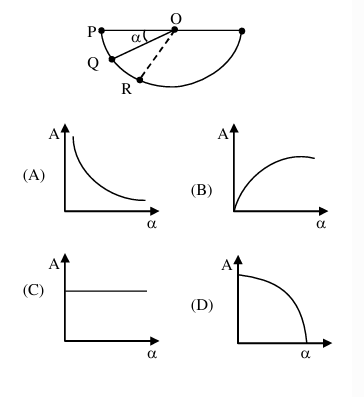
A ball is released from rest from point P of a smooth semi-spherical vessel as shown in figure. The ratio of the centripetal force and normal reaction on the ball at point Q is A while angular position of point Q is \(\alpha\) with respect to point P. Which of the following graphs represent the correct relation between A and \(\alpha\) when ball goes from Q to R ?
▶️ Answer/Explanation
Detailed solution


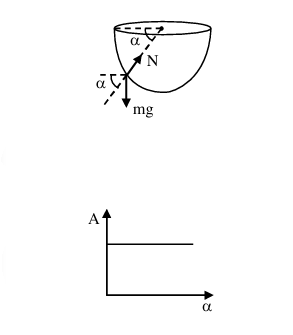
Velocity at point Q: \(v = \sqrt{2gR \sin \alpha}\)

\(N – mg \sin \alpha = \frac{mv^2}{R} = 2mg \sin \alpha \Rightarrow \frac{N}{2mg\sin\alpha} = (\frac{1}{2})+1=\frac{3}{2}\)

A = which is constant.

Answer: (C)

Question 5

A thin circular ring of mass M and radius R is rotating with a constant angular velocity 2 rads–1 in a horizontal plane about an axis vertical to its plane and passing through the center of the ring. If two objects each of mass m be attached gently to the opposite ends of a diameter of ring, the ring will then rotate with an angular velocity (in rads–1).
(A) \(\frac{M}{M+m}\)
(B) \(\frac{M}{2m+2M}\)
(C) \(\frac{2M}{M+2m}\)
(D) \(\frac{2(M+2m)}{M}\)
▶️ Answer/Explanation
Detailed solution

Applying conservation of angular momentum:

By conservation: \(MR^2 \times \omega = (MR^2 + 2mR^2) \omega_f\)

\(\Rightarrow \omega_f = \frac{2M}{M+2m}\)

Answer: (C)

Question 6

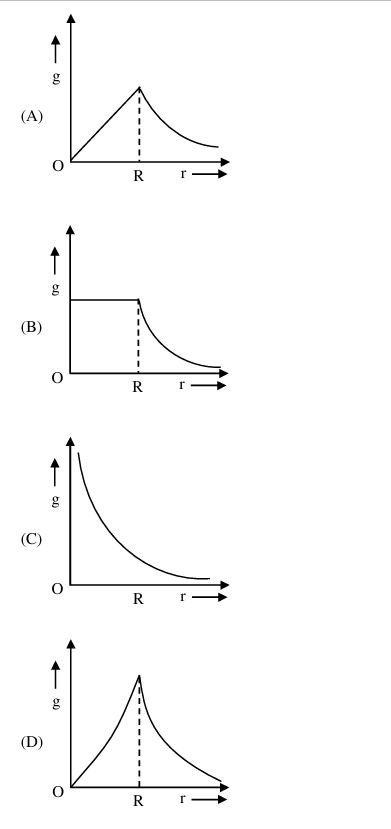
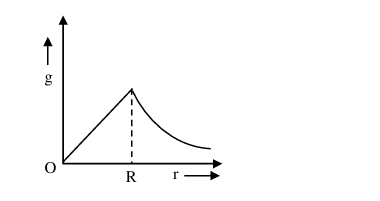
The variation of acceleration due to gravity (g) with distance (r) from the center of the earth is correctly represented by : (Given R = radius of earth)
▶️ Answer/Explanation
Detailed solution

For \(r \le R\): \(g = \frac{GMr}{R^3}\) (linear increase with r)
For \(r \ge R\): \(g = \frac{GM}{r^2}\) (inverse square law decrease)


Answer: (A)

Question 7

The efficiency of a Carnot’s engine, working between steam point and ice point, will be :
(A) 26.81%
(B) 37.81%
(C) 47.81%
(D) 57.81%
▶️ Answer/Explanation
Detailed solution

Carnot efficiency: \(\eta = \left[ 1 – \frac{T_L}{T_H} \right] \times 100\%\)

\(T_L = 0^\circ C = 273K\), \(T_H = 100^\circ C = 373K\)

\(\eta = \left[ 1 – \frac{273}{373} \right] \times 100\% = \left[ \frac{100}{373} \right] \times 100\% \approx 26.81\%\)

Answer: (A)

Question 8

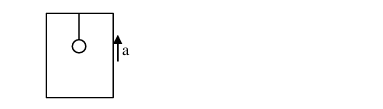
Time period of a simple pendulum in a stationary lift is ‘T’. If the lift accelerates with \(\frac{g}{6}\) vertically upwards then the time period will be : (where \(g = \) acceleration due to gravity)
(A) \(\sqrt{\frac{6}{5}} T\)
(B) \(\sqrt{\frac{5}{6}} T\)
(C) \(\sqrt{\frac{6}{7}} T\)
(D) \(\sqrt{\frac{7}{6}} T\)
▶️ Answer/Explanation
Detailed solution


Time period \(T = 2\pi \sqrt{\frac{\ell}{g_{\text{eff}}}}\)

Stationary lift: \(T = 2\pi \sqrt{\frac{\ell}{g}}\)

Lift accelerating upwards with \(a = \frac{g}{6}\): \(g_{\text{eff}} = g + a = g + \frac{g}{6} = \frac{7g}{6}\)

New time period \(T’ = 2\pi \sqrt{\frac{\ell}{\frac{7g}{6}}} = 2\pi \sqrt{\frac{6\ell}{7g}} = \sqrt{\frac{6}{7}} T\)

Answer: (C)

Question 9

A thermally insulated vessel contains an ideal gas of molecular mass M and ratio of specific heats 1.4. Vessel is moving with speed v and is suddenly brought to rest. Assuming no heat is lost to the surrounding and vessel temperature of the gas increases by : (R = universal gas constant)
(A) \(\frac{Mv^2}{7R}\)
(B) \(\frac{Mv^2}{5R}\)
(C) \(2\frac{Mv^2}{7R}\)
(D) \(7\frac{Mv^2}{5R}\)
▶️ Answer/Explanation
Detailed solution

Given \(\gamma = \frac{C_p}{C_v} = 1.4 = 1 + \frac{2}{F} \Rightarrow F = 5\) (degrees of freedom)

Kinetic energy of the vessel is converted into internal energy of the gas.

\(\frac{1}{2} (nm) v^2 = \frac{F}{2} nR \Delta T\)

\(\Rightarrow \frac{1}{2} M v^2 = \frac{5}{2} R \Delta T\) (for 1 mole, n=1, m=M)

\(\Rightarrow \Delta T = \frac{Mv^2}{5R}\)

Answer: (B)

Question 10

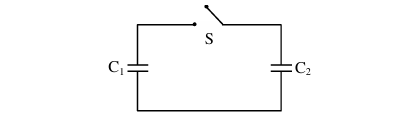
Two capacitors having capacitance \(C_1\) and \(C_2\) respectively are connected as shown in figure. Initially, capacitor \(C_1\) is charged to a potential difference V volt by a battery. The battery is then removed and the charged capacitor \(C_1\) is now connected to uncharged capacitor \(C_2\) by closing the switch S. The amount of charge on the capacitor \(C_2\), after equilibrium is :
(A) \(\frac{C_1 C_2 V}{(C_1 + C_2)}\)
(B) \(\frac{(C_1 + C_2) V}{C_1 C_2}\)
(C) \((C_1 + C_2) V\)
(D) \((C_1 – C_2) V\)
▶️ Answer/Explanation
Detailed solution

Initial charge on \(C_1\): \(Q = C_1 V\)

After connecting \(C_2\), total capacitance \(C_{\text{total}} = C_1 + C_2\)

Common potential after connection: \(V_{\text{common}} = \frac{Q_{\text{total}}}{C_{\text{total}}} = \frac{C_1 V}{C_1 + C_2}\)

Charge on capacitor \(C_2\): \(Q_2 = C_2 \times V_{\text{common}} = \frac{C_1 C_2 V}{C_1 + C_2}\)

Answer: (A)

Question 11

Assertion (A) : Non-polar materials do not have any permanent dipole moment.
Reason (R) : When a non-polar material is placed in an electric field, the centre of the positive charge distribution of it’s individual atom or molecule coincides with the centre of the negative charge distribution. In the light of above statements, choose the most appropriate answer from the options given below.
(A) Both (A) and (R) are correct and (R) is the correct explanation of (A).
(B) Both (A) and (R) are correct and (R) is not the correct explanation of (A).
(C) (A) is correct but (R) is not correct.
(D) (A) is not correct but (R) is correct.
▶️ Answer/Explanation
Detailed solution

S1 :In nonpolar molecules, centre of +ve charge coincide with centre of -ve charge,hence net dipole moment is comes to zero.

S2: When non polar material is placed in external field,centre of charges does not coincide , hence give non zero moment in field.

Answer: (C)

Question 12

The magnetic flux through a coil perpendicular to its plane is varying according to the relation \(\phi = (5t^3 + 4t^2 + 2t – 5)\) Weber. If the resistance of the coil is 5 ohm, then the induced current through the coil at t = 2 sec will be:
(A) 15.6 A
(B) 16.6 A
(C) 17.6 A
(D) 18.6 A
▶️ Answer/Explanation
Detailed solution

Induced emf: \(|e| = \frac{d\phi}{dt} = \frac{d}{dt}(5t^3 + 4t^2 + 2t – 5) = 15t^2 + 8t + 2\)

At t = 2 s: \(|e| = 15(2)^2 + 8(2) + 2 = 60 + 16 + 2 = 78\) V

Induced current: \(I = \frac{|e|}{R} = \frac{78}{5} = 15.6\) A

Answer: (A)

Question 13

An aluminium wire is stretched to make its length 0.4% larger. Then percentage change in resistance is:
(A) 0.4 %
(B) 0.2 %
(C) 0.8 %
(D) 0.6 %
▶️ Answer/Explanation
Detailed solution

Resistance \(R = \frac{\rho \ell}{A}\)

Volume \(V = A \ell\) is constant. \(\Rightarrow A \propto \frac{1}{\ell}\)

\(\Rightarrow R \propto \ell^2\)

Fractional change: \(\frac{\Delta R}{R} = 2 \frac{\Delta \ell}{\ell}\)

Percentage change: \(\frac{\Delta R}{R} \times 100\% = 2 \times 0.4\% = 0.8\%\)

Answer: (C)

Question 14

A proton and an alpha particle of the same enter in a uniform magnetic field which is acting perpendicular to their direction of motion. The ratio of the circular paths described by the alpha particle and proton is:
(A) 1 : 4
(B) 4 : 1
(C) 2 : 1
(D) 1 : 2
▶️ Answer/Explanation
Detailed solution

Radius of circular path in magnetic field: \(R = \frac{mv}{qB}\)

For same velocity and magnetic field: \(R \propto \frac{m}{q}\)

For proton: \(m_p = m\), \(q_p = e\)

For alpha particle: \(m_\alpha = 4m\), \(q_\alpha = 2e\)

Ratio: \(\frac{R_\alpha}{R_p} = \frac{m_\alpha}{m_p} \times \frac{q_p}{q_\alpha} = \frac{4m}{m} \times \frac{e}{2e} = 4 \times \frac{1}{2} = 2\)

Answer: (C)

Question 15

If electric field intensity of a uniform plane electro magnetic wave is given as
\[ E = -301.6 \sin(kz – \omega t) \hat{a}_x + 452.4 \sin(kz – \omega t) \hat{a}_y \frac{V}{m} \]
Then, magnetic intensity H of this wave in Am\(^{-1}\) will be:
[Given: Speed of light in vacuum \( c = 3 \times 10^8 \, \text{ms}^{-1} \), permeability of vacuum \( \mu_0 = 4\pi \times 10^{-7} \, \text{NA}^{-2} \)]
(A) \( +0.8 \sin(kz – \omega t) \hat{a}_y + 0.8 \sin(kz – \omega t) \hat{a}_x \)
(B) \( +1.0 \times 10^{-6} \sin(kz – \omega t) \hat{a}_y + 1.5 \times 10^{-6} (kz – \omega t) \hat{a}_x \)
(C) \( -0.8 \sin(kz – \omega t) \hat{a}_y – 1.2 \sin(kz – \omega t) \hat{a}_x \)
(D) \( -1.0 \times 10^{-6} \sin(kz – \omega t) \hat{a}_y – 1.5 \times 10^{-6} \sin(kz – \omega t) \hat{a}_x \)
▶️ Answer/Explanation
Detailed solution

For electromagnetic waves: \(|\vec{H}| = \frac{|\vec{E}|}{\mu_0 c}\)

For x-component: \(H_x = \frac{E_y}{\mu_0 c} = \frac{452.4}{(4\pi \times 10^{-7}) \times 3 \times 10^8} \approx -1.2\) (direction determined by \(\vec{E} \times \vec{H}\) along propagation)

For y-component: \(H_y = \frac{E_x}{\mu_0 c} = \frac{301.6}{(4\pi \times 10^{-7}) \times 3 \times 10^8} \approx -0.8\)

Direction: Using \(\vec{E} \times \vec{H}\) gives propagation in +z direction, so \(\vec{H} = -0.8 \sin(kz – \omega t) \hat{a}_y – 1.2 \sin(kz – \omega t) \hat{a}_x\)

Answer: (C)

Question 16

In free space, an electromagnetic wave of 3 GHz frequency strikes over the edge of an object of size \(\frac{\lambda}{100}\), where \(\lambda\) is the wavelength of the wave in free space. The phenomenon, which happens there will be:
(A) Reflection
(B) Refraction
(C) Diffraction
(D) Scattering
▶️ Answer/Explanation
Detailed solution

 \(\frac {a}{\lambda} = \frac{1}{100} \)

For reflection size of obstacle must be much larger
than wavelength, for diffraction size should be
order of wavelength.
Since the object is of size
\(\frac{\lambda}{100}\), much smaller than wavelength, so scattering will occur.


Answer: (D)

Question 17

An electron with speed v and a photon with speed c have the same de-Broglie wavelength. If the kinetic energy and momentum of electron are \( E_e \) and \( p_e \) and that of photon are \( E_{ph} \) and \( p_{ph} \) respectively. Which of the following is correct?
(A) \(\frac{E_e}{E_{ph}} = \frac{2c}{v}\)
(B) \(\frac{E_e}{E_{ph}} = \frac{v}{2c}\)
(C) \(\frac{p_e}{p_{ph}} = \frac{2c}{v}\)
(D) \(\frac{p_e}{p_{ph}} = \frac{v}{2c}\)
▶️ Answer/Explanation
Detailed solution

Same de-Broglie wavelength: \(\lambda_e = \lambda_{ph} \Rightarrow \frac{h}{p_e} = \frac{h}{p_{ph}} \Rightarrow p_e = p_{ph}\)

Electron kinetic energy: \(E_e = \frac{p_e^2}{2m} = \frac{p_e v}{2}\)

Photon energy: \(E_{ph} = p_{ph} c = p_e c\)

Ratio: \(\frac{E_e}{E_{ph}} = \frac{p_e v/2}{p_e c} = \frac{v}{2c}\)

Answer: (B)

Question 18

How many alpha and beta particles are emitted when Uranium \( _{92}U^{238} \) decays to lead \( _{82}Pb^{206} \)?
(A) 3 alpha particles and 5 beta particles
(B) 6 alpha particles and 4 beta particles
(C) 4 alpha particles and 5 beta particles
(D) 8 alpha particles and 6 beta particles
▶️ Answer/Explanation
Detailed solution


Mass number change: \(238 – 206 = 32\)

Each alpha decay reduces mass by 4: \(\frac{32}{4} = 8\) alpha particles

Atomic number change due to alpha: \(8 \times 2 = 16\)

Actual atomic number change: \(92 – 82 = 10\)

Beta particles needed: \(16 – 10 = 6\) beta particles (each beta increases atomic number by 1)

Answer: (D)

Question 19

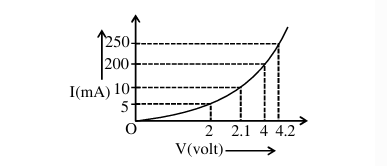
The I-V characteristics of a p-n junction diode in forward bias is shown in the figure. The ratio of dynamic resistance, corresponding to forward bias voltages of 2V and 4V respectively, is:
(A) 1:2
(B) 5:1
(C) 1:40
(D) 20:1
▶️ Answer/Explanation
Detailed solution

Dynamic resistance \(r_d = \frac{\Delta V}{\Delta I}\)

At 2V: \(\Delta V = 0.1V\), \(\Delta I \approx 5mA\), so \(r_{d1} = \frac{0.1}{5 \times 10^{-3}} = 20\Omega\)

At 4V: \(\Delta V = 0.2V\), \(\Delta I \approx 50mA\), so \(r_{d2} = \frac{0.2}{50 \times 10^{-3}} = 4\Omega\)

Ratio: \(\frac{r_{d1}}{r_{d2}} = \frac{20}{4} = 5:1\)

Answer: (B)

Question 20

Choose the correct statement for amplitude modulation:
(A) Amplitude of modulating is varied in accordance with the information signal.
(B) Amplitude of modulated is varied in accordance with the information signal.
(C) Amplitude of carrier signal is varied in accordance with the information signal.
(D) Amplitude of modulated is varied in accordance with the modulating signal.
▶️ Answer/Explanation
Detailed solution

In amplitude modulation (AM), the amplitude of the high-frequency carrier wave is varied in accordance with the instantaneous amplitude of the modulating signal (information signal).

Answer: (C)

Section-B

Question 1

A fighter jet is flying horizontally at a certain altitude with a speed of \(200 \, \text{ms}^{-1}\). When it passes directly overhead an anti-aircraft gun, bullet is fired from the gun, at an angle \(\theta\) with the horizontal, to hit the jet. If the bullet speed is \(400 \, \text{m/s}\), the value of \(\theta\) will be …… \(^\circ\).
▶️ Answer/Explanation
Detailed solution

Both should have same horizontal component of velocity

\( 200 = 400 \cos \theta \)

\( \cos \theta = \frac{1}{2} \)

\( \theta = 60^\circ \)

Answer: 60

Question 2

A ball of mass \(0.5 \, \text{kg}\) is dropped from the height of \(10 \, \text{m}\). The height, at which the magnitude of velocity becomes equal to the magnitude of acceleration due to gravity, is …… m. (Use \(g = 10 \, \text{m/s}^2\)).
▶️ Answer/Explanation
Detailed solution

Given \(v = g = 10 \, \text{m/s}\)

Using \(v^2 = u^2 + 2as\):

\( 10^2 = 0 + 2(10)s \)

\( 100 = 20s \)

\( s = 5 \, \text{m} \)

Height from ground = \(10 – 5 = 5 \, \text{m}\)

Answer: 5

Question 3

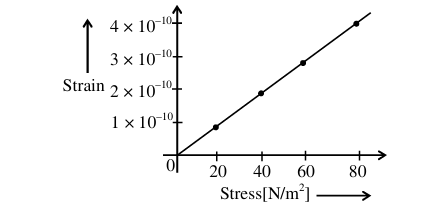
The elastic behaviour of material for linear stress and linear strain, is shown in the figure. The energy density for a linear strain of \(5 \times 10^{-4}\) is …… \(\text{kJ/m}^3\). Assume that material is elastic upto the linear strain of \(5 \times 10^{-4}\).
▶️ Answer/Explanation
Detailed solution

From graph, \(Y = \frac{\text{stress}}{\text{strain}} = 2.0 \times 10^{10} \, \text{N/m}^2\)

Energy density = \(\frac{1}{2} \times \text{stress} \times \text{strain} = \frac{1}{2} \times (\text{strain})^2 \times Y\)

\( = \frac{1}{2} \times (5 \times 10^{-4})^2 \times 2.0 \times 10^{10} \)

\( = \frac{1}{2} \times 25 \times 10^{-8} \times 2.0 \times 10^{10} \)

\( = 25 \times 10^2 = 25000 \, \text{J/m}^3 = 25 \, \text{kJ/m}^3 \)

Answer: 25

Question 4

The elongation of a wire on the surface of the earth is \(10^{-4} \, \text{m}\). The same wire of same dimensions is elongated by \(6 \times 10^{-5} \, \text{m}\) on another planet. The acceleration due to gravity on the planet will be …… \(\text{ms}^{-2}\). (Take acceleration due to gravity on the surface of earth = \(10 \, \text{m/s}^2\))
▶️ Answer/Explanation
Detailed solution

\(\Delta \ell \propto g\)

\( \frac{\Delta \ell_{\text{earth}}}{\Delta \ell_{\text{planet}}} = \frac{g_{\text{earth}}}{g_{\text{planet}}} \)

\( \frac{10^{-4}}{6 \times 10^{-5}} = \frac{10}{g_{\text{planet}}} \)

\( g_{\text{planet}} = 10 \times \frac{6 \times 10^{-5}}{10^{-4}} = 10 \times 0.6 = 6 \, \text{m/s}^2 \)

Answer: 6

Question 5

A \(10 \, \Omega\), \(20 \, \text{mH}\) coil carrying constant current is connected to a battery of \(20 \, \text{V}\) through a switch is opened current becomes zero in \(100 \, \mu \text{s}\). The average emf induced in the coil is …… V.
▶️ Answer/Explanation
Detailed solution

Initial current \(i_0 = \frac{V}{R} = \frac{20}{10} = 2 \, \text{A}\)

Final current \(i = 0 \, \text{A}\)

Time \(\Delta t = 100 \, \mu \text{s} = 100 \times 10^{-6} \, \text{s}\)

Inductance \(L = 20 \, \text{mH} = 20 \times 10^{-3} \, \text{H}\)

Average emf \(< \epsilon > = \frac{L \Delta i}{\Delta t} = \frac{20 \times 10^{-3} \times (2 – 0)}{100 \times 10^{-6}}\)

\[ = \frac{40 \times 10^{-3}}{10^{-4}} = 400 \, \text{V} \]

Answer: 400

Question 6

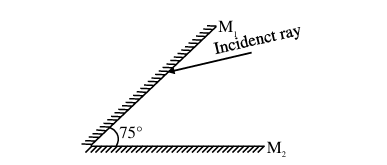
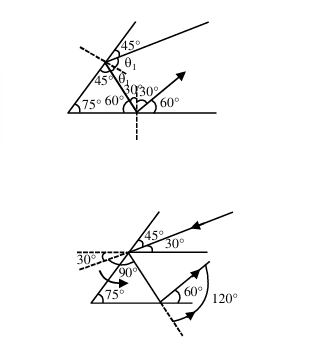
A light ray is incident, at an incident angle \(\theta_1\), on the system of two plane mirrors \(M_1\) and \(M_2\) having an inclination angle \(75^\circ\) between them (as shown in figure). After reflecting from mirror \(M_1\) it gets reflected back by the mirror \(M_2\) with an angle of reflection \(30^\circ\). The total deviation of the ray will be ………….. degree.
▶️ Answer/Explanation
Detailed solution


\( \delta_{\text{total}} = 360^\circ – 2\theta \)

\( \delta_{\text{total}} = 360^\circ – 2 \times 75^\circ =  210^\circ \)

\(\theta_1 = 40^\circ\)

Alternatively, from geometry: \(\delta = 120^\circ + 90^\circ = 210^\circ\)

Answer: 210

Question 7

In a vernier callipers, each cm on the main scale is divided into 20 equal parts. If tenth vernier scale division coincides with nineth main scale division. Then the value of vernier constant will be ………….. \(\times 10^{-2} \, \text{mm}\).
▶️ Answer/Explanation
Detailed solution

\(20 \, \text{MSD} = 1 \, \text{cm}\)

\(1 \, \text{MSD} = \frac{1}{20} \, \text{cm}\)

\(10 \, \text{VSD} = 9 \, \text{MSD}\)

\(1 \, \text{VSD} = \frac{9}{10} \, \text{MSD} = \frac{9}{10} \times \frac{1}{20} = \frac{9}{200} \, \text{cm}\)

Vernier Constant \(VC = 1 \, \text{MSD} – 1 \, \text{VSD} = \frac{1}{20} – \frac{9}{200} = \frac{10 – 9}{200} = \frac{1}{200} \, \text{cm}\)

\[ VC = \frac{1}{200} \times 10 \, \text{mm} = \frac{10}{200} \, \text{mm} = 0.05 \, \text{mm} = 5 \times 10^{-2} \, \text{mm} \]

Answer: 5

Question 8

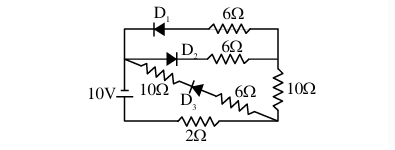
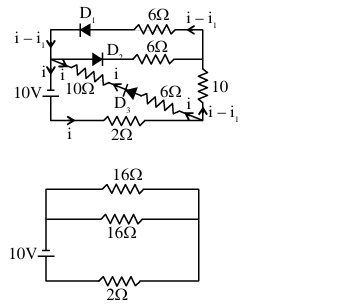
As per the given circuit, the value of current through the battery will be ……….. A.
▶️ Answer/Explanation
Detailed solution


After analyzing the diode configuration and equivalent resistance:

Net resistance \(R_{\text{net}} = 10 \, \Omega\)

Current \(I = \frac{V}{R_{\text{net}}} = \frac{10}{10} = 1 \, \text{A}\)

Answer: 1

Question 9

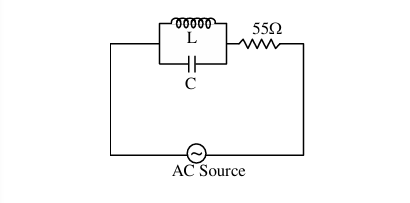
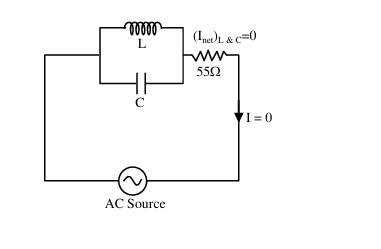
A \(110 \, \text{V}, 50 \, \text{Hz}\), AC source is connected in the circuit (as shown in figure). The current through the resistance \(55 \, \Omega\), at resonance in the circuit, will be …… A.
▶️ Answer/Explanation
Detailed solution
At resonance \(I_L=I_C\)


\(\frac{1}{Z}=\sqrt{({\frac{1}{X_L} – \frac{1}{X_C}})^2}\)

At resonance, \(X_L = X_C\)

(\(Z \to \infty\))

 \(Z_{\text{total}} \to \infty\)

Current through the circuit \(I = 0 \, \text{A}\)

Answer: 0

Question 10

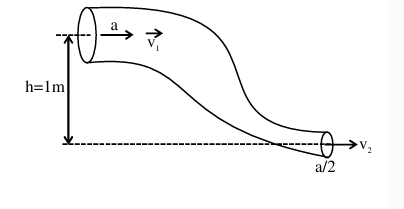
An ideal fluid of density \(800 \, \text{kgm}^{-3}\), flows smoothly through a bent pipe (as shown in figure) that tapers in cross-sectional area from \(a\) to \(\frac{a}{2}\). The pressure difference between the wide and narrow sections of pipe is \(4100 \, \text{Pa}\). At wider section, the velocity of fluid is \(\frac{\sqrt{x}}{6} \, \text{ms}^{-1}\) for \(x = \) ……
▶️ Answer/Explanation
Detailed solution

From continuity equation: \(aV_1 = \frac{a}{2}V_2 \Rightarrow V_2 = 2V_1\)

From Bernoulli’s theorem:

\( P_1 – P_2 = \rho\left[ \frac{V_2^2 – V_1^2}{2} + g(h_2 – h_1) \right] \)

\( 4100 = 800\left[ \frac{4V_1^2 – V_1^2}{2} + 10 \times (-1) \right] \)

\( 4100 = 800\left[ \frac{3V_1^2}{2} – 10 \right] \)

\( \frac{4100}{800} + 10 = \frac{3V_1^2}{2} \)

\( \frac{41}{8} + 10 = \frac{3V_1^2}{2} \)

\( \frac{121}{8} = \frac{3V_1^2}{2} \)

\( V_1^2 = \frac{121}{8} \times \frac{2}{3} = \frac{121}{12} \)

\( V_1 = \sqrt{\frac{121}{12}} = \sqrt{\frac{363}{36}} = \frac{\sqrt{363}}{6} \)

Therefore, \(x = 363\)

Answer: 363

Scroll to Top