
Question
(a) State Kirchhoff’s first law. (1 mark)
________________________________
(b) Fig. 5.1 shows a circuit containing a thermistor T that has a negative temperature coefficient.
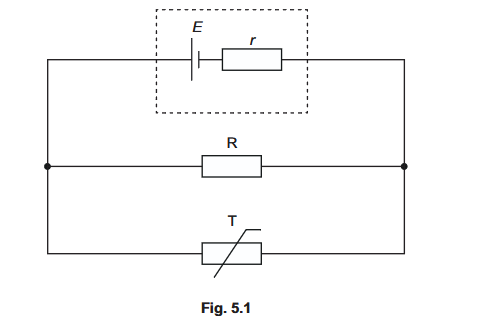
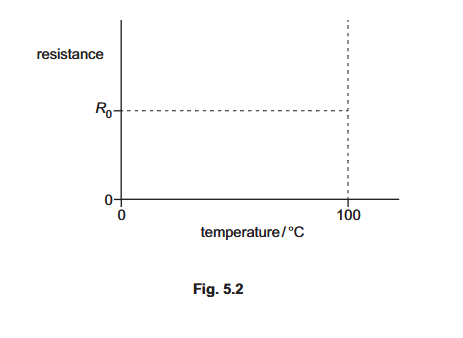
The thermistor has resistance \(R_0\) at a temperature of \(0^\circ\mathrm{C}\).
(i) On Fig. 5.2, sketch a possible variation of the resistance of the thermistor with temperature between \(0^\circ\mathrm{C}\) and \(100^\circ\mathrm{C}\). (2 marks)
(ii) With reference to the current in the cell, explain why the current in resistor R decreases with increasing temperature of the thermistor. (3 marks)
________________________________
________________________________
________________________________
(c) The electromotive force (e.m.f.) \(E\) of the cell in Fig. 5.1 is \(1.50\,\mathrm{V}\). The internal resistance \(r\) of the cell is \(0.12\,\Omega\).
Resistor R has a resistance of \(6.00\,\Omega\).
At a particular temperature of the thermistor, the current in R is \(0.200\,\mathrm{A}\).
For this temperature of the thermistor, determine:
(i) the current in the cell. (2 marks)
current = __________________________________________ \( \mathrm{A} \)
(ii) the resistance of the thermistor. (2 marks)
resistance = __________________________________________ \( \Omega \)
Syllabus Topic Codes (Cambridge International AS & A Level Physics 9702):
• 9.2: Potential difference and power — part (c)(i)
• 9.3: Resistance and resistivity — parts (b)(i), (b)(ii) and (c)(ii)
• 10.1: Practical circuits — parts (b) and (c)
• 10.2: Kirchhoff’s laws — parts (a), (b)(ii) and (c)(i), (c)(ii)
▶️ Answer/Explanation
(a) Kirchhoff’s first law [1 mark]
The sum of the currents entering a junction is equal to the sum of the currents leaving the junction.
Equivalently, the algebraic sum of currents at a junction is zero.
Answer: \( \boxed{\text{sum of current(s) into a junction = sum of current(s) out of the junction}} \)
(b)(i) Variation of thermistor resistance with temperature [2 marks]
The thermistor has a negative temperature coefficient, so its resistance decreases as its temperature increases.
The graph should therefore be a line with a negative gradient, starting at \(R_0\) when the temperature is \(0^\circ\mathrm{C}\) and remaining above \(R=0\) between \(0^\circ\mathrm{C}\) and \(100^\circ\mathrm{C}\).
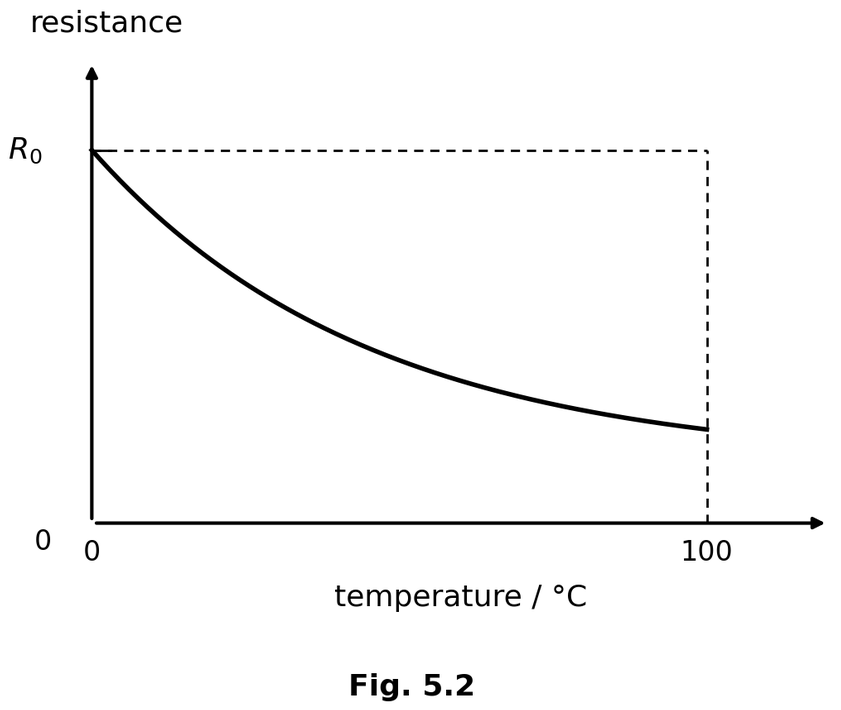
Answer: \( \boxed{\text{A decreasing resistance-temperature curve from }(0,R_0)} \)
(b)(ii) Current in resistor R [3 marks]
As the temperature increases, the resistance of thermistor T decreases.
Therefore, the total resistance of the external circuit decreases, so the current in the cell increases.
The increased cell current produces a greater potential difference across the internal resistance \(r\). Since the e.m.f. is constant, the terminal potential difference therefore decreases.
The resistance of resistor R is constant, so from \(I=\dfrac{V}{R}\), the decrease in terminal potential difference causes the current in R to decrease.
Answer: \( \boxed{\text{Current in R decreases because the terminal p.d. decreases.}} \)
(c)(i) Current in the cell [2 marks]
The potential difference across resistor R is
\(V_R=IR\)
\(V_R=0.200\times6.00\)
\(V_R=1.20\,\mathrm{V}\)
The potential difference across the internal resistance is therefore
\(V_r=E-V_R\)
\(V_r=1.50-1.20=0.30\,\mathrm{V}\)
Using \(V_r=Ir\),
\(I_{\mathrm{cell}}=\dfrac{0.30}{0.12}\)
\(I_{\mathrm{cell}}=2.5\,\mathrm{A}\)
Answer: \( \boxed{2.5\,\mathrm{A}} \)
(c)(ii) Resistance of the thermistor [2 marks]
Using Kirchhoff’s first law at the junction,
\(I_T=I_{\mathrm{cell}}-I_R\)
\(I_T=2.5-0.200\)
\(I_T=2.3\,\mathrm{A}\)
The thermistor and resistor R are connected in parallel, so the potential difference across the thermistor is \(1.20\,\mathrm{V}\).
Therefore,
\(R_T=\dfrac{V}{I_T}\)
\(R_T=\dfrac{6.00\times0.200}{2.3}\)
\(R_T=0.52\,\Omega\)
Answer: \( \boxed{0.52\,\Omega} \)