Home / CIE iGCSE Maths C1.2 Sets – Exam Style Practice Questions- Paper 3

CIE iGCSE Maths C1.2 Sets - Exam Style Practice Questions- Paper 3- New Syllabus

Question

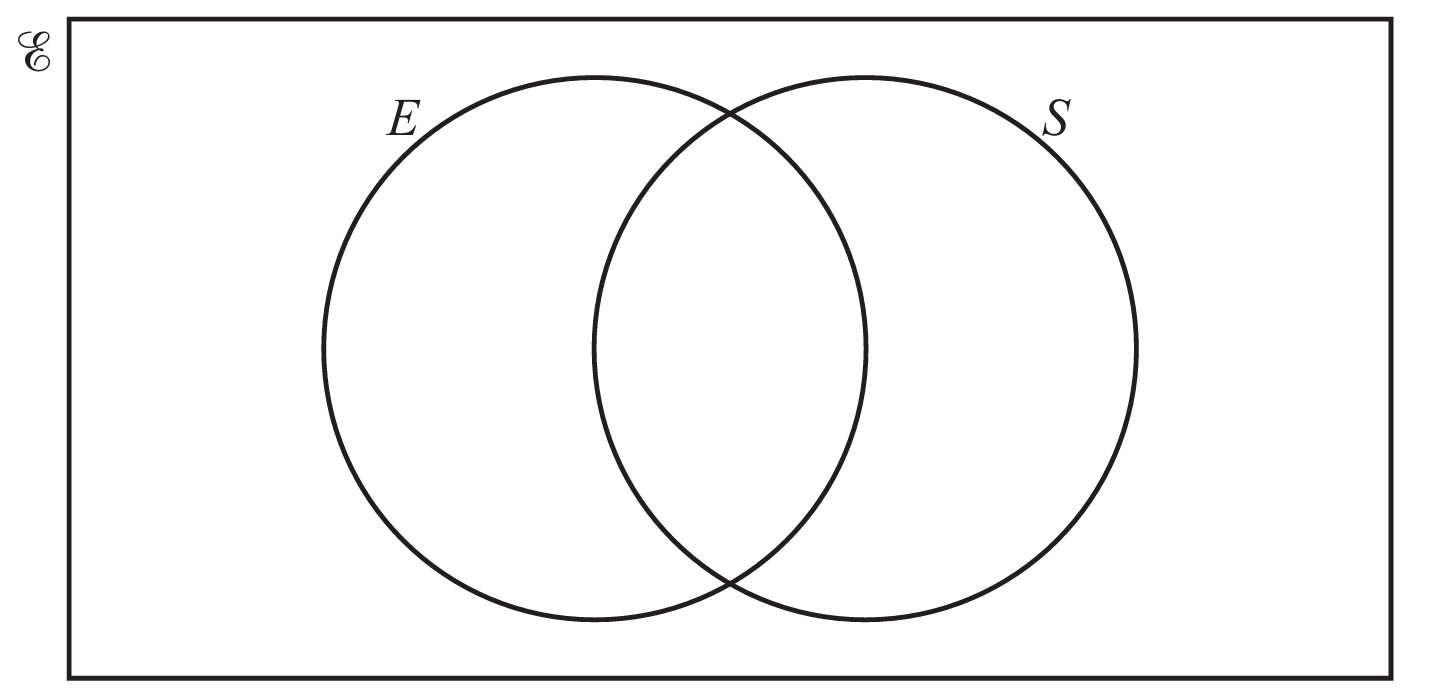
Li asks $28$ students if they speak English (E) and if they speak Spanish (S).

$15$ students speak English.
$12$ students speak Spanish.
$6$ do not speak English and do not speak Spanish.

(a) Complete the Venn diagram.

(b) Write down how many students speak English but do not speak Spanish.

(c) Find $n(E \cup S)$.

Most-appropriate topic codes (Cambridge IGCSE Mathematics 0580):

• C1.2 Sets
▶️ Answer/Explanation

(a)
The total number of students speaking at least one language is $28 – 6 = 22$.
If we add the individual totals, we get $15 + 12 = 27$. The overlap (students speaking both) is the difference: $27 – 22 = 5$.
English only is $15 – 5 = 10$, and Spanish only is $12 – 5 = 7$. The $6$ goes on the outside.
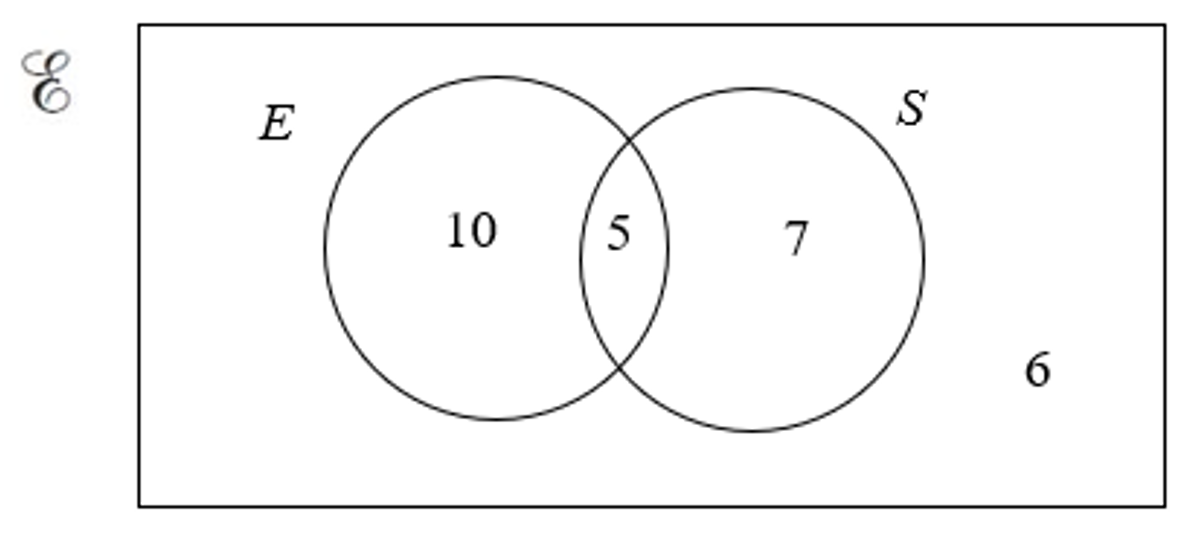

✅ Answer: Venn diagram values: E only = 10, intersection = 5, S only = 7, outside = 6.

(b)
This refers strictly to the section inside circle E but outside circle S.
From our calculation above, this value is $10$.
✅ Answer: $10$

(c)
The notation $n(E \cup S)$ asks for the total number of students in the union of sets E and S.
This is the sum of the elements in the circles: $10 + 5 + 7 = 22$.
✅ Answer: $22$
Question

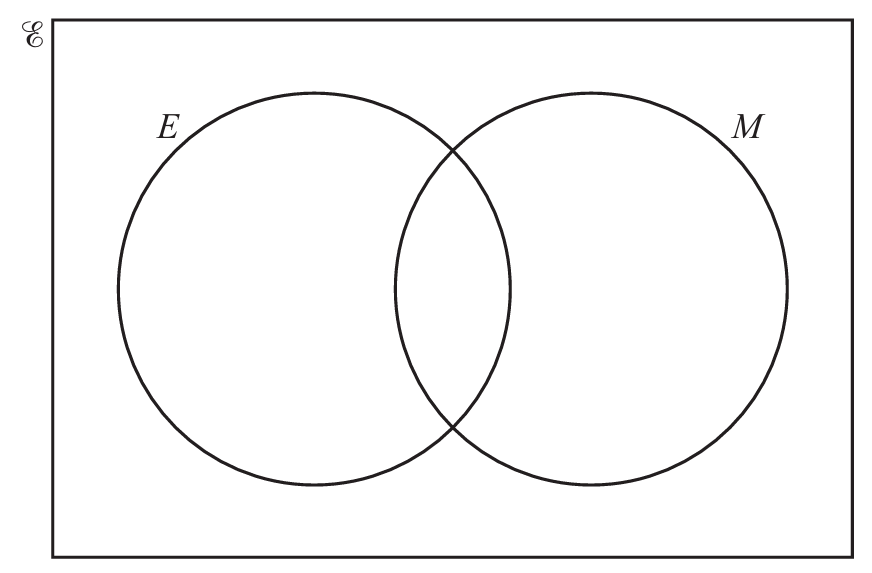
(a) $ξ = \{1, 2, 3, 4, 5, 6, 7, 8, 9, 10, 11, 12\}$
$E = \{x: x$ is an even number$\}$
$M = \{x: x$ is a multiple of 3$\}$

(i) Complete the Venn diagram.

(ii) Write down $n(E \cup M)$.

(iii) A number is chosen at random from the universal set $\%$. Write down the probability that the number is in the set $E \cap M$.

(b) Meg says that an even number cannot be a prime number.

Is she correct?
Give a reason for your answer.

▶️ Answer/Explanation
Solution

(a)(i) 

E circle contains: 2, 4, 6, 8, 10, 12

M circle contains: 3, 6, 9, 12

Intersection (E ∩ M): 6, 12

Outside both circles: 1, 5, 7, 11

(a)(ii) 8

Count all elements in E or M: 2,3,4,6,8,9,10,12

(a)(iii) $\frac{1}{6}$

There are 2 numbers in E ∩ M (6,12) out of 12 total numbers.

(b) No because 2 is even and a prime number.

Meg’s statement is incorrect as 2 is the only even prime number.

Scroll to Top