
IB DP Chemistry - Structure 2.1 The ionic model - IB Style Questions For HL Paper 1A -FA 2025
Question
Which two elements form a compound with the strongest ionic attraction?
(B) \( \mathrm{Li} \) and \( \mathrm{Se} \)
(C) \( \mathrm{K} \) and \( \mathrm{O} \)
(D) \( \mathrm{K} \) and \( \mathrm{Se} \)
▶️ Answer/Explanation
Correct Answer: \( \boxed{\mathrm{A}} \)
The strength of ionic attraction increases with increasing ionic charge and decreasing ionic radius. It can be related qualitatively to Coulomb’s law:
\( F\propto\dfrac{q_1q_2}{r^2} \)
\( \mathrm{Li^+} \) is smaller than \( \mathrm{K^+} \), and \( \mathrm{O^{2-}} \) is smaller than \( \mathrm{Se^{2-}} \). Therefore, the \( \mathrm{Li^+} \) and \( \mathrm{O^{2-}} \) ions have the smallest separation and the strongest electrostatic attraction.
Therefore, the correct answer is (A).
Question
An expanded view of the NaCl lattice is given in the figure.
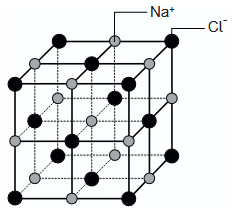
Which statement is correct for the lattice structure of NaCl?
(B) The forces of attraction in the lattice are very weak.
(C) Each sodium ion is surrounded by four chloride ions.
(D) The structure breaks apart when dissolved in water.
▶️ Answer/Explanation
Correct Answer: \( \boxed{\mathrm{D}} \)
NaCl is an ionic lattice containing \( \mathrm{Na^+} \) and \( \mathrm{Cl^-} \) ions held together by strong electrostatic attractions between oppositely charged ions.
(A) is incorrect because the ions are held together by ionic attractions, not covalent bonds.
(B) is incorrect because the electrostatic attractions in the ionic lattice are strong.
(C) is incorrect because each \( \mathrm{Na^+} \) ion is surrounded by six \( \mathrm{Cl^-} \) ions in the NaCl structure.
When NaCl dissolves in water, the ionic lattice is broken apart and the ions become hydrated by water molecules. Therefore, the correct answer is (D).
Question
| Formula | Electron configuration of the Ca species | Electron configuration of the N species |
|---|---|---|
| A. Ca2N3 | [Ar] | [Ne] |
| B. Ca2N3 | [Ar] 4s2 | [He] 2s2 2p3 |
| C. Ca2N2 | [Ar] 4s2 | [He] 2s2 2p3 |
| D. Ca2N2 | [Ar] | [Ne] |
▶️ Answer/Explanation
Calcium nitride:
- Formula: Ca3N2 (Ca2+ and N3−)
- Ca2+: loses 2 electrons → [Ar] configuration (without 4s2)
- N3−: gains 3 electrons → [Ne] configuration (1s2 2s2 2p6)
✅ Answer: (D) – Ca2N2 with [Ar] and [Ne] configurations
Note: While the exact formula should be Ca3N2, among the given options, (D) has the correct electron configurations for the ionic species.
Question
The table shows some physical properties of a certain substance.
| Melting point / °C | Electrical conductivity | |
|---|---|---|
| Molten | Solid | |
| 1414 | poor | poor |
▶️ Answer/Explanation
Correct Answer: A. Network covalent
• A very high melting point (1414 °C) suggests a giant covalent structure.
• Poor electrical conductivity in both molten and solid states is also characteristic of network covalent solids.
• Ionic compounds would conduct electricity when molten, and metals conduct in solid form—so these are eliminated.
✔️ Therefore, the substance is most likely **network covalent**.