
AS & A Level Chemistry 13.1 Formulae, functional groups and the naming of organic compounds Exam Style Practice Questions Paper 1- New Syllabus
Question
The diagram shows the skeletal formula of the hormone testosterone.
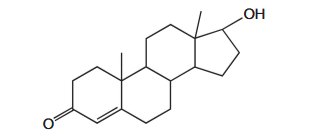
What is the molecular formula of testosterone?
(B) \(\mathrm{C_{17}H_{22}O_2}\)
(C) \(\mathrm{C_{17}H_{24}O_2}\)
(D) \(\mathrm{C_{19}H_{26}O_2}\)
▶️ Answer/Explanation
Correct Answer: \( \boxed{\mathrm{A}} \)
From the skeletal formula:
- There are 19 carbon atoms.
- There are 2 oxygen atoms (one ketone group and one alcohol group).
- Accounting for the four fused rings and the double bond gives a total of 28 hydrogen atoms.
Therefore, the molecular formula is:
\(\mathrm{C_{19}H_{28}O_2}\)
Therefore, the correct answer is (A).
Question
An organic compound, T, contains only one functional group.
Compound T has the empirical formula \( \mathrm{C_2H_4O} \).
Some functional groups are listed.
1. Alcohol
2. Aldehyde
3. Ester
4. Ketone
Which functional groups are possible for compound T?
(B) 1 and 4
(C) 2 and 3
(D) 2 and 4
▶️ Answer/Explanation
Correct Answer: \( \boxed{\mathrm{C}} \)
The empirical formula is \( \mathrm{C_2H_4O} \), so any possible molecular formula must be a whole-number multiple of this ratio.
- Aldehydes can have the formula \( \mathrm{C_nH_{2n}O} \), for example ethanal, \( \mathrm{C_2H_4O} \).
- Esters can also have molecular formulas that simplify to \( \mathrm{C_2H_4O} \), for example compounds with formula \( \mathrm{C_4H_8O_2} \).
- Alcohols have the general formula \( \mathrm{C_nH_{2n+2}O} \), which does not simplify to \( \mathrm{C_2H_4O} \).
- Ketones require at least three carbon atoms, so no ketone has the empirical formula \( \mathrm{C_2H_4O} \).
Therefore, the possible functional groups are 2 and 3, so the correct answer is (C).
Question
Each mineral listed behaves as a mixture of two carbonate compounds. They can be used as fire retardants because they decompose on heating, producing \( \mathrm{CO_2} \). This gas smothers the fire.
Barytocalcite, \( \mathrm{BaCa(CO_3)_2} \)
Dolomite, \( \mathrm{CaMg(CO_3)_2} \)
Huntite, \( \mathrm{Mg_3Ca(CO_3)_4} \)
What is the order of effectiveness as fire retardants, from best to worst?
| Best | → | Worst | |
|---|---|---|---|
| (A) | Dolomite | Barytocalcite | Huntite |
| (B) | Dolomite | Huntite | Barytocalcite |
| (C) | Huntite | Barytocalcite | Dolomite |
| (D) | Huntite | Dolomite | Barytocalcite |
▶️ Answer/Explanation
Correct Answer: \( \boxed{\mathrm{D}} \)
The effectiveness of the minerals depends on the amount of \( \mathrm{CO_2} \) released when their carbonate ions decompose.
Each carbonate ion produces one mole of \( \mathrm{CO_2} \).
Number of carbonate ions per formula unit:
Barytocalcite: \(2\)
Dolomite: \(2\)
Huntite: \(4\)
Huntite releases the greatest amount of \( \mathrm{CO_2} \), making it the most effective fire retardant.
Between dolomite and barytocalcite, magnesium carbonate decomposes more readily than barium carbonate, so dolomite releases \( \mathrm{CO_2} \) more easily than barytocalcite.
Therefore, the order from best to worst is Huntite → Dolomite → Barytocalcite. Hence, the correct answer is (D).