
AS & A Level Chemistry 22.2 Mass spectrometry Exam Style Practice Questions Paper 1- New Syllabus
Question
The mass spectrum of element Z is shown.
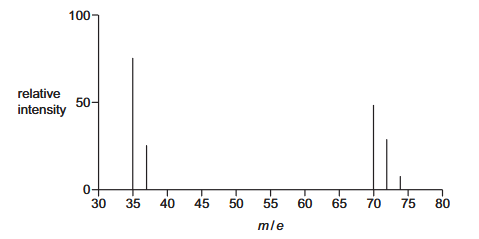
What is element Z?
(B) chlorine
(C) gallium
(D) tungsten
▶️ Answer/Explanation
Correct Answer: \( \boxed{\mathrm{B}} \)
The spectrum shows two major peaks at approximately \(m/e=35\) and \(m/e=37\) in a ratio of about 3:1.
These correspond to the naturally occurring isotopes:
- \( \mathrm{^{35}Cl} \) (about 75%)
- \( \mathrm{^{37}Cl} \) (about 25%)
The additional peaks at \(m/e=70\), 72 and 74 are molecular ion peaks for \( \mathrm{Cl_2^+} \):
- \( \mathrm{^{35}Cl-^{35}Cl^+} \rightarrow m/e=70 \)
- \( \mathrm{^{35}Cl-^{37}Cl^+} \rightarrow m/e=72 \)
- \( \mathrm{^{37}Cl-^{37}Cl^+} \rightarrow m/e=74 \)
This characteristic pattern is unique to chlorine.
Therefore, the correct answer is (B).
Question
The mass spectrum of an organic compound has the following features.
- The molecular ion peak is at \( m/e = 60 \). This peak has a relative intensity of \(100\).
- There is a peak at \( m/e = 61 \), which has a relative intensity of \(2.2\).
- There is no fragment peak at \( m/e = 17 \).
- There is a fragment peak at \( m/e = 31 \).
What could be the identity of the organic compound?
(B) Methoxyethane, \( \mathrm{CH_3OCH_2CH_3} \)
(C) Ethanoic acid, \( \mathrm{CH_3COOH} \)
(D) Propan-2-ol, \( \mathrm{CH_3CH(OH)CH_3} \)
▶️ Answer/Explanation
Correct Answer: \( \boxed{\mathrm{A}} \)
The molecular ion peak at \( m/e = 60 \) shows that the compound has a relative molecular mass of \(60\).
The peak at \( m/e = 61 \) has an intensity of about \(2.2\%\), indicating the presence of two carbon atoms, since the natural abundance of \(^{13}\mathrm{C}\) is approximately \(1.1\%\) per carbon atom.
There is no fragment peak at \( m/e = 17 \), so a hydroxyl group (\( \mathrm{-OH} \)) is unlikely. This rules out ethanoic acid and propan-2-ol.
A fragment at \( m/e = 31 \) is consistent with the \( \mathrm{CH_3O^+} \) ion, which is commonly produced by esters containing a methoxy group.
Methyl methanoate, \( \mathrm{HCOOCH_3} \), satisfies all of these observations.
Therefore, the correct answer is (A).
Question
The mass spectrum of \( \mathrm{CH_3Cl} \) shows a molecular ion peak, \( \mathrm{M^+} \), at the \( \mathrm{m/e} \) value of \(50\) with a relative abundance of \(18.0\%\).
Other peaks are present in the mass spectrum.
What is seen in the mass spectrum at the \( \mathrm{m/e} \) value of \(52\)?
(B) A peak with relative abundance of \(6.0\%\)
(C) A peak with relative abundance of \(18.0\%\)
(D) A peak with relative abundance of \(54.0\%\)
▶️ Answer/Explanation
Correct Answer: \( \boxed{\mathrm{B}} \)
Chlorine has two common isotopes:
- \( \mathrm{^{35}Cl} \): about \(75\%\)
- \( \mathrm{^{37}Cl} \): about \(25\%\)
Therefore, the molecular ion peaks occur in the ratio \(3:1\).
If the \( \mathrm{M^+} \) peak at \( \mathrm{m/e}=50 \) has a relative abundance of \(18.0\%\), then the peak at \( \mathrm{m/e}=52 \) is:
\( \mathrm{18.0 \times \dfrac{1}{3}=6.0\%} \)
Therefore, the correct answer is (B).