
AS & A Level Chemistry 3.7 Dot-and-cross diagrams Exam Style Practice Questions Paper 1- New Syllabus
Question
Which dot-and-cross diagram is correct for \(\mathrm{Al_2Cl_6}\)?
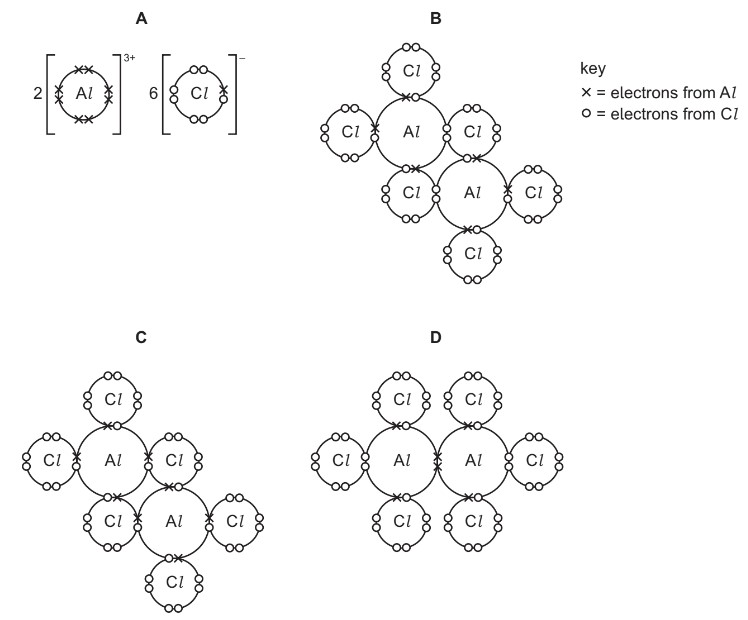
(B) Diagram B
(C) Diagram C
(D) Diagram D
▶️ Answer/Explanation
Correct Answer: \( \boxed{\mathrm{B}} \)
\(\mathrm{Al_2Cl_6}\) exists as a dimer of two \(\mathrm{AlCl_3}\) molecules joined by two coordinate (dative covalent) bonds.
Each aluminium atom forms three ordinary covalent bonds with chlorine atoms and accepts one lone pair from a bridging chlorine atom, giving each aluminium an octet.
- (A) Shows ions, implying ionic bonding, which is incorrect for \(\mathrm{Al_2Cl_6}\). ✘
- (B) Correctly shows two bridging chlorine atoms donating lone pairs to aluminium atoms through coordinate bonds. ✔️
- (C) Shows incorrect bonding arrangement for the bridging chlorine atoms. ✘
- (D) Does not correctly represent the coordinate bonding in the dimer. ✘
Therefore, the correct dot-and-cross diagram is (B).
Question
In which structure are three atoms bonded together in a straight line?
(B) propane, \(\mathrm{C_3H_8}\)
(C) silicon tetrachloride, \(\mathrm{SiCl_4}\)
(D) sulfur hexafluoride, \(\mathrm{SF_6}\)
▶️ Answer/Explanation
Correct Answer: \( \boxed{\mathrm{D}} \)
Consider the molecular geometry of each substance:
- (A) In poly(ethene), each carbon is tetrahedral (\(109.5^\circ\)), so the carbon atoms are not arranged in a straight line. ✘
- (B) In propane, each carbon is tetrahedral, giving a zigzag chain rather than a straight line. ✘
- (C) \(\mathrm{SiCl_4}\) has a tetrahedral shape, so no three atoms are collinear. ✘
- (D) \(\mathrm{SF_6}\) has an octahedral shape. Opposite fluorine atoms lie \(180^\circ\) apart, giving a straight-line arrangement \(\mathrm{F-S-F}\). ✔️
Therefore, the correct answer is (D).
Question
Which molecules contain at least one unpaired electron?
1 \(\mathrm{NO}\)
2 \(\mathrm{NO_2}\)
3 \(\mathrm{NH_3}\)
(B) 1 and 2 only are correct
(C) 2 and 3 only are correct
(D) 1 only is correct
▶️ Answer/Explanation
Correct Answer: \( \boxed{\mathrm{B}} \)
Molecules with an odd number of valence electrons usually contain at least one unpaired electron.
- 1. \(\mathrm{NO}\): Has 11 valence electrons, so it contains one unpaired electron. ✔️
- 2. \(\mathrm{NO_2}\): Has 17 valence electrons, so it also contains one unpaired electron. ✔️
- 3. \(\mathrm{NH_3}\): Has 8 valence electrons around nitrogen with all electrons paired, so it has no unpaired electrons. ✘
Therefore, only statements 1 and 2 are correct, so the answer is (B).