A uniform rod is attached by a hinge at one end to a wall. The other end of the rod is supported by a wire so that the rod is horizontal and in equilibrium.
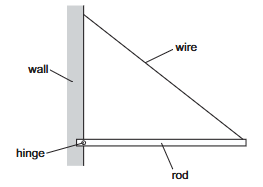
Which arrow shows the direction of the force on the rod from the hinge?
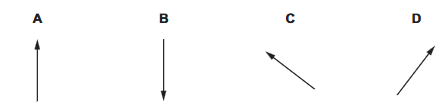
Correct Answer: \( \boxed{\mathrm{D}} \)
The wire exerts a force on the rod that has an upward and leftward component.
To maintain equilibrium, the hinge must provide a force with rightward and upward components.
Hence, the hinge force acts diagonally upwards to the right.
Therefore, the correct answer is (D).
A uniform beam rests on two supports, \(X\) and \(Y\), as shown.
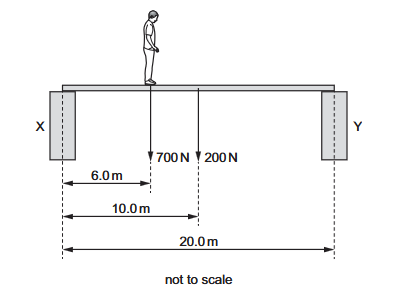
The beam has length \(20.0\,\mathrm{m}\) and weight \(200\,\mathrm{N}\).
A man of weight \(700\,\mathrm{N}\) stands on the beam at a distance of \(6.0\,\mathrm{m}\) from support \(X\).
The beam is in equilibrium.
What is the contact force of support \(X\) on the beam?
Correct Answer: \( \boxed{\mathrm{C}} \)
Let the reactions at supports \(X\) and \(Y\) be \(R_X\) and \(R_Y\).
Taking moments about \(X\):
\(R_Y(20)=700(6)+200(10)=6200\).
Hence, \(R_Y=310\,\mathrm{N}\).
Using vertical equilibrium,
\(R_X+310=700+200=900\).
Therefore, \(R_X=590\,\mathrm{N}\).
Four forces, all in the same plane, act on an object.
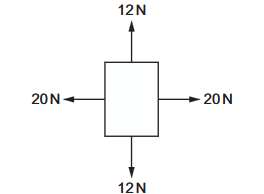
What could describe the motion of the object?
Correct Answer: \( \boxed{\mathrm{B}} \)
The horizontal forces are equal and opposite (\(20\,\mathrm{N}\)), and the vertical forces are also equal and opposite (\(12\,\mathrm{N}\)).
Hence, the resultant force on the object is zero.
With zero resultant force, the object has zero acceleration according to Newton’s first law.
The object could therefore remain at rest or move with constant velocity in a straight line.
Therefore, the correct answer is (B).
