
Question
(a) State the principle of superposition. (2 marks)
____________________________________________
____________________________________________
(b) An electromagnetic wave of wavelength \(0.026\,\mathrm{m}\) in free space is incident normally on an aluminium sheet, as shown in Fig. 4.1.
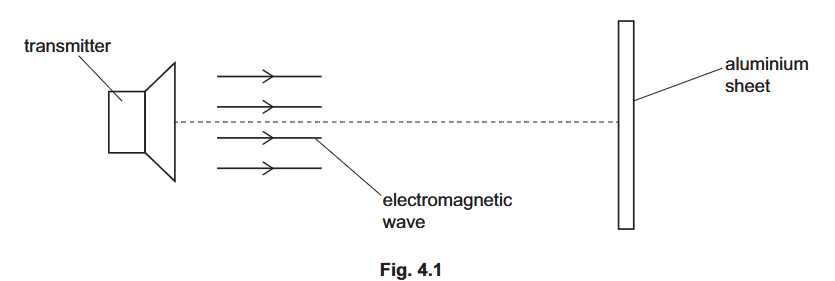
The wave reflects at the aluminium sheet and a stationary wave is formed in the region between the transmitter and the sheet.
(i) Explain how the stationary wave, including its nodes and antinodes, is formed. (3 marks)
____________________________________________
____________________________________________
____________________________________________
(ii) Calculate the frequency of the electromagnetic wave. (2 marks)
frequency = __________________________ \( \mathrm{Hz} \)
(iii) State the principal region of the electromagnetic spectrum to which the wave belongs. (1 mark)
____________________________________________
(iv) Determine the distance between a node and an adjacent antinode. (1 mark)
distance = __________________________ \( \mathrm{m} \)
Syllabus Topic Codes (Cambridge International AS & A Level Physics 9702):
• 8.2: Stationary waves — parts (b)(i) and (b)(iv)
• 7.4: Electromagnetic waves and the electromagnetic spectrum — parts (b)(ii) and (b)(iii)
▶️ Answer/Explanation
(a) Principle of superposition [2 marks]
When two or more waves meet, the resultant displacement is equal to the sum of the displacements of the individual waves.
Answer: \( \boxed{\text{resultant displacement = sum of the individual displacements}} \)
(b)(i) Formation of a stationary wave [3 marks]
The incident wave and the reflected wave travel in opposite directions and superpose.
At certain positions, the two waves interfere constructively, producing points of maximum amplitude called antinodes.
At other positions, the two waves interfere destructively, producing points of zero amplitude called nodes.
Answer: \( \boxed{\text{superposition of incident and reflected waves produces nodes and antinodes}} \)
(b)(ii) Frequency of the electromagnetic wave [2 marks]
For an electromagnetic wave in free space,
\(c=f\lambda\)
Therefore,
\(f=\dfrac{c}{\lambda}\)
\(f=\dfrac{3.00\times10^8}{0.026}\)
\(f=1.15\times10^{10}\,\mathrm{Hz}\)
Answer: \( \boxed{1.2\times10^{10}\,\mathrm{Hz}} \)
(b)(iii) Region of the electromagnetic spectrum [1 mark]
A wavelength of \(0.026\,\mathrm{m}\) corresponds to the microwave region of the electromagnetic spectrum.
Answer: \( \boxed{\text{microwave}} \)
(b)(iv) Distance between a node and adjacent antinode [1 mark]
In a stationary wave, the distance between an adjacent node and antinode is \(\dfrac{\lambda}{4}\).
\(\text{distance}=\dfrac{0.026}{4}\)
\(\text{distance}=6.5\times10^{-3}\,\mathrm{m}\)
Answer: \( \boxed{6.5\times10^{-3}\,\mathrm{m}} \)