IB DP Biology- A3.2 Classification and cladistics-IB Style Questions For HL Paper 1A -FA 2025
Question
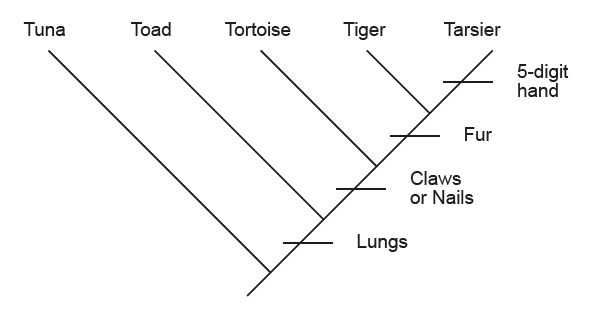
The following cladogram illustrates the evolutionary relationships among several vertebrates.
Based on the cladogram, which of the following conclusions can be made?
A. Tortoises do not possess lungs.
B. A tortoise and a tarsier share a closer evolutionary relationship than a tiger and a tarsier.
C. A toad and a tuna are more closely related than a tiger and a tuna.
D. Tigers possess both fur and 5-digit hands.
▶️ Answer/Explanation
The cladogram shows that the tuna diverged first, while the toad shares a more recent common ancestor with other terrestrial animals.
This indicates that the toad and tuna are more closely related to each other than either is to the tiger, which diverged later and possesses additional traits such as fur.
✅ Answer: (C) A toad and a tuna are more closely related than a tiger and a tuna.
This indicates that the toad and tuna are more closely related to each other than either is to the tiger, which diverged later and possesses additional traits such as fur.
✅ Answer: (C) A toad and a tuna are more closely related than a tiger and a tuna.
Question
In a natural classification, what do all members of a genus have in common?
A. They all have the same binomial name.
B. They all belong to the same species.
C. They can freely interbreed to produce fertile offspring.
D. They have all evolved from the same common ancestor.
▶️Answer/Explanation
Answer: D
Explanation:
In biology, classification is based on the evolutionary relationships among organisms. The genus is a category that groups together species that are closely related. All species within a genus share a common evolutionary ancestor, meaning they have evolved from the same lineage.
