
▶️ Answer/Explanation
(a)
Essential amino acids cannot be synthesized by human cells in sufficient amounts and therefore must be obtained from the diet.
Non-essential amino acids can be synthesized by human cells, for example from other amino acids or metabolic intermediates, so they do not have to be obtained directly from the diet.
(b)
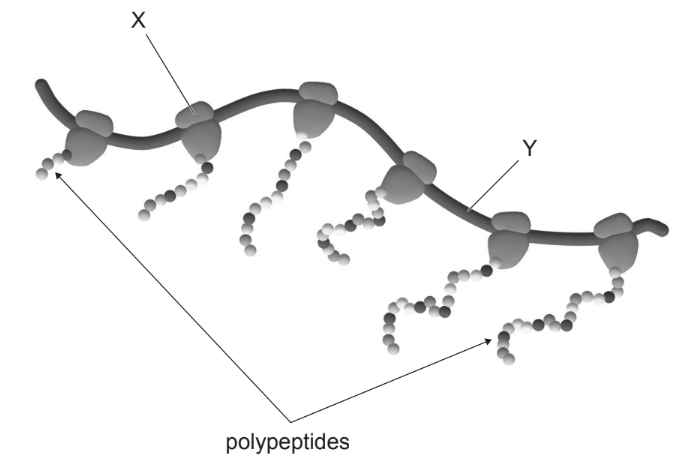
The diagram shows several ribosomes attached to a single strand of messenger RNA. Each ribosome is translating the mRNA and producing a polypeptide.
X: Small subunit of a ribosome.
Y: Messenger RNA (mRNA).
(c)
The different lengths of the polypeptides are due to the ribosomes being at different positions along the mRNA molecule.
The ribosomes move along the mRNA and translate its codons, adding amino acids one at a time to the growing polypeptide chain. A ribosome that has been translating the mRNA for longer will have added more amino acids and therefore produces a longer polypeptide.
Thus, the ribosome on the right has moved further along the mRNA and has added more amino acids, giving its polypeptide a greater length than those produced by the ribosomes earlier in the process.