Home / IB DP Biology- B4.1 Adaptation to environment – IB Style Questions For SL Paper 1A

IB DP Biology- B4.1 Adaptation to environment - IB Style Questions For SL Paper 1A -FA 2025

Question

Which environmental condition(s) would raise the rate of transpiration in plants?
I. Increased carbon dioxide concentration in the atmosphere
II. Increased temperature of the atmosphere
III. Decreased humidity of the atmosphere relative to the inside of the leaf
(A) I and II only
(B) III only
(C) II and III only
(D) I and III only
▶️ Answer/Explanation
Detailed solution

Factors affecting transpiration rate:

  • I. Increased CO₂ concentration → Causes stomatal closure, decreasing transpiration
  • II. Increased temperature → Increases water vapor pressure gradient, increasing transpiration
  • III. Decreased humidity → Increases water vapor pressure gradient between leaf and air, increasing transpiration

Only II and III increase transpiration rate.

Answer: (C)

Question

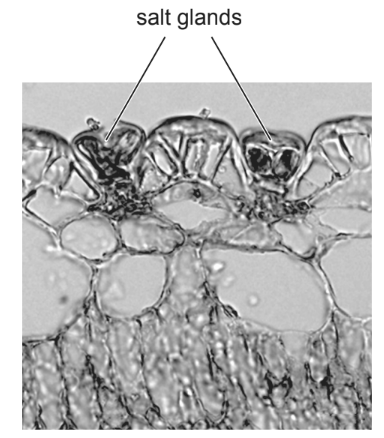
Avicennia officinalis is a tree species that is adapted to live in mangrove swamps. Salt glands can be seen in the micrograph of a transverse section of an A. officinalis leaf.

How does A. officinalis benefit from this adaptation?

(A) The glands provide nitrates for amino acid synthesis as mangrove soils are nitrogen-deficient.
(B) The salt in the leaves attracts predators to eat the leaves.
(C) A high concentration of salt in the glands allows absorption of water into the leaf cells.
(D) The glands secrete salt to keep cytoplasmic concentration suitable for metabolic processes.
▶️ Answer/Explanation

Correct Answer: \( \boxed{\mathbf{D}} \)

Mangroves grow in high-salinity environments. Salt glands remove excess salt from the plant by secreting it onto the leaf surface. This prevents excessive salt accumulation inside cells, helping to maintain a suitable cytoplasmic solute concentration for normal metabolic processes.

Question

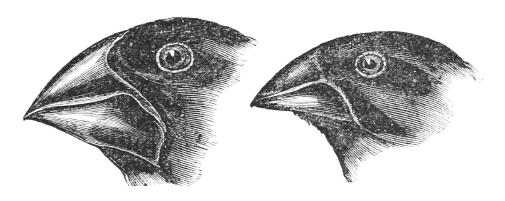
Scientists studying ground finches (Geospiza fortis) on the island of Daphne Major in the Galápagos found great differences in the shapes of their beaks.

finch beak variation

What is the explanation for this variation in beak shape between the birds?

A. Ground finches grow larger beaks if there is competition for food.
B. They belong to different species.
C. They are adapted for different diets.
D. The more a beak is used by a ground finch, the larger it becomes.

▶️ Answer/Explanation

Answer: C. They are adapted for different diets.

Explanation:
The image shows two ground finches from the Galápagos Islands with distinctly different beak shapes. This is a classic example of adaptive radiation—a process where species evolve different characteristics to occupy different ecological niches.

Let’s examine the options:

A. Incorrect – Beak size and shape are not determined by use or competition during an individual bird’s lifetime. These traits are inherited and shaped by natural selection over generations.

B. Not necessarily – Although there are multiple finch species, the variation in beak shape here is due to adaptation to different food sources, not simply species distinction.

C. Correct – The differences in beak shape are adaptations for feeding on different types of food. For instance:
Thicker, stronger beaks help crack hard seeds.
Longer, thinner beaks are better for feeding on insects.

D. Incorrect – This represents a Lamarckian concept (that traits develop through use), which has been disproven. Evolutionary changes occur via natural selection, not by acquired traits during an organism’s life.

Scroll to Top