
IB DP Biology- D4.3 Climate change- IB Style Questions For HL Paper 1A -New Syllabus
Question
The data show how the hardiness zones in part of North America are predicted to change by 2050. A hardiness zone represents the average annual minimum temperature, with lower numbers indicating colder conditions.
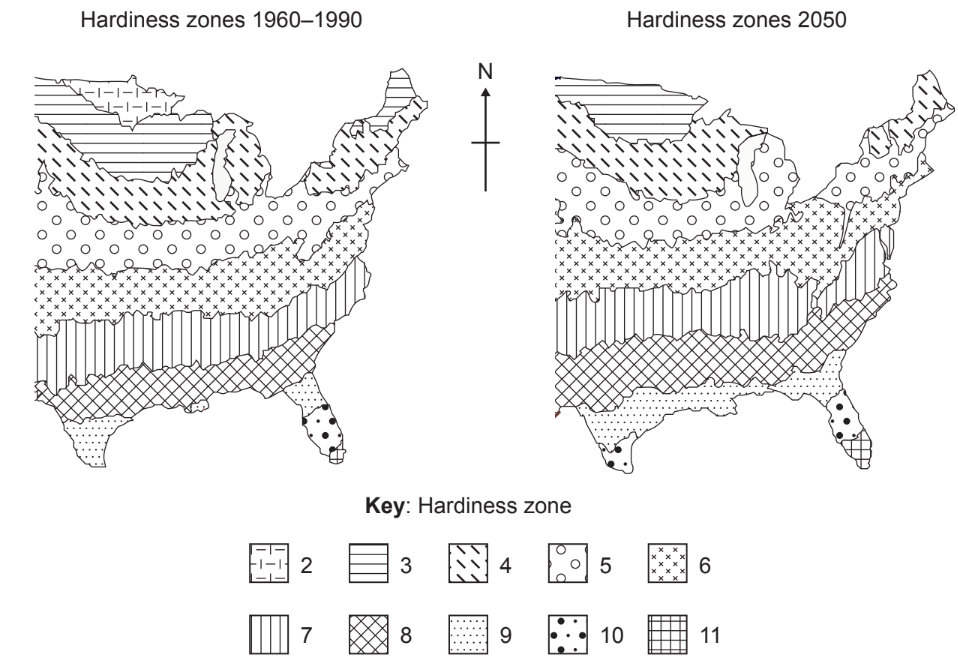
What is a likely consequence of this change for tree species?
(B) Tree species that are not cold-resistant will decline.
(C) There will be no change in the distribution of the tree species.
(D) Tree species that currently live in the north will outcompete other tree species.
▶️ Answer/Explanation
Correct Answer: \( \boxed{\mathbf{A}} \)
As temperatures increase, hardiness zones shift northwards, allowing tree species adapted to warmer climates to expand into previously colder regions. Consequently, the distribution of many tree species moves northwards in response to climate change.
Question
Which factor is the primary cause of modern climate change observed across the globe?
A. The burning of fossil fuels, releasing greenhouse gases into the atmosphere
B. Natural variations in solar output, causing short-term temperature changes
C. Ocean currents redistributing heat and altering regional weather systems
D. Volcanic eruptions that temporarily warm the Earth’s atmosphere
▶️ Answer/Explanation
✅ Answer: (A) The burning of fossil fuels, releasing greenhouse gases into the atmosphere.
Question
Which of the following could be a subject of phenological research?
(B) Changes in allele frequencies in a population over time
(C) The relationship between changes in ocean acidification and carbon dioxide concentration
(D) The emergence of a new species of migratory bird by divergent evolution
▶️ Answer/Explanation
Correct Answer: \( \boxed{\mathbf{A}} \)
Phenology is the study of the timing of recurring biological events and how they are influenced by seasonal and climatic changes. Examples include budburst, flowering, leaf fall, bird migration, and breeding seasons. Therefore, recording the timing of budburst each year is a phenological study.