
Home / IBDP Physics- D.2 Electric and magnetic fields- IB Style Questions For HL Paper 1A

IBDP Physics- D.2 Electric and magnetic fields- IB Style Questions For HL Paper 1A -FA 2025

Question 

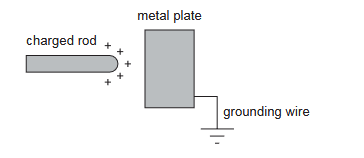
A positively charged rod is near a metal plate that is grounded as shown.

The grounding wire and then the rod are removed. What is correct about the overall charge on the plate before and after grounding is removed?

 Charge on plate before grounding is removedCharge on plate after grounding is removed
(A)neutralneutral
(B)neutralnegative
(C)negativeneutral
(D)negativenegative
▶️ Answer/Explanation

Correct Answer: \( \boxed{\mathrm{D}} \)

The positively charged rod attracts electrons towards the near side of the metal plate. When the plate is grounded, electrons can flow from the Earth onto the plate because the positive rod attracts them.

Therefore, while the rod is present and the plate is grounded, the plate can acquire an excess of electrons and has an overall negative charge.

The grounding wire is removed first. This prevents the excess electrons from flowing back to Earth, so the plate remains negatively charged.

When the positively charged rod is subsequently removed, the excess electrons redistribute themselves over the plate. However, the total charge remains negative.

Thus, the plate is negative both before and after the grounding wire is removed.

Hence, the correct answer is \( \boxed{\mathrm{D}} \).

Question 

A positively charged particle is moving towards a current-carrying wire as shown.

What is the direction of the magnetic force acting on the charged particle?

(A) To the right
(B) To the left
(C) Into the page
(D) Out of the page
▶️ Answer/Explanation

Correct Answer: \( \boxed{\mathrm{B}} \)

The magnetic field around a straight current-carrying wire forms concentric circles around the wire. Using the right-hand grip rule, with the current directed to the right, the magnetic field at the position of the particle is into the page.

The magnetic force on a charged particle is given by

\(F=qvB\sin\theta\)

The particle is positively charged, so the force direction is given directly by the right-hand rule for \(\mathbf{v}\times\mathbf{B}\).

The particle’s velocity is downward and the magnetic field is into the page. Applying the right-hand rule gives a force towards the left.

Hence, the correct answer is \( \boxed{\mathrm{B}} \).

Question

P and R are parallel wires carrying the same current into the plane of the paper. P and R are equidistant from a point Q. The line PQ is perpendicular to the line RQ.
The magnetic field due to P at Q is \( X \). What is the magnitude of the resultant magnetic field at Q due to both wires?
(A) \( \dfrac{x}{2} \)
(B) \( x \)
(C) \( x\sqrt{2} \)
(D) \( 2x \)
▶️ Answer / Explanation
Detailed solution

The magnetic field produced by a long straight current-carrying wire is given by:

\( B = \dfrac{\mu_0 I}{2\pi r} \)

Since wires P and R carry the same current and are equidistant from point Q, the magnitudes of the magnetic fields at Q due to each wire are equal.

Hence, the magnetic field at Q due to wire P has magnitude \( X \), and the magnetic field at Q due to wire R also has magnitude \( X \).

From the geometry of the arrangement, the directions of these two magnetic fields at Q are perpendicular to each other.
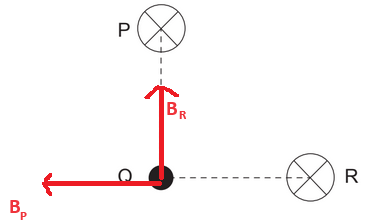
Therefore, the resultant magnetic field at Q is given by vector addition:

\( B_{\text{resultant}} = \sqrt{X^2 + X^2} = X\sqrt{2} \)

Answer: (C)

Scroll to Top