
IBDP Physics- B.2 Greenhouse effect - IB Style Questions For HL Paper 1A -FA 2025
Question
The energy balance model of a planet’s climate is shown. The reflected and radiated intensities are given in terms of the incident incoming intensity \(I\).
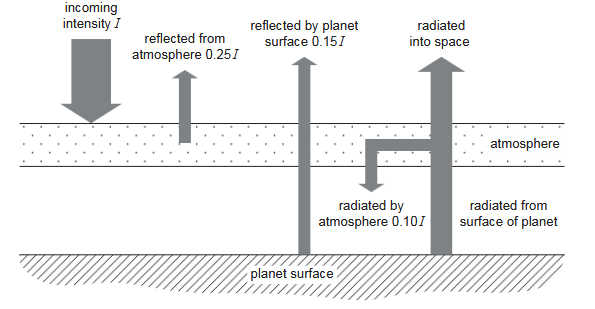
What is the radiated intensity from the surface of the planet?
(B) \(0.50I\)
(C) \(0.70I\)
(D) \(1.10I\)
▶️ Answer/Explanation
Correct Answer: \( \boxed{\mathrm{C}} \)
First, determine the solar intensity absorbed by the planet’s surface.
The incoming intensity is \(I\). Of this, \(0.25I\) is reflected by the atmosphere and \(0.15I\) is reflected by the planet’s surface.
Therefore, the intensity absorbed by the surface is
\(I-0.25I-0.15I=0.60I\)
The atmosphere also radiates \(0.10I\) towards the surface. Hence, the total energy received by the surface is
\(0.60I+0.10I=0.70I\)
At thermal equilibrium, the energy radiated by the surface must equal the energy received by the surface.
Therefore,
\(I_{\mathrm{radiated}}=0.70I\)
Hence, the correct answer is \( \boxed{\mathrm{C}} \).
Question
The diagram shows the incident, radiated and reflected intensities of the solar radiation for two regions X and Y on the surface of Earth. X and Y have the same surface temperature.
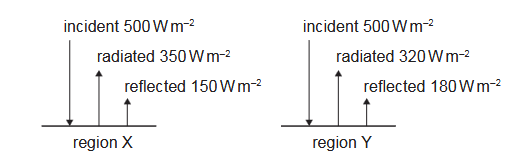
Which region has a greater albedo, and which region has a greater emissivity?
| Greater albedo | Greater emissivity | |
|---|---|---|
| (A) | X | X |
| (B) | Y | X |
| (C) | X | Y |
| (D) | Y | Y |
▶️ Answer/Explanation
Correct Answer: \( \boxed{\mathrm{B}} \)
Albedo is the fraction of incident radiation that is reflected:
\(\mathrm{albedo}=\frac{I_{\mathrm{reflected}}}{I_{\mathrm{incident}}}\)
For region X,
\(\mathrm{albedo}_X=\frac{150}{500}=0.30\)
For region Y,
\(\mathrm{albedo}_Y=\frac{180}{500}=0.36\)
Therefore, region Y has the greater albedo.
The absorbed intensity is the incident intensity minus the reflected intensity. For X,
\(I_{\mathrm{absorbed},X}=500-150=350\,\mathrm{W\,m^{-2}}\)
For Y,
\(I_{\mathrm{absorbed},Y}=500-180=320\,\mathrm{W\,m^{-2}}\)
Since X and Y have the same surface temperature, the thermal radiation emitted per unit area depends on emissivity according to
\(P=\varepsilon\sigma T^4\)
The radiated intensity is \(350\,\mathrm{W\,m^{-2}}\) for X and \(320\,\mathrm{W\,m^{-2}}\) for Y. Since their temperatures are equal, the region with the greater radiated intensity has the greater emissivity.
Therefore, region X has the greater emissivity.
Thus,
\( \boxed{\text{Greater albedo: Y,\quad Greater emissivity: X}} \)
Hence, the correct answer is \( \boxed{\mathrm{B}} \).
Question
II. Changing the fuel of power stations from natural gas to uranium-235
III. Changing the fuel of power stations from natural gas to oil
(B) I and III only
(C) II and III only
(D) I, II and III
▶️ Answer/Explanation
I. Capturing and storing \( \mathrm{CO}_2 \) reduces the amount released into the atmosphere. Since \( \mathrm{CO}_2 \) is a major greenhouse gas, this reduces the enhanced greenhouse effect.
II. Nuclear power using uranium-235 does not produce \( \mathrm{CO}_2 \) during electricity generation. Replacing natural gas with nuclear power therefore reduces greenhouse gas emissions.
III. Burning oil releases more \( \mathrm{CO}_2 \) per unit energy than natural gas. Switching from natural gas to oil would increase greenhouse gas emissions, not reduce them.
Therefore, only changes I and II reduce the enhanced greenhouse effect.
✅ Answer: (A)