
▶️ Answer/Explanation
Detailed solution:
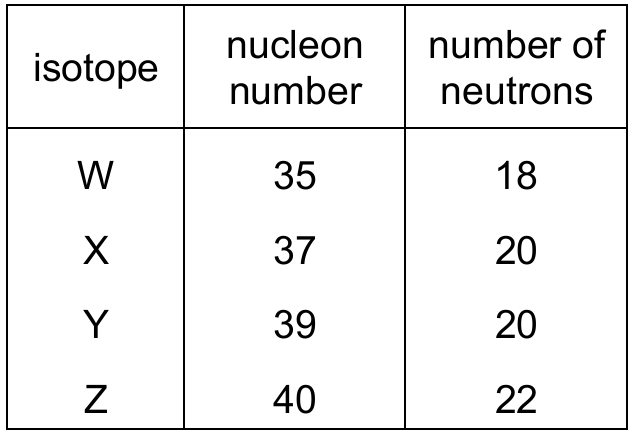
To find the proton number of each isotope, subtract the number of neutrons from the nucleon number. For W: $35 – 18 = 17$ protons; X: $37 – 20 = 17$ protons; Y: $39 – 20 = 19$ protons; Z: $40 – 22 = 18$ protons. Isotopes are atoms of the same element that have the same number of protons but different numbers of neutrons. Since W and X both have 17 protons (but different nucleon numbers), they are isotopes of the same element, making statement A correct. The other statements are incorrect: X and Y have different proton numbers so they are different elements, Y and Z have different proton numbers, and Z has 18 protons while Y has 19, so Z does not have a higher proton number than Y.
▶️ Answer/Explanation
Detailed solution:
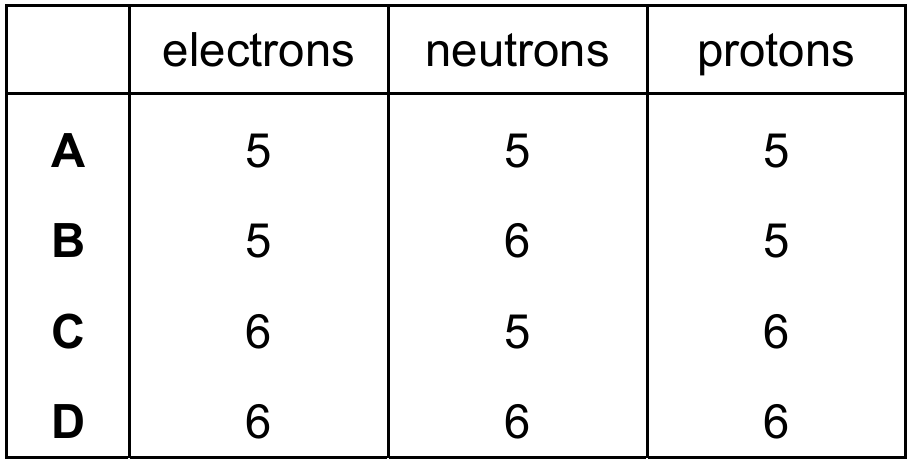
$^{11}_{5}\mathrm{B}$ has atomic number 5, so any isotope of boron must have 5 protons. In a neutral atom, electrons equal protons, so 5 electrons. $^{11}_{5}\mathrm{B}$ itself has 11 – 5 = 6 neutrons. The question asks for a particle which is an isotope of $^{11}_{5}\mathrm{B}$. An isotope has the same number of protons (5) but a different number of neutrons. Option A (5 electrons, 5 neutrons, 5 protons) represents boron-10 ($^{10}_{5}\mathrm{B}$), which is indeed a different isotope of boron. Option B represents $^{11}_{5}\mathrm{B}$ itself, while options C and D have the wrong number of protons.