iGCSE Chemistry (0620) Core:2.5 Simple molecules and covalent bonds: Exam Style Questions Paper 1- New Syllabus
Question

▶️ Answer/Explanation
Detailed solution:
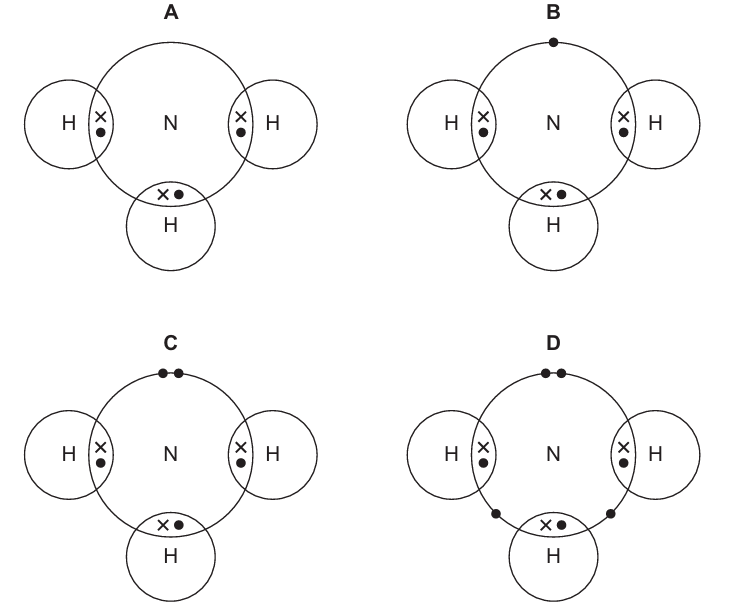
Nitrogen has five outer electrons, and each hydrogen has one. In ammonia ($\text{NH}_3$), nitrogen shares three of its electrons with three hydrogen atoms to form three single covalent bonds. This leaves one lone pair (two electrons) on the nitrogen. So we look for a diagram where the central nitrogen atom has three bonding pairs (each a shared pair with H) and one lone pair. That configuration is shown in option C.
Question
- argon
- methane
- iron(III) oxide
- chlorine
▶️ Answer/Explanation
Detailed solution:
Shared pairs of electrons are found in covalent bonds. Argon is a noble gas that exists as single atoms with no chemical bonds, so it has no shared pairs. Iron(III) oxide is an ionic compound where electrons are transferred from iron to oxygen. Methane (CH₄) has four C–H covalent bonds, each containing a shared pair of electrons. Chlorine exists as Cl₂ molecules with one shared pair of electrons between the two chlorine atoms. So only methane and chlorine contain shared pairs of electrons.
Question
▶️ Answer/Explanation
Detailed solution:
We need to find the atoms that put every single one of their outer shell electrons into shared covalent bonds. Hydrogen has only one electron, and in all these molecules it shares that one electron, so it always uses its entire outer shell. Carbon has four outer electrons, and in $CH_4$ it forms four covalent bonds, using them all. Chlorine in HCl and oxygen in $H_2O$, however, have lone pairs of electrons that sit on the atom and are not used for bonding, so they do not use all their outer shell electrons. That makes C and H the only correct pair.
