iGCSE Chemistry (0620) Core:2.7 Metallic bonding: Exam Style Questions Paper 1- New Syllabus
Question
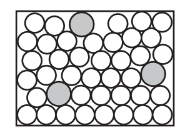
The diagram represents the structure of a solid.

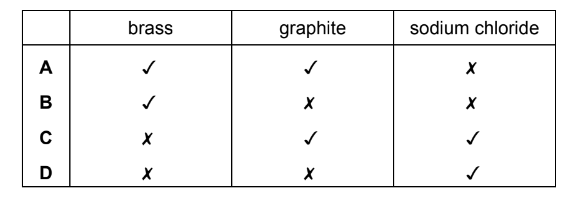
Which solids does the diagram represent?

▶️ Answer/Explanation
The diagram shows a giant lattice structure where particles are arranged in a regular, repeating three-dimensional pattern — this is characteristic of giant structures, which include ionic lattices, giant covalent structures, and metallic lattices. Diamond is a giant covalent structure where each carbon atom is covalently bonded to four others in a tetrahedral arrangement forming an extensive lattice, and silicon(IV) oxide (SiO₂) similarly forms a giant covalent lattice structure with a comparable appearance. Simple molecular solids such as iodine do not form giant lattices — they consist of discrete molecules held together by weak intermolecular forces — and sodium chloride, while also a giant lattice, is ionic rather than covalent. Row B correctly identifies diamond and silicon(IV) oxide as the two solids represented by this type of giant covalent lattice diagram.
✅ Answer: (B)
✅ Answer: (B)
Question
Three substances are listed.
- solid copper
- aqueous sodium bromide
- solid lead(II) bromide
Which substances conduct electricity?
A. 1, 2 and 3
B. 1 and 2 only
C. 1 and 3 only
D. 2 and 3 only
▶️ Answer/Explanation
Solid copper is a metal that conducts electricity efficiently due to its regular lattice structure surrounded by a highly mobile ‘sea’ of delocalised electrons. Aqueous sodium bromide is an ionic compound dissolved in water, meaning its ionic crystal network has broken down to let individual ions move freely and carry charge under an electric potential. Conversely, solid lead(II) bromide cannot conduct electricity because its constituent ions are securely locked in a rigid, fixed giant lattice structure, rendering them unable to move freely to transport current. This rules out options A, C, and D, making option B correct.
✅ Answer: (B)
✅ Answer: (B)
