iGCSE Chemistry (0620) Core:9.1 Properties of metals: Exam Style Questions Paper 1- New Syllabus
Question

▶️ Answer/Explanation
Detailed solution:
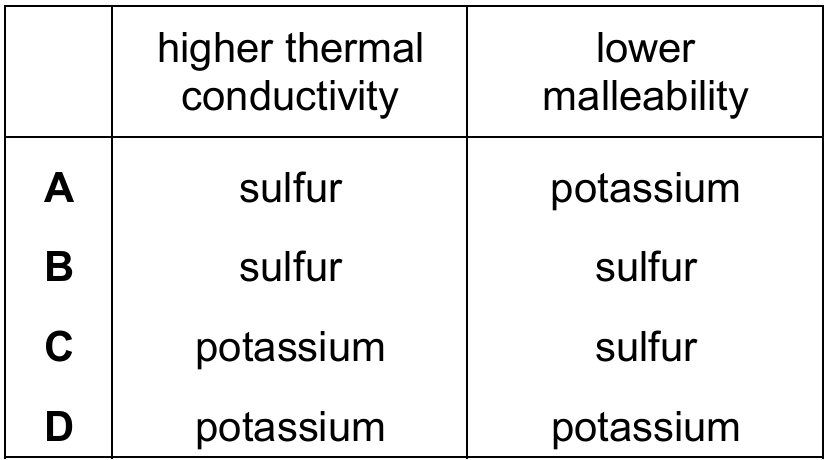
Potassium is a metal, so it has high thermal conductivity and is malleable. Sulfur is a non-metal, so it has poor thermal conductivity and is brittle (low malleability). So, potassium has the higher thermal conductivity, and sulfur has the lower malleability. That matches row C perfectly.
Question
- Calcium reacts faster than magnesium with cold water.
- Aluminium is more easily extracted than iron from its ore.
- Copper reacts faster than iron with dilute hydrochloric acid.
- Potassium and silver are both good conductors of electricity.
▶️ Answer/Explanation
Detailed solution:
Calcium is above magnesium in the reactivity series, so it reacts more vigorously with cold water, making statement 1 correct. Aluminium is more reactive than iron and is extracted by electrolysis, which is much harder and costlier than extracting iron in a blast furnace, so statement 2 is false. Copper sits below hydrogen in the reactivity series and cannot react with dilute acids at all, whereas iron does, so statement 3 is also false. All metals are good conductors of electricity, so both the highly reactive potassium and the unreactive silver conduct well, making statement 4 true. Only 1 and 4 are correct.
Question
- dilute acids to produce hydrogen
- steam to produce a basic oxide
- oxygen to produce a basic oxide.
▶️ Answer/Explanation
Detailed solution:
A substance that reacts with dilute acids to produce hydrogen gas is a metal. The fact that it forms a basic oxide with both steam and oxygen confirms it’s a metal. Silver is too unreactive to react with dilute acids, so it cannot be the answer. Phosphorus and silicon are non-metals and would form acidic oxides. Magnesium fits all the criteria: it reacts with acids, and its oxide (MgO) is a basic oxide.
