
iGCSE Chemistry (0620) Theory (Core):1.2 Diffusion: Exam Style Questions Paper 3 New Syllabus
Question
Dilute hydrochloric acid reacts with small pieces of calcium carbonate.
\(2HCl(aq) + CaCO_3(s) → CaCl_2(aq) + H_2O(l) + CO_2(g)\)
(a) State the meaning of the state symbol (aq).
(b) Fig. 6.1 shows how the mass of small pieces of calcium carbonate changes as the reaction proceeds. The calcium carbonate is in excess.
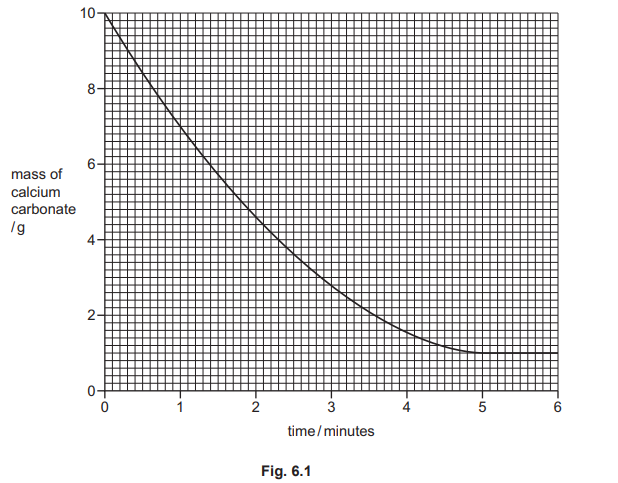
(i) Deduce the mass of calcium carbonate two minutes from the start of the reaction.
(ii) Explain how the graph shows that the calcium carbonate is in excess.
(iii) The experiment is repeated at a higher temperature. All other conditions stay the same. Draw a line on Fig. 6.1 to show how the mass of calcium carbonate changes at a higher temperature as the time increases.
(c) (i) Describe the effect, if any, on the rate of reaction when large pieces of calcium carbonate are used instead of small pieces of calcium carbonate. All other conditions stay the same.
(ii) Increasing the concentration of dilute hydrochloric acid increases the rate of reaction of dilute hydrochloric acid with calcium carbonate. Choose the correct unit of concentration from the list. Draw a circle around your chosen answer.

(d) Concentrated hydrochloric acid gives off hydrogen chloride gas. Hydrogen chloride is an acidic gas that turns damp universal indicator paper red. A long glass tube is set up as shown in Fig. 6.2.
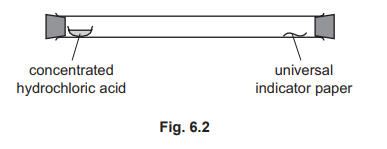
At first, the universal indicator paper does not change colour. The universal indicator paper turns red after a short time. Explain these results in terms of kinetic particle theory.
(e) Hydrogen chloride breaks down to form hydrogen and chlorine at 1500°C. The reaction is endothermic. State the meaning of the term endothermic.
Most-appropriate topic codes (Cambridge IGCSE Chemistry 0620):
• Topic 7.1 — Characteristic properties of acids and bases (Parts a, e)
• Topic 6.2 — Rate of reaction (Parts b, c)
• Topic 1.1 & 1.2 — States of matter and diffusion (Part d)
▶️ Answer/Explanation
(a)
For the correct answer:
aqueous / dissolved in water
The symbol (aq) stands for “aqueous”, which means the substance is dissolved in water to form a solution. In this reaction, hydrochloric acid (HCl) and calcium chloride (CaCl₂) are both in the aqueous state.
(b)(i)
\(4.6 \, (\mathrm{g})\)
Reading from the graph at exactly 2 minutes on the x-axis, the corresponding mass on the y-axis is approximately 4.6 g. This shows that 0.4 g of calcium carbonate has reacted by this time (starting from 5.0 g).
(b)(ii)
line levels off above 0 g / line levels off at 1 g
The mass of calcium carbonate does not drop to zero; it levels off at about 1 g. This residual mass confirms that some solid carbonate remains unreacted because all the acid has been used up, proving the solid was provided in excess.
(b)(iii)
For the correct line (2 marks):
• curve steeper and starting at 10 g (1)
• line levels off at 1 g and before 4.8 min (1)
At a higher temperature, particles have more kinetic energy, increasing the frequency and energy of collisions. The initial rate is faster (steeper slope), so the reaction finishes sooner (levels off earlier). The final mass remains the same (1 g) because the same amounts of reactants produce the same products.
(c)(i)
(rate) decreases / rate slows / slower (reaction)
Using large pieces reduces the total surface area of the solid calcium carbonate exposed to the acid. Fewer collisions occur between acid particles and the solid per second, which decreases the reaction rate according to collision theory.
(c)(ii)
\(mol / dm^3\) (or mol dm⁻³)
Concentration in chemistry is typically measured in moles per cubic decimetre (\( \mathrm{mol/dm^3} \)), which represents the amount of solute (in moles) dissolved in one cubic decimetre of solution. This unit is standard for expressing concentration in rate studies.
(d)
For the correct answer (3 marks for any 3 of the following):
• diffusion
• particles move / collide / travel
• (movement of) particles is random / in every direction
• particles spread out / particles mix
• particles hit filter paper
• (particles spread) from higher concentration to lower concentration
Initially, the hydrogen chloride gas particles are concentrated at the open end. They move randomly and diffuse down the concentration gradient along the tube. It takes time for them to travel the distance and reach the indicator paper, which then turns red upon contact with the acidic gas.
(e)
(reaction which) takes in thermal energy (from the surroundings)
An endothermic reaction absorbs heat from its surroundings. This results in a decrease in the temperature of the surroundings because the system requires energy to break chemical bonds in the reactants (e.g., breaking HCl bonds to form H₂ and Cl₂).