
iGCSE Chemistry (0620) Theory (Core):9.1 Properties of metals: Exam Style Questions Paper 3- New Syllabus
Question
This question is about metals.
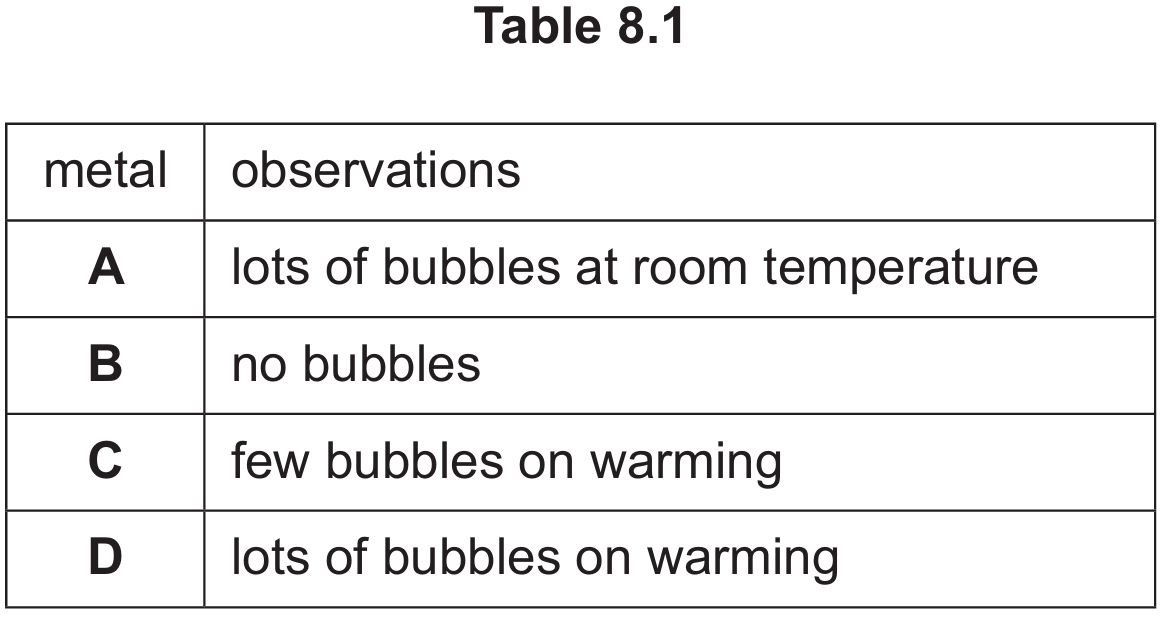
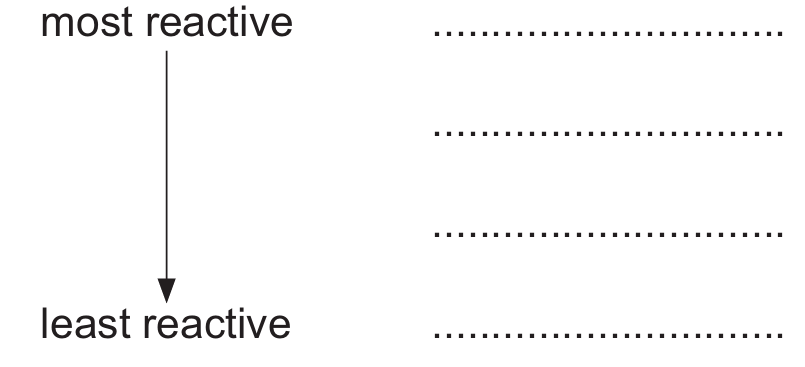
Put the metals, A, B, C and D, in order of their reactivity.
(a)(ii) Increasing the temperature of the acid increases the rate of reaction.
State two other ways to increase the rate of this reaction.
(b) In another experiment, a student adds lithium to water. An alkaline solution is formed.
(b)(i) State the colour seen in the flame test for lithium ions.
(b)(ii) State the ion that all aqueous alkalis contain.
(b)(iii) State the colour of thymolphthalein in an aqueous alkali.
(c) Pewter is an alloy that contains tin.
(c)(i) State which one of these diagrams, A, B, C or D, best represents an alloy.

(c)(ii) Suggest one property of pewter that makes it more useful than pure tin.
(d) Metals are good thermal conductors.
Describe two other physical properties that are typical of metals.
Most-appropriate topic codes (Cambridge IGCSE Chemistry 0620):
• Topic 9.4 — Reactivity series (Part (a)(i))
• Topic 6.2 — Rate of reaction (Part (a)(ii))
• Topic 12.5 — Identification of ions and gases (Parts (b)(i), (b)(ii), (b)(iii))
• Topic 9.3 — Alloys and their properties (Parts (c)(i), (c)(ii))
• Topic 9.1 — Properties of metals (Part (d))
▶️ Answer/Explanation
(a)(i)
For the correct answer:
most reactive A → D → C → B least reactive
The more vigorous the reaction with a dilute acid, the higher the reactivity of the metal. Metal A reacts vigorously (‘lots of bubbles’) at room temperature, indicating the highest reactivity. Metal D also shows ‘lots of bubbles’, but only upon warming, so it is less reactive than A. Metal C produces ‘few bubbles’ even on warming, showing low reactivity. Metal B shows ‘no bubbles’, indicating it is below hydrogen in the reactivity series and does not react with sulfuric acid at all, making it the least reactive.
(a)(ii)
For the correct answer (any two of):
1. increase the concentration (of the acid)
2. add a catalyst
3. increase (surface) area of metal / smaller pieces of metal
The rate of reaction can be increased by raising the frequency of successful collisions between reactant particles. This can be achieved by increasing the concentration of the acid (more particles per unit volume), increasing the surface area of the solid metal (exposing more atoms for reaction), or by adding a catalyst (providing an alternative pathway with lower activation energy).
(b)(i)
For the correct answer:
red
Flame tests are used to identify metal ions. Each metal ion emits a characteristic colour of light when electrons, excited by heat, fall back to their original energy levels. Lithium ions ($\mathrm{Li}^+$) produce a distinctive crimson red flame.
(b)(ii)
For the correct answer:
$\mathrm{OH}^-$
An alkali is defined as a soluble base. All aqueous alkalis contain the hydroxide ion ($\mathrm{OH}^-$). When lithium reacts with water, lithium hydroxide ($\mathrm{LiOH}$) is formed, which dissolves to produce $\mathrm{Li}^+$ and $\mathrm{OH}^-$ ions, giving an alkaline solution with a pH greater than 7.
(b)(iii)
For the correct answer:
blue
Indicators change colour depending on the pH of a solution. Thymolphthalein is colourless in acidic and neutral solutions but turns a distinctive blue in alkaline solutions. This is a specific indicator used to show the presence of a base.
(c)(i)
For the correct answer:
D
An alloy is a mixture of a metal with other elements, often other metals or carbon. In a diagrammatic representation, a pure metal is shown as a regular, ordered lattice of identical sized atoms. An alloy is represented by a lattice with atoms of different sizes. The presence of these differently sized atoms disrupts the regular layers, preventing them from sliding easily. Diagram D shows this structure of different sized atoms.
(c)(ii)
For the correct answer:
harder / stronger
Pewter is an alloy, and alloys are generally harder and stronger than their pure constituent metals. In pure tin, all atoms are the same size, so layers of atoms can slide over one another easily, making it soft. In pewter, the addition of different-sized atoms (like copper, antimony, or bismuth) distorts the regular lattice. This inhibits the sliding of atomic planes, significantly increasing the hardness and strength of the material, making it more suitable for utilitarian objects.
(d)
For the correct answer (any two of):
1. malleable
2. ductile
3. good electrical conductor
4. high melting point / high boiling point
Metals possess a ‘sea’ of delocalised electrons, which accounts for many of their characteristic physical properties. They are excellent electrical conductors because these delocalised electrons can move freely through the lattice carrying charge. They are malleable (can be hammered into shape) and ductile (can be drawn into wires) because the layers of atoms can slide over each other without the metallic bonding being broken. They generally have high melting and boiling points due to the strong electrostatic attraction between the positive metal ions and the negative delocalised electrons.