Home / iGCSE Chemistry 0620 Extended – 11.4 Alkanes- Exam Style Questions Paper 2

iGCSE Chemistry 0620 Extended - 11.4 Alkanes- Exam Style Questions Paper 2- New Syllabus

Question

Methane forms chloromethane in a photochemical reaction using ultraviolet light.

Which statement about this reaction is correct?

A. Methane is mixed with hydrogen chloride gas, and ultraviolet light prevents a combustion reaction.
B. Methane is mixed with hydrogen chloride gas, and ultraviolet light provides the activation energy for the reaction.
C. Methane is mixed with chlorine gas, and ultraviolet light prevents a combustion reaction.
D. Methane is mixed with chlorine gas, and ultraviolet light provides the activation energy for the reaction.

▶️ Answer/Explanation
The reaction is CH₄ + Cl₂ → CH₃Cl + HCl. It requires chlorine gas, not hydrogen chloride. UV light breaks the Cl–Cl bond to form chlorine radicals, providing the activation energy needed to start the substitution reaction. The UV light does not prevent combustion—it initiates the reaction.
Answer: D

Question

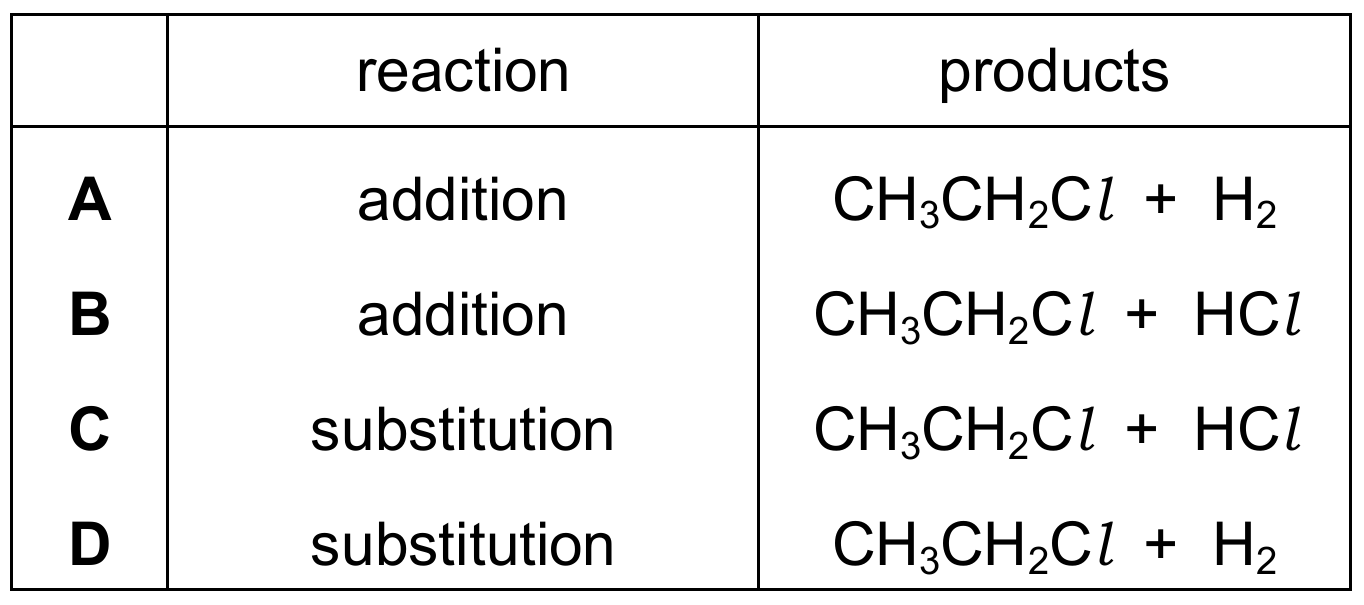
Ethane reacts with chlorine. Which row identifies the type of reaction and the formulae of the products formed?

▶️ Answer/Explanation

Correct Answer: C

Explanation: Alkanes (saturated hydrocarbons) undergo substitution reactions with halogens in the presence of ultraviolet light. One hydrogen atom in ethane is replaced by a chlorine atom, forming chloroethane (CH₃CH₂Cl) and hydrogen chloride (HCl). This is a photochemical substitution reaction.

✅ Substitution reaction producing CH₃CH₂Cl + HCl.

Question

Which type of reaction takes place when methane reacts with chlorine in the presence of ultraviolet light?

A. addition
B. cracking
C. polymerisation
D. substitution

▶️ Answer/Explanation
The reaction of methane with chlorine in UV light is a photochemical substitution reaction: \(\mathrm{CH_4 + Cl_2 \xrightarrow{UV} CH_3Cl + HCl}\). In this reaction, a hydrogen atom in methane is substituted (replaced) by a chlorine atom. UV light provides the activation energy needed to break the Cl−Cl bond.
Answer: (D)
Scroll to Top