Home / iGCSE Chemistry 0620 Extended – 12.4 Separation and purification- Exam Style Questions Paper 2

iGCSE Chemistry 0620 Extended - 12.4 Separation and purification- Exam Style Questions Paper 2- New Syllabus

Question

Which items of apparatus are used to separate a mixture of liquids with different boiling points?

▶️ Answer/Explanation
To separate a mixture of liquids with different boiling points, you need a fractional distillation setup. This includes a round-bottom flask, a fractionating column packed with glass beads, a thermometer, a condenser with a water jacket, and a receiving flask. Diagram A correctly shows this complete apparatus arrangement.
Answer: A

Question

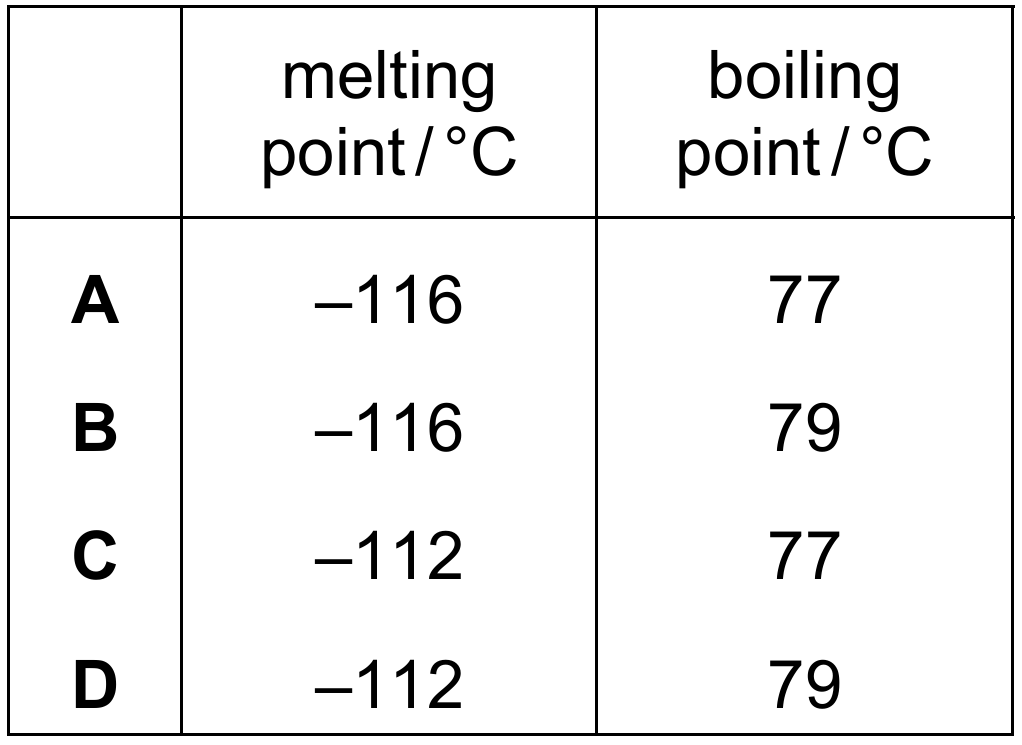
Pure ethanol has a melting point of $-114^{\circ}C$ and a boiling point of $78^{\circ}C$. What are the melting and boiling points of a sample of ethanol with glucose dissolved in it?

▶️ Answer/Explanation
When an impurity (like glucose) is dissolved in a pure solvent (like ethanol), the melting point of the solution decreases and the boiling point increases. This is due to colligative properties. Pure ethanol melts at -114°C, so with glucose dissolved, it will melt at a lower temperature (like -116°C). Pure ethanol boils at 78°C, so with an impurity, it will boil at a higher temperature (like 79°C). Option B correctly shows both effects.
Answer: (B)

Question

Ethanol can be made by fermentation of sugar, using yeast. This produces a mixture of ethanol and water. How is ethanol separated from this mixture?

A. distilling the mixture using a fractionating column
B. filtering the mixture
C. heating to evaporate most of the water, and allowing the ethanol to crystallise
D. heating to evaporate the water

▶️ Answer/Explanation

Correct Answer: A

Explanation: The fermentation mixture contains ethanol (boiling point 78°C) and water (boiling point 100°C). Since they are miscible liquids with different boiling points, fractional distillation is used to separate them. The fractionating column allows the more volatile ethanol to vaporise first, then condense and be collected separately from water. Filtering would remove solids, not separate dissolved liquids. Ethanol does not crystallise; it is a liquid. Evaporating water would leave ethanol, but this is inefficient and less pure.

✅ Distilling the mixture using a fractionating column.

Scroll to Top