
▶️ Answer/Explanation
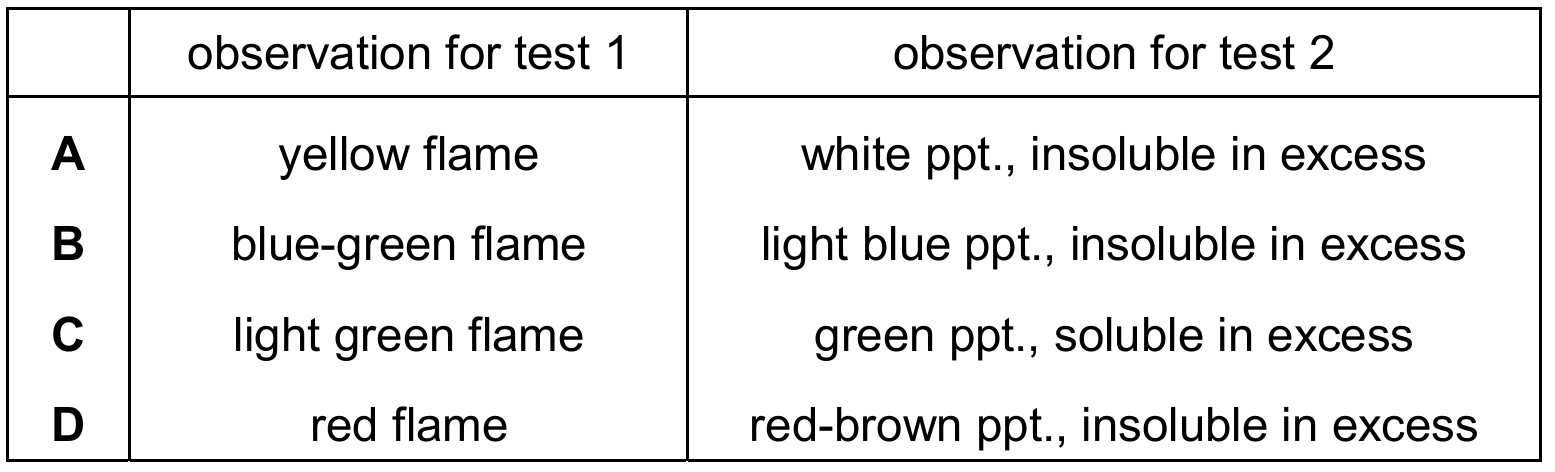
Copper(II) ions (\(\mathrm{Cu^{2+}}\)) give a blue-green flame in a flame test, and with aqueous sodium hydroxide form a light blue precipitate of copper(II) hydroxide that is insoluble in excess NaOH.
(A) Yellow flame = Na⁺, but Na⁺ gives no precipitate with NaOH.
(C) Light green flame is not characteristic of any common cation; green ppt. soluble in excess indicates Cr³⁺, but chromium gives no distinct flame colour.
(D) Red flame = Li⁺ or Ca²⁺ (orange-red), but red-brown ppt. indicates Fe³⁺, a mismatch.
✅ Answer: (B)
(A) Yellow flame = Na⁺, but Na⁺ gives no precipitate with NaOH.
(C) Light green flame is not characteristic of any common cation; green ppt. soluble in excess indicates Cr³⁺, but chromium gives no distinct flame colour.
(D) Red flame = Li⁺ or Ca²⁺ (orange-red), but red-brown ppt. indicates Fe³⁺, a mismatch.
✅ Answer: (B)
▶️ Answer/Explanation
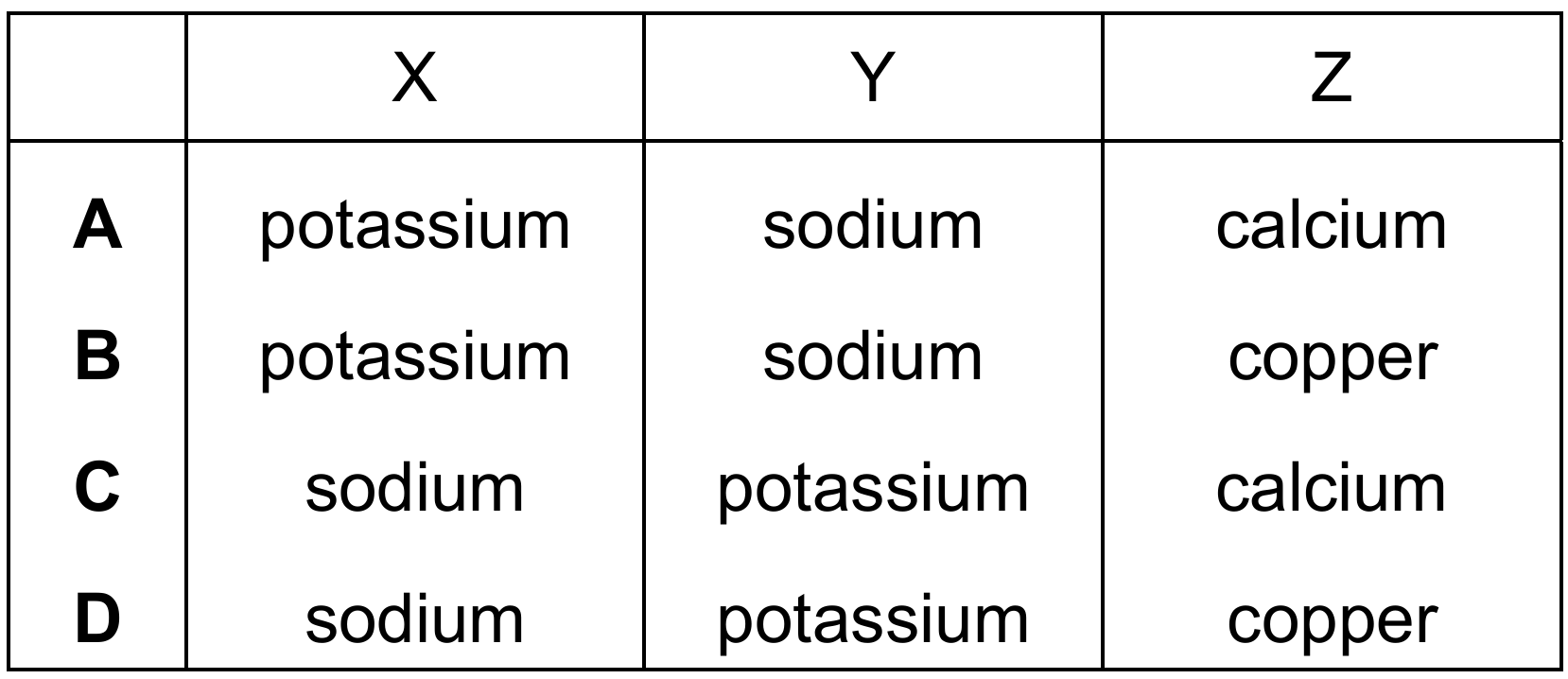
Correct Answer: D
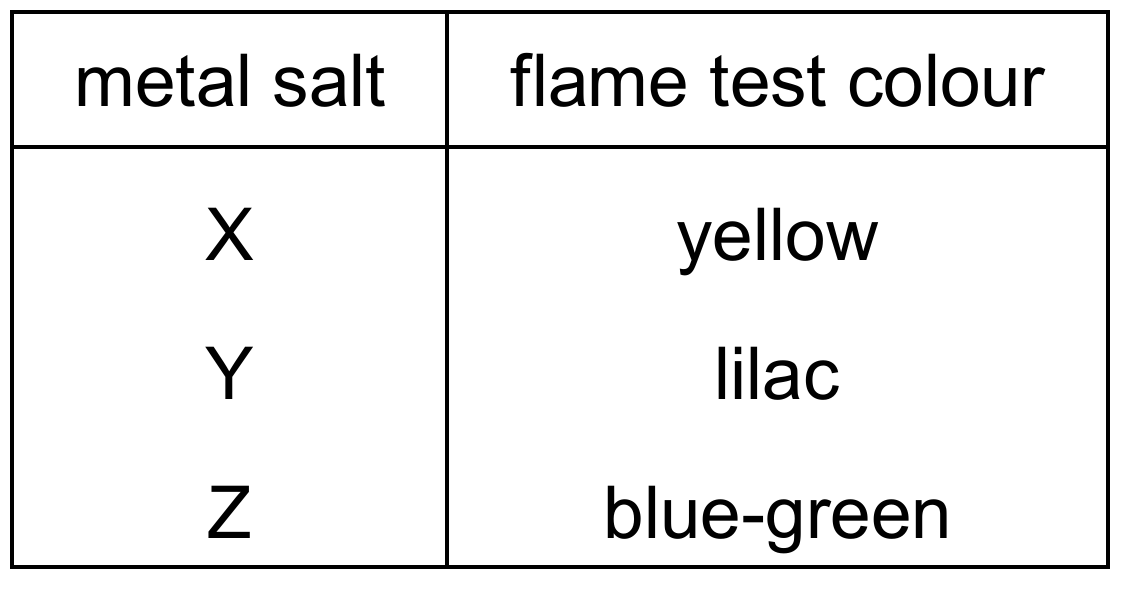
Explanation: Flame test colours for common metal ions:
– Sodium (Na⁺) gives a yellow flame.
– Potassium (K⁺) gives a lilac flame.
– Copper(II) (Cu²⁺) gives a blue-green flame.
– Calcium (Ca²⁺) gives an orange-red flame.
✅ X = sodium (yellow), Y = potassium (lilac), Z = copper(II) (blue-green).