Home / iGCSE Chemistry 0620 Extended – 2.1 Elements, compounds and mixtures- Exam Style Questions Paper 2

iGCSE Chemistry 0620 Extended - 2.1 Elements, compounds and mixtures- Exam Style Questions Paper 2- New Syllabus

Question

An atom of element X contains:

  • 5 protons
  • 6 neutrons
  • 5 electrons.

Which statements about element X are correct?

  1. X has an atomic number of 6.
  2. X has a nucleon number of 11.
  3. X is in Group II of the Periodic Table.
  4. X is in the second period of the Periodic Table.

A. 1 and 3
B. 1 and 4
C. 2 and 3
D. 2 and 4

▶️ Answer/Explanation
Let’s look at the characteristics of element X step-by-step. The atomic number equals the number of protons, which is 5 (making statement 1 incorrect). The nucleon number is the sum of protons and neutrons: $5 + 6 = 11$, so statement 2 is correct. With 5 electrons, the electronic configuration is 2, 3, placing it in Group III (not Group II) and Period 2 because it has 2 occupied electron shells. Therefore, statements 2 and 4 are correct.
Answer: (D)

Question

The diagrams represent some elements, compounds and mixtures.

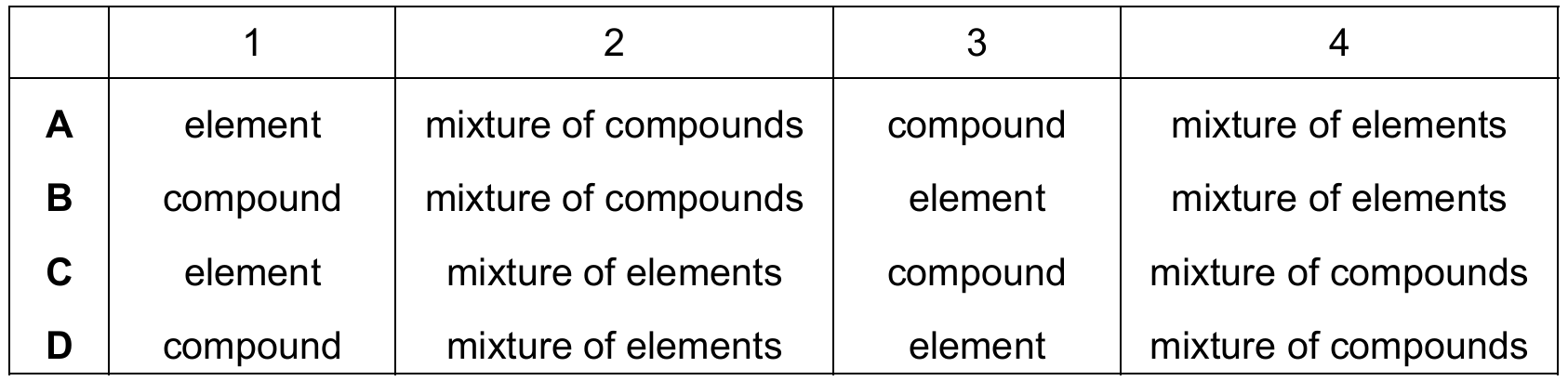
Which row describes the numbered substances?

▶️ Answer/Explanation
Let’s break down each particle diagram: Diagram 1 contains only one type of molecule made up of different types of atoms chemically bonded together, which defines a pure compound. Diagram 2 shows two different kinds of multi-atom molecules mixed together, representing a mixture of compounds. Diagram 3 contains diatomic molecules composed of identical atoms, which defines a pure element. Diagram 4 displays single, unbonded atoms of two different shades mixed together, which indicates a mixture of elements. Therefore, row B correctly identifies all four boxes.
Answer: (B)

Question

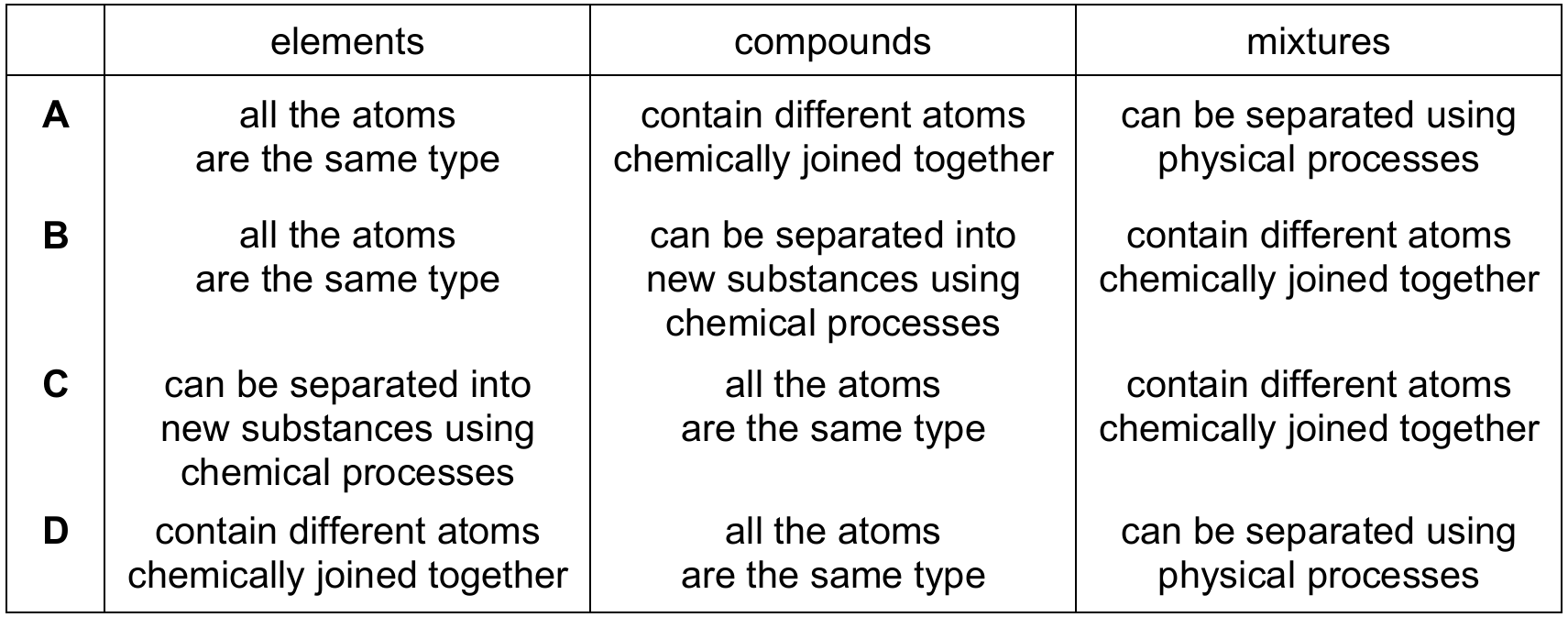
Which row describes elements, compounds and mixtures?

▶️ Answer/Explanation
Elements consist of only one type of atom. Compounds are substances formed from two or more different types of atoms chemically bonded together. Mixtures consist of different substances not chemically combined, which can be separated by physical processes.
Answer: (A)
Scroll to Top