Home / iGCSE Chemistry 0620 Extended – 2.6 Giant covalent structures- Exam Style Questions Paper 2

iGCSE Chemistry 0620 Extended - 2.6 Giant covalent structures- Exam Style Questions Paper 2- New Syllabus

Question

Substances with giant covalent structures can be used as lubricants and as cutting tools for hard materials.

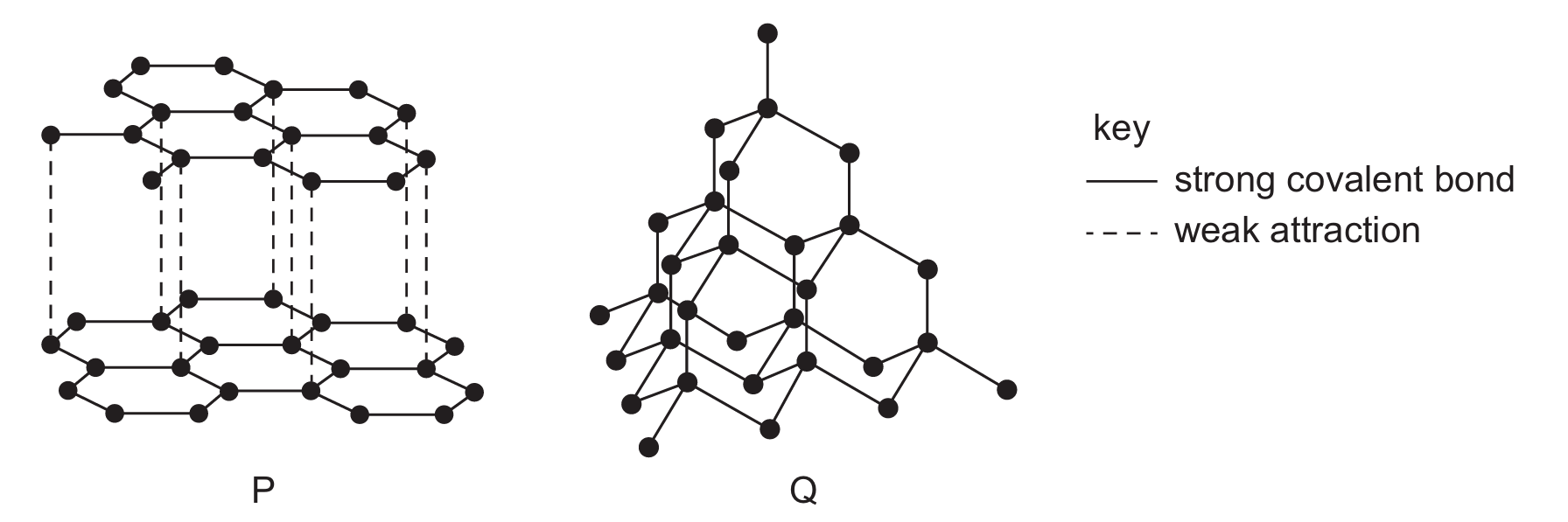
The diagrams show how the atoms are arranged in two giant covalent substances, P and Q.

Which statement is correct?

A. Only P is used as a cutting tool and only Q is used as a lubricant.
B. Only P is used as a lubricant and only Q is used as a cutting tool.
C. P and Q are both used as cutting tools.
D. P and Q are both used as lubricants.

▶️ Answer/Explanation

Correct Answer: B

Explanation: Based on the syllabus (section 2.6), diamond (typically P, tetrahedral structure) is used in cutting tools due to its extreme hardness. Graphite (typically Q, layered structure) is used as a lubricant because its layers can slide over each other due to weak intermolecular forces.

✅ Therefore, only P is used as a lubricant and only Q is used as a cutting tool.
Question

Rescuers are drilling through fallen rock in order to rescue some people trapped in a cave. The drill needs lubricating from time to time.

Four statements are made about the materials used for the drill tip and the lubricant to explain the reasons for their use.

  1. Diamond is used for the drill tip as it does not conduct electricity.
  2. Diamond is used for the drill tip as it is very hard.
  3. Graphite is used as the lubricant as it conducts electricity.
  4. Graphite is used as the lubricant as it is soft and slippery.

Which statements are correct?

A. 1 and 3
B. 1 and 4
C. 2 and 3
D. 2 and 4

▶️ Answer/Explanation
Diamond is the hardest naturally occurring substance, which makes it ideal for use in drill tips (statement 2 is correct). The reason is its hardness, not its lack of electrical conductivity. Graphite has a layered structure with weak forces between layers, allowing the layers to slide over each other, making it soft and slippery — ideal as a lubricant (statement 4 is correct). Graphite’s electrical conductivity is not the reason for its use as a lubricant.
Answer: (D)

Question

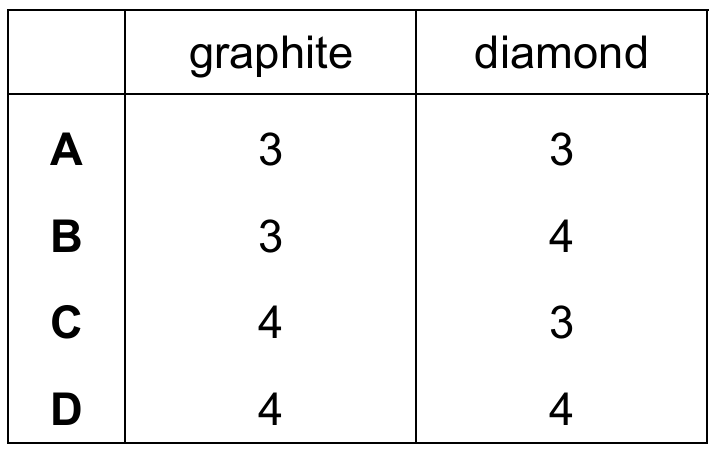
Graphite and diamond are both forms of the element carbon. Which row shows the number of other carbon atoms that each carbon atom is covalently bonded to in graphite and in diamond?

▶️ Answer/Explanation
In diamond, each carbon atom forms 4 covalent bonds in a tetrahedral structure. In graphite, each carbon atom forms 3 covalent bonds, forming layers of hexagonal rings.
Answer: (B)
Scroll to Top