Home / iGCSE Chemistry 0620 Extended – 2.7 Metallic bonding- Exam Style Questions Paper 2

iGCSE Chemistry 0620 Extended - 2.7 Metallic bonding- Exam Style Questions Paper 2- New Syllabus

Question

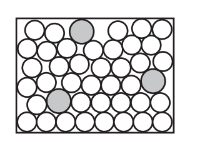
The diagram represents the structure of a solid.

Structure of a solid diagram

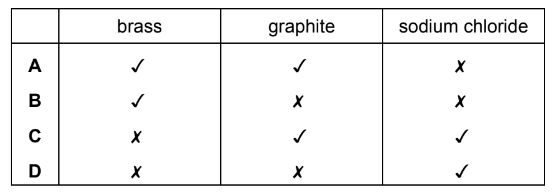
Which solids does the diagram represent?

Solids options table

▶️ Answer/Explanation
The diagram shows a lattice of positive ions surrounded by a sea of delocalized electrons — this is the characteristic structure of a metallic solid, or alternatively a giant ionic lattice. A structure with a regular arrangement of positive and negative ions alternating represents an ionic compound. A giant covalent structure (like diamond) shows atoms bonded by shared electron pairs with no free electrons. Based on the structure shown, the diagram represents solids that possess this giant lattice arrangement with free/delocalized electrons.
Answer: (B)

Question

Which statement explains why solid magnesium is a good conductor of electricity?

A. Magnesium has delocalised electrons that can move through the lattice.
B. Magnesium has strong attractions between ions.
C. Magnesium consists of a giant lattice of anions in a ‘sea’ of delocalised electrons.
D. Magnesium consists of metal ions that move through the lattice.

▶️ Answer/Explanation

Correct Answer: A

Explanation: In metallic bonding, the positive metal ions (cations) are arranged in a giant lattice surrounded by a ‘sea’ of delocalised electrons. These delocalised electrons are free to move throughout the structure, allowing them to carry an electric current.

✅ Magnesium has delocalised electrons that can move through the lattice.

Question

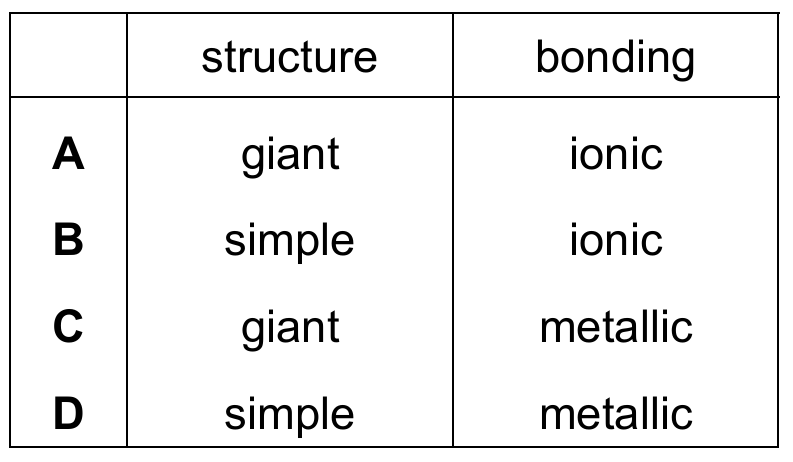
Which row describes the structure and bonding in cobalt?

▶️ Answer/Explanation
Cobalt is a transition metal. Metals have a giant structure consisting of positive metal ions arranged in a lattice, surrounded by a ‘sea’ of delocalised electrons. This is called metallic bonding.
Answer: (C)
Scroll to Top