Home / iGCSE Chemistry 0620 Extended – 3.1 Formulae- Exam Style Questions Paper 2

iGCSE Chemistry 0620 Extended - 3.1 Formulae- Exam Style Questions Paper 2- New Syllabus

Question

The molecular formulae of four compounds are listed.

  1. \(\mathrm{CH_4}\) 
  2. \(\mathrm{C_2H_4}\) 
  3. \(\mathrm{C_2H_5OH}\)
  4. \(\mathrm{C_6H_{12}O_6}\)

Which molecular formulae are also the empirical formulae for the compounds?

A. 1 and 2 
B. 1 and 3 
C. 2 and 4 
D. 3 and 4

▶️ Answer/Explanation

Correct Answer: B (1 and 3)

Explanation:
– \(\mathrm{CH_4}\): Ratio C:H = 1:4 (already simplest) → empirical formula is \(\mathrm{CH_4}\).
– \(\mathrm{C_2H_4}\): Ratio C:H = 2:4 simplifies to 1:2 → empirical formula is \(\mathrm{CH_2}\).
– \(\mathrm{C_2H_5OH}\): Formula is \(\mathrm{C_2H_6O}\). Ratio C:H:O = 2:6:1 (cannot simplify further) → empirical formula is \(\mathrm{C_2H_6O}\) (same as molecular).
– \(\mathrm{C_6H_{12}O_6}\): Ratio C:H:O = 6:12:6 simplifies to 1:2:1 → empirical formula is \(\mathrm{CH_2O}\).

✅ Compounds 1 and 3 have molecular formulae that are also empirical formulae.

Question

Which compound has an empirical formula that is the same as its molecular formula?

A. butane
B. but-1-ene
C. butanoic acid
D. butan-1-ol

▶️ Answer/Explanation
The empirical formula is the simplest whole number ratio of atoms in a compound.
Butane: molecular formula \(\mathrm{C_4H_{10}}\), empirical formula \(\mathrm{C_2H_5}\) (different).
But-1-ene: molecular formula \(\mathrm{C_4H_8}\), empirical formula \(\mathrm{CH_2}\) (different).
Butanoic acid: molecular formula \(\mathrm{C_4H_8O_2}\), empirical formula \(\mathrm{C_2H_4O}\) (different).
Butan-1-ol: molecular formula \(\mathrm{C_4H_{10}O}\), empirical formula \(\mathrm{C_4H_{10}O}\) (same).
Answer: (D)

Question

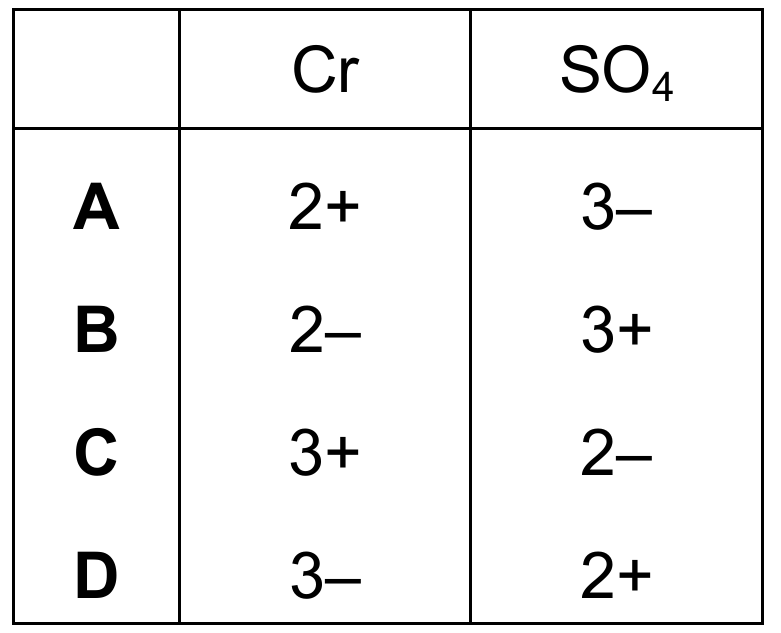
Which row identifies the charge on the chromium ion and on the sulfate ion in \(\mathrm{Cr_2(SO_4)_3}\)?

▶️ Answer/Explanation
The sulfate ion is \(\mathrm{SO_4^{2-}}\) (charge of 2−). In \(\mathrm{Cr_2(SO_4)_3}\), total negative charge = \(3 \times (-2) = -6\). For the compound to be neutral, total positive charge must be +6. Since there are 2 Cr ions: \(2 \times (\text{Cr charge}) = +6\), so each Cr ion has a charge of 3+.
Answer: (C)
Scroll to Top