iGCSE Chemistry 0620 Extended - 4.1 Electrolysis- Exam Style Questions Paper 2- New Syllabus
Question
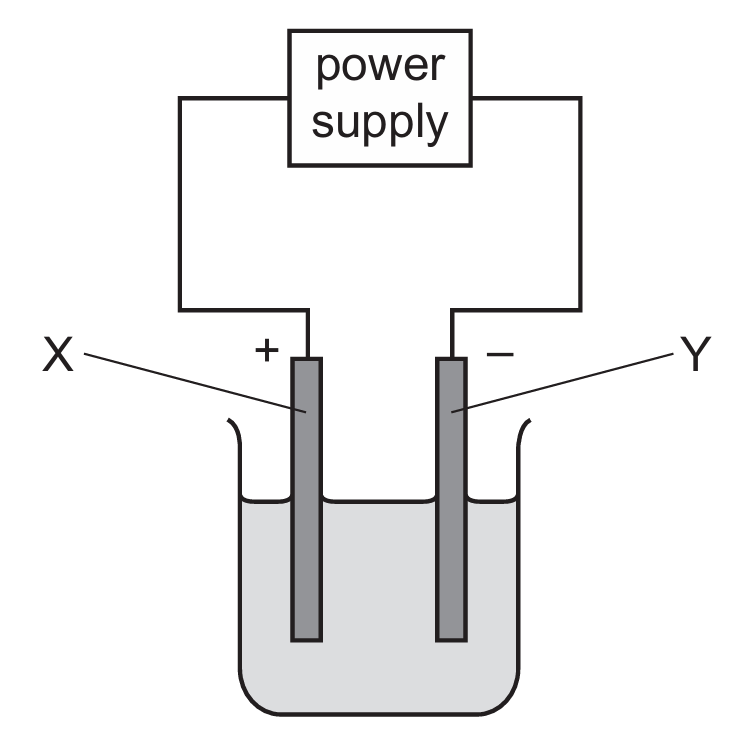
Molten lead(II) bromide is electrolysed using inert electrodes.

Which statement describes the movement of electrons?
A. from X to Y through the external wire
B. from Y to X through the external wire
C. from X to Y through the electrolyte
D. from Y to X through the electrolyte
▶️ Answer/Explanation
In electrolysis, electrons flow through the external wire from the anode (positive electrode, X) to the cathode (negative electrode, Y). Within the electrolyte, current is carried by the movement of ions (cations move toward the cathode, anions toward the anode), not by free electrons.
✅ Answer: (A)
✅ Answer: (A)
Question
A solution of copper(II) sulfate can be electrolysed using copper electrodes or carbon electrodes.
Which statements are correct?
- Using copper electrodes, oxygen gas forms at the anode.
- Using copper electrodes, copper atoms lose electrons at the anode.
- Using carbon electrodes, copper metal forms at the cathode.
- Using carbon electrodes, copper ions gain electrons at the cathode.
A. 1 and 2
B. 1 and 3
C. 2, 3 and 4
D. 4 only
▶️ Answer/Explanation
With active copper electrodes, the anode dissolves (Cu \(\rightarrow\) Cu\(^{2+}\) + 2e\(^-\)), and copper deposits at the cathode. With inert carbon electrodes, copper deposits at the cathode, and oxygen forms at the anode (from OH\(^-\) discharge). Statements 2, 3, and 4 are correct.
✅ Answer: (C)
✅ Answer: (C)
Question
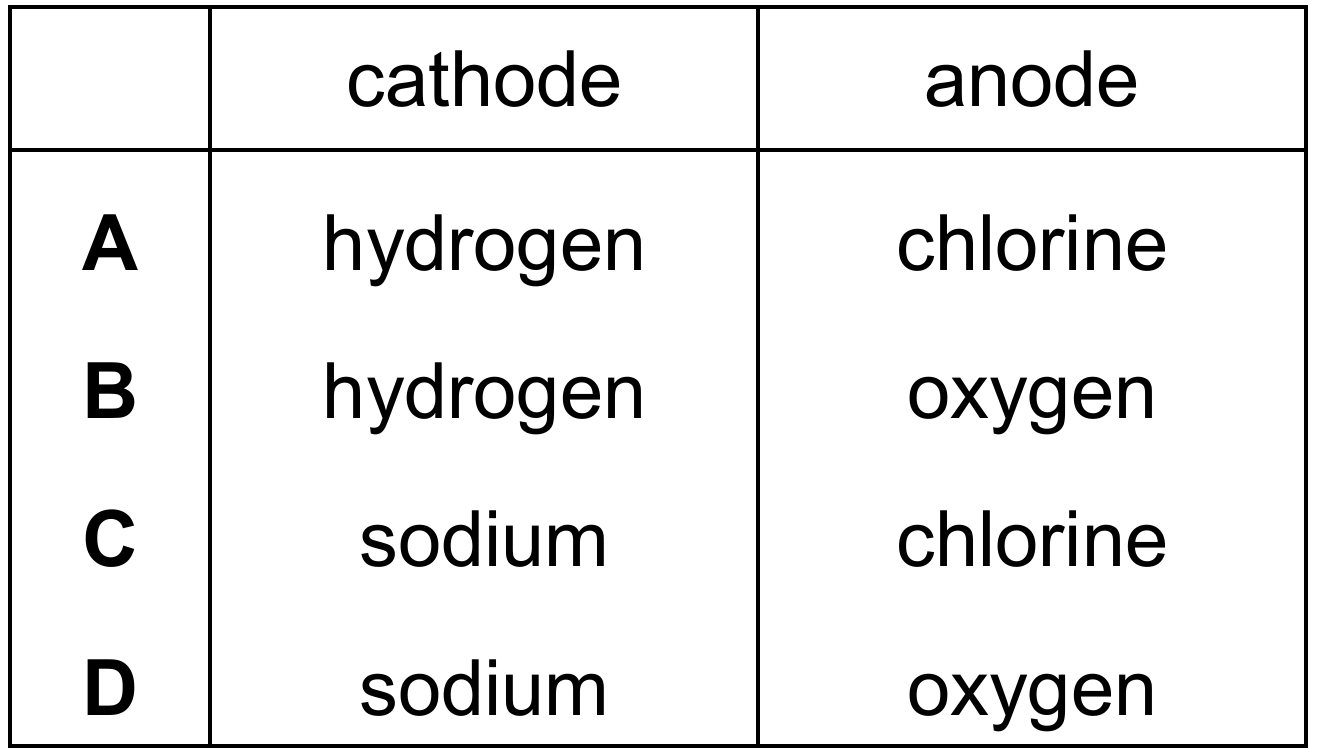
Which product is initially obtained at each electrode during the electrolysis of concentrated aqueous sodium chloride?

▶️ Answer/Explanation
In concentrated aqueous sodium chloride:
At the cathode (−): \(\mathrm{H^+}\) ions are discharged in preference to \(\mathrm{Na^+}\) ions because \(\mathrm{H^+}\) is more easily reduced. Hydrogen gas (\(\mathrm{H_2}\)) is produced.
At the anode (+): \(\mathrm{Cl^-}\) ions are discharged in preference to \(\mathrm{OH^-}\) ions due to the high concentration of chloride ions. Chlorine gas (\(\mathrm{Cl_2}\)) is produced.
✅ Answer: (A)
At the cathode (−): \(\mathrm{H^+}\) ions are discharged in preference to \(\mathrm{Na^+}\) ions because \(\mathrm{H^+}\) is more easily reduced. Hydrogen gas (\(\mathrm{H_2}\)) is produced.
At the anode (+): \(\mathrm{Cl^-}\) ions are discharged in preference to \(\mathrm{OH^-}\) ions due to the high concentration of chloride ions. Chlorine gas (\(\mathrm{Cl_2}\)) is produced.
✅ Answer: (A)
