
▶️ Answer/Explanation
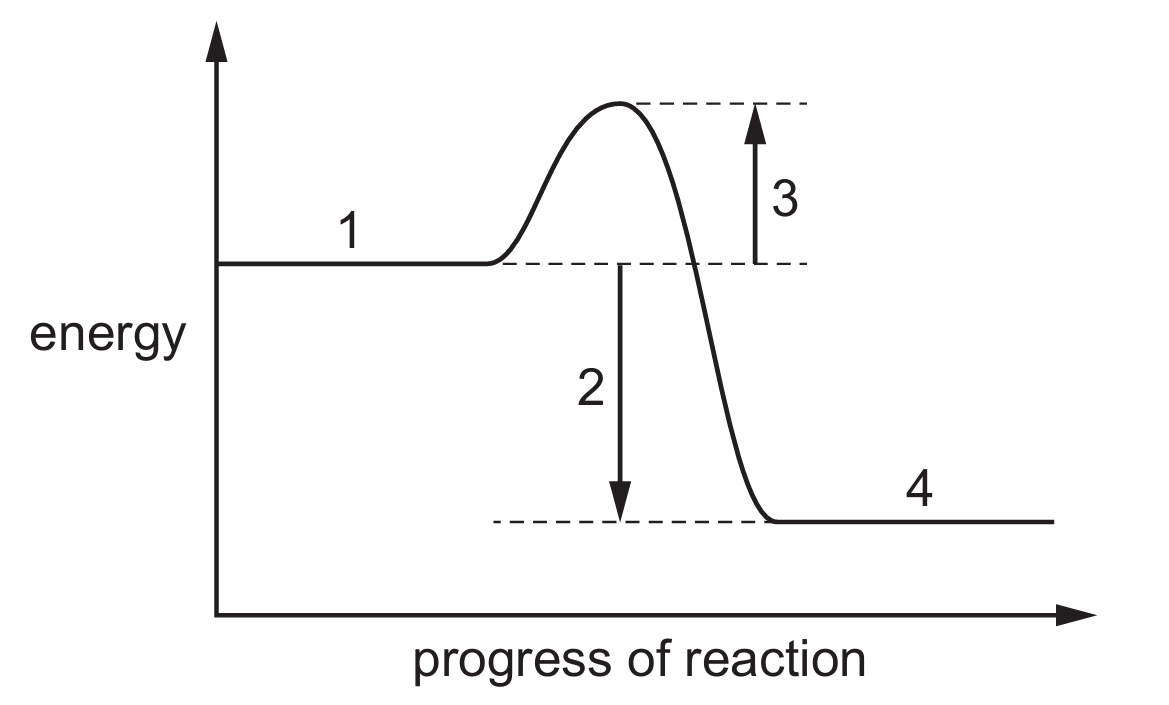
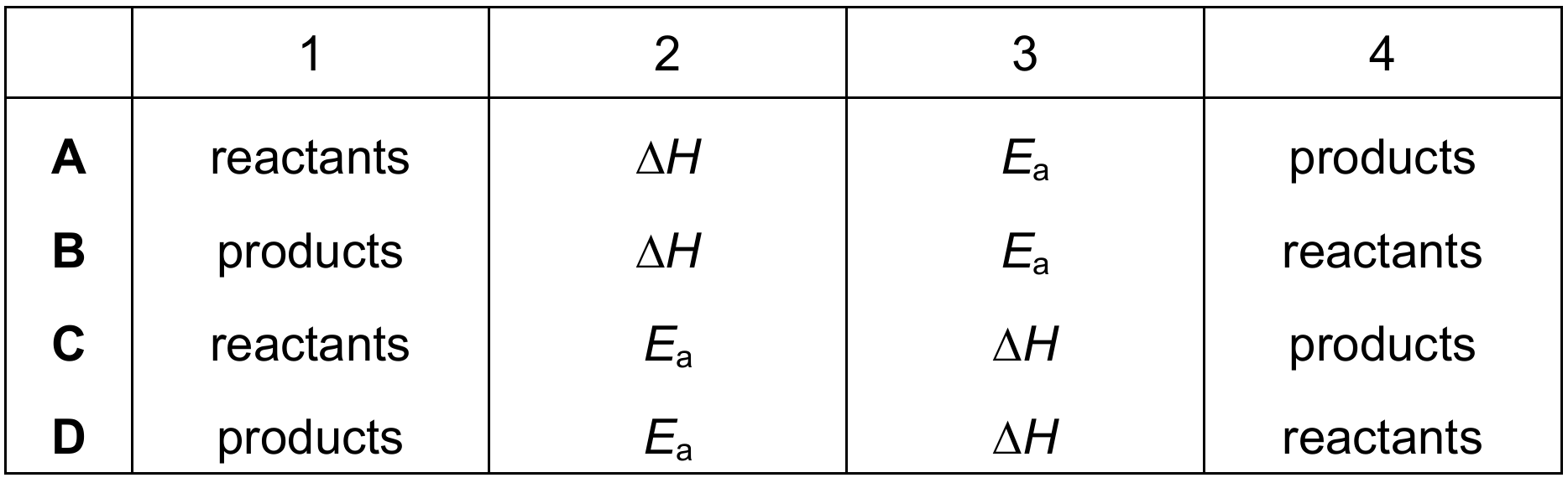
In this energy profile diagram: Label 1 marks the initial chemical energy level, which represents the reactants. Label 4 represents the final resting energy level, which belongs to the products. Label 3 measures the vertical height from the reactant line up to the peak of the curve, representing the activation energy ($E_a$). Label 2 is the difference in energy between reactants and products, which is the overall enthalpy change of the reaction ($\Delta H$). This combination corresponds directly to row A.
✅ Answer: (A)
✅ Answer: (A)
▶️ Answer/Explanation
Let’s calculate the total energy taken in to break reactant bonds and the energy released when making product bonds:
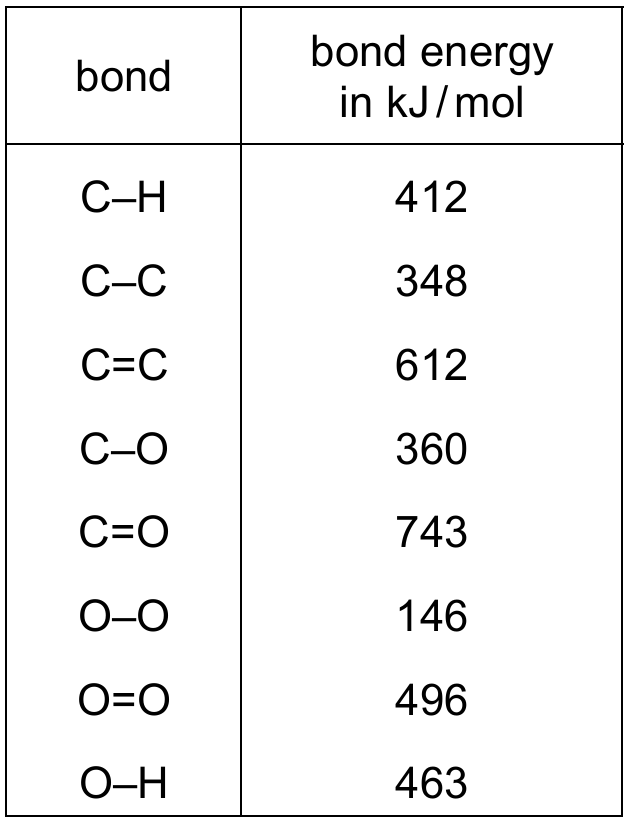
• Bonds broken (Reactants): Ethene ($\text{CH}_2=\text{CH}_2$) has $1 \times (\text{C}=\text{C})$ and $4 \times (\text{C}-\text{H})$. We also break $3 \times (\text{O}=\text{O})$.
$$\text{Energy In} = 612 + 4(412) + 3(496) = 612 + 1648 + 1488 = 3748\text{ kJ/mol}$$
• Bonds formed (Products): $2 \times \text{CO}_2$ has $4 \times (\text{C}=\text{O})$ bonds total. $2 \times \text{H}_2\text{O}$ has $4 \times (\text{O}-\text{H})$ bonds total.
$$\text{Energy Out} = 4(743) + 4(463) = 2972 + 1852 = 4824\text{ kJ/mol}$$
• Overall energy change:
$$\Delta H = \text{Energy In} – \text{Energy Out} = 3748 – 4824 = -1076\text{ kJ/mol}$$
✅ Answer: (B)
• Bonds broken (Reactants): Ethene ($\text{CH}_2=\text{CH}_2$) has $1 \times (\text{C}=\text{C})$ and $4 \times (\text{C}-\text{H})$. We also break $3 \times (\text{O}=\text{O})$.
$$\text{Energy In} = 612 + 4(412) + 3(496) = 612 + 1648 + 1488 = 3748\text{ kJ/mol}$$
• Bonds formed (Products): $2 \times \text{CO}_2$ has $4 \times (\text{C}=\text{O})$ bonds total. $2 \times \text{H}_2\text{O}$ has $4 \times (\text{O}-\text{H})$ bonds total.
$$\text{Energy Out} = 4(743) + 4(463) = 2972 + 1852 = 4824\text{ kJ/mol}$$
• Overall energy change:
$$\Delta H = \text{Energy In} – \text{Energy Out} = 3748 – 4824 = -1076\text{ kJ/mol}$$
✅ Answer: (B)