
▶️ Answer/Explanation
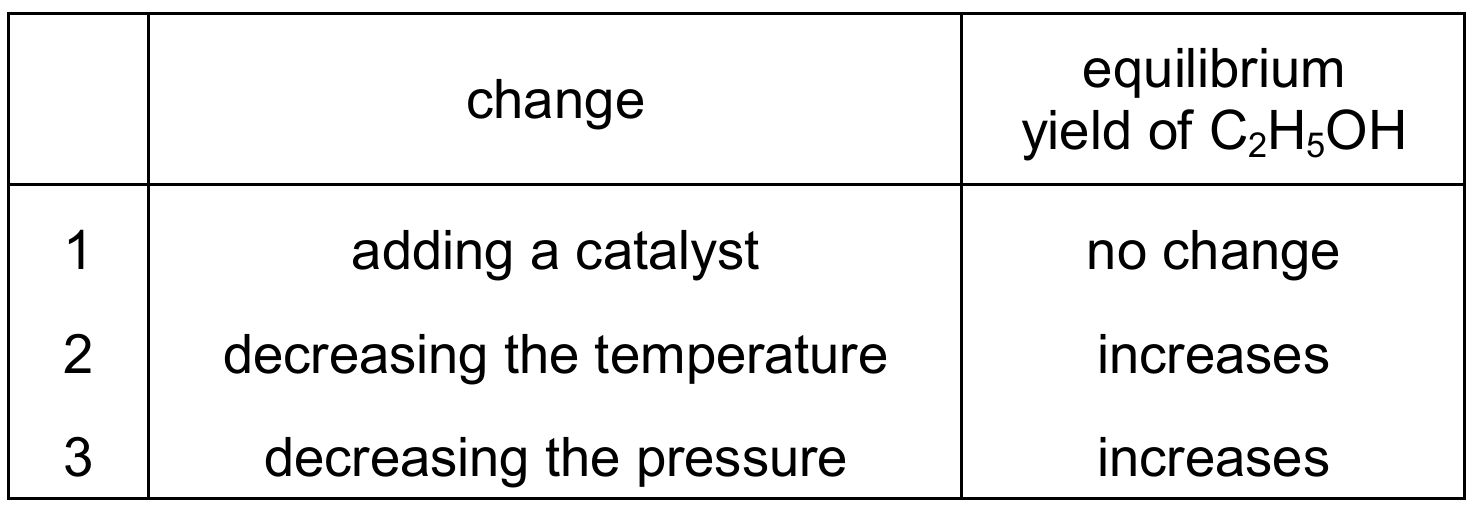
Statement 1: A catalyst increases the rate of both forward and reverse reactions equally. It does not affect the position of equilibrium or the yield — correct.
Statement 2: The forward reaction is exothermic. Decreasing temperature favours the exothermic reaction, shifting equilibrium to the right, increasing yield — correct.
Statement 3: 2 moles of gaseous reactants → 1 mole of gaseous product. Decreasing pressure favours the side with more gas moles (reactants), shifting equilibrium left, decreasing yield — incorrect.
✅ Answer: (A)
Statement 2: The forward reaction is exothermic. Decreasing temperature favours the exothermic reaction, shifting equilibrium to the right, increasing yield — correct.
Statement 3: 2 moles of gaseous reactants → 1 mole of gaseous product. Decreasing pressure favours the side with more gas moles (reactants), shifting equilibrium left, decreasing yield — incorrect.
✅ Answer: (A)
▶️ Answer/Explanation
Statement 1: A catalyst increases the rate of both forward and reverse reactions equally. It does not affect the position of equilibrium or the yield — correct.
Statement 2: The forward reaction is exothermic. Decreasing temperature favours the exothermic reaction, shifting equilibrium to the right, increasing yield — correct.
Statement 3: 2 moles of gaseous reactants → 1 mole of gaseous product. Decreasing pressure favours the side with more gas moles (reactants), shifting equilibrium left, decreasing yield — incorrect.
✅ Answer: (A)
Statement 2: The forward reaction is exothermic. Decreasing temperature favours the exothermic reaction, shifting equilibrium to the right, increasing yield — correct.
Statement 3: 2 moles of gaseous reactants → 1 mole of gaseous product. Decreasing pressure favours the side with more gas moles (reactants), shifting equilibrium left, decreasing yield — incorrect.
✅ Answer: (A)
▶️ Answer/Explanation
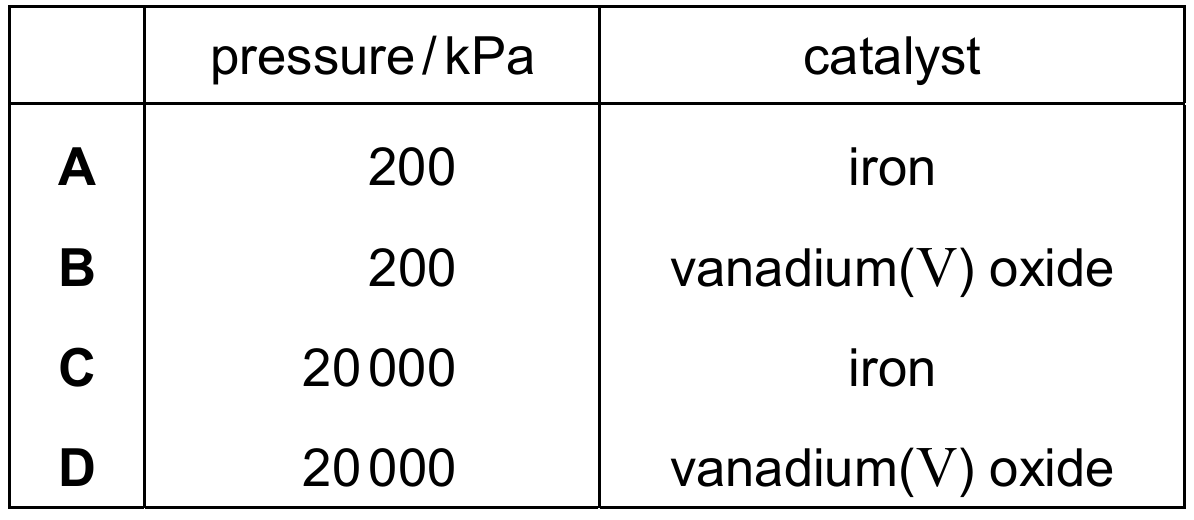
The Contact process for the conversion of sulfur dioxide to sulfur trioxide: \(2\mathrm{SO_2(g) + O_2(g) \rightleftharpoons 2SO_3(g)}\) uses typical conditions of \(450^{\circ}\mathrm{C}\), \(200\,\mathrm{kPa}\) (\(2\,\mathrm{atm}\)) pressure, and a vanadium(V) oxide (\(\mathrm{V_2O_5}\)) catalyst. Iron is the catalyst used in the Haber process, not the Contact process.
✅ Answer: (B)
✅ Answer: (B)