
▶️ Answer/Explanation
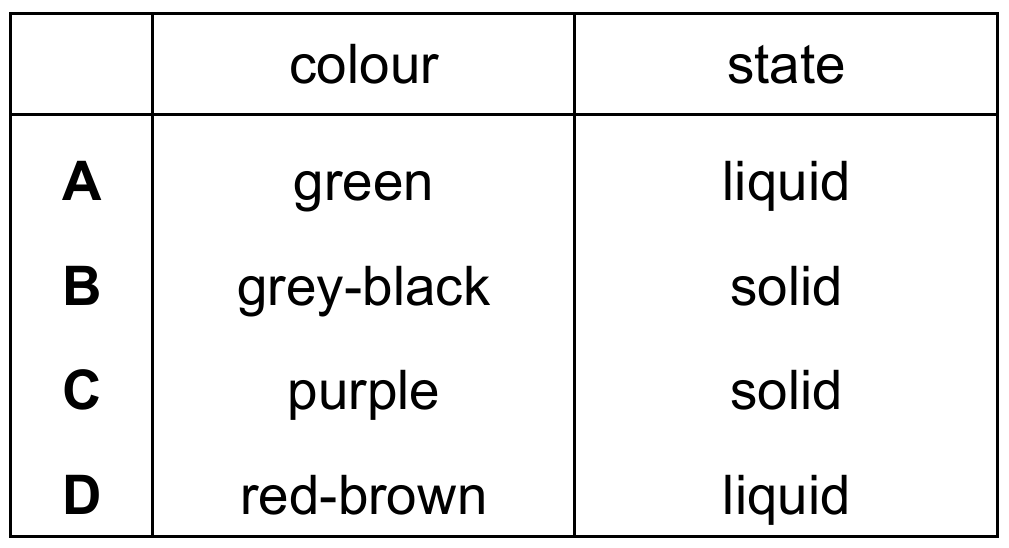
At room temperature and pressure, iodine is a grey-black solid. (Bromine is a red-brown liquid, chlorine is a pale yellow-green gas).
✅ Answer: (B)
✅ Answer: (B)
Some halide ions are displaced from aqueous potassium halides by halogens.
In which mixtures are the halide ions displaced?
A. 1 and 3
B. 1 and 4
C. 2 and 3
D. 2 and 4
Correct Answer: A (1 and 3)
Explanation: A more reactive halogen displaces a less reactive halide from solution. Reactivity decreases down Group VII: Cl > Br > I.
1. KBr + Cl₂: Cl displaces Br (Cl more reactive) → displacement occurs. ✅
2. KBr + I₂: I is less reactive than Br → no displacement. ❌
3. KI + Cl₂: Cl displaces I (Cl more reactive) → displacement occurs. ✅
4. KCl + I₂: I is less reactive than Cl → no displacement. ❌
✅ Displacement occurs in mixtures 1 and 3.
Which row describes the colour and state of iodine at room temperature and pressure?
Which statement about Group I or Group VII elements is correct?
A. Group VII elements are monatomic non-metals.
B. Lithium is more reactive with water than caesium.
C. The melting point of Group I metals increases down the group.
D. Potassium bromide reacts with chlorine to produce an orange solution.