iGCSE Chemistry 0620 Extended - 8.5 Noble gases- Exam Style Questions Paper 2- New Syllabus
Question
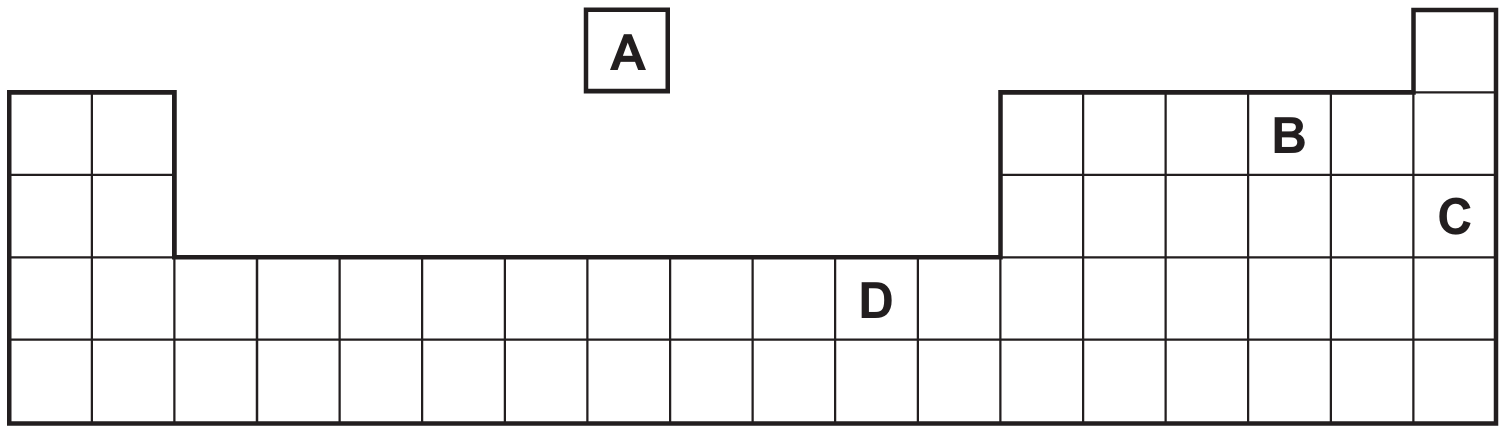
Part of the Periodic Table is shown.
Which element is an inert gas?

▶️ Answer/Explanation
Inert gases are located in Group VIII (Group 18) of the Periodic Table. Based on the standard layout and the answer key, the specific letter corresponding to an element in this column is C. (Common inert gases include Helium, Neon, Argon).
✅ Answer: (C)
✅ Answer: (C)
Question
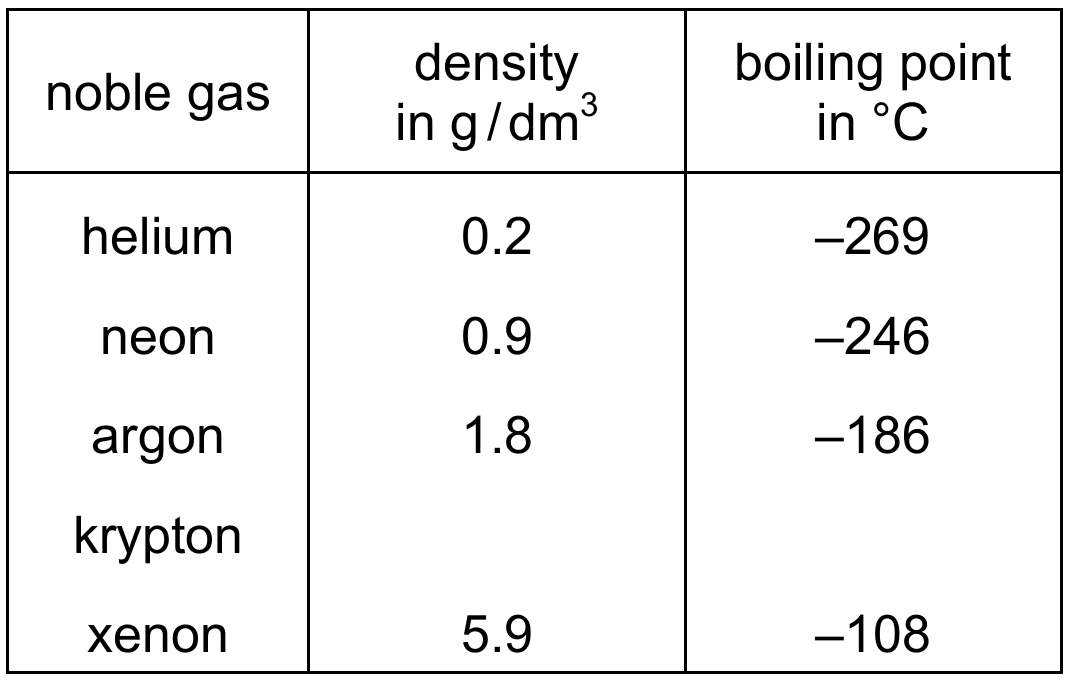
The table shows some properties of noble gases.

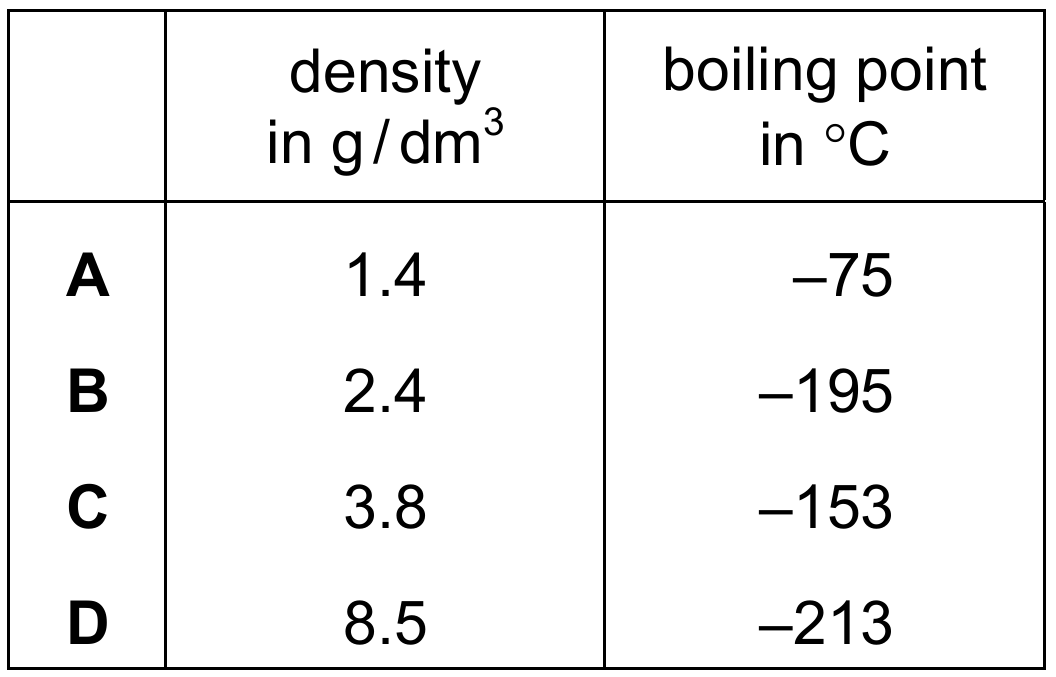
Which row predicts the density and the boiling point of krypton?

▶️ Answer/Explanation
Going down Group VIII, both density and boiling point increase due to increasing atomic mass and stronger intermolecular forces. Krypton is below argon, so its density must be higher than argon’s (1.8 g/dm³) and its boiling point higher than argon’s (−186°C). Option C shows a density of 3.8 (higher) and a boiling point of −153°C (higher), fitting the trend. The other options either show lower values or values that don’t follow the gradual trend.
✅ Answer: (C)
✅ Answer: (C)
Question
Which statement about the elements in Group VIII is correct?
A. They all form diatomic molecules.
B. They all have eight electrons in their outer electron shells.
C. They all react with oxygen to form oxides.
D. They all are gases at room temperature.
▶️ Answer/Explanation
All noble gases (Group VIII/Group 0) exist as monatomic gases at room temperature. Helium has only 2 electrons in its outer shell, so statement B is wrong. They do not form diatomic molecules, and they are too unreactive to form oxides under normal conditions.
✅ Answer: D
✅ Answer: D