
▶️ Answer/Explanation
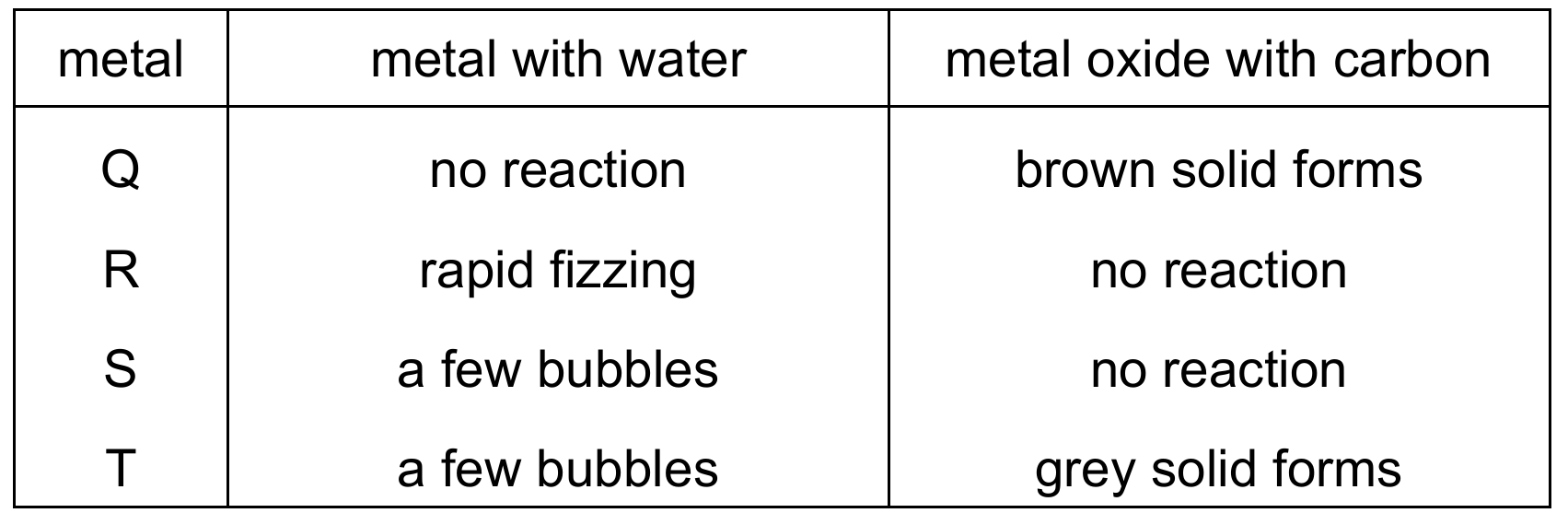
Least reactive: Q (no reaction with water, oxide reduced by carbon). Next: T (few bubbles with water, oxide reduced). Next: S (few bubbles, oxide not reduced). Next: R (rapid fizzing, oxide not reduced). Reactivity series determined by reaction with water: no reaction < slow reaction < rapid reaction. Oxides of less reactive metals (lower than carbon) are reduced by carbon.
✅ Answer: (A)
✅ Answer: (A)
▶️ Answer/Explanation
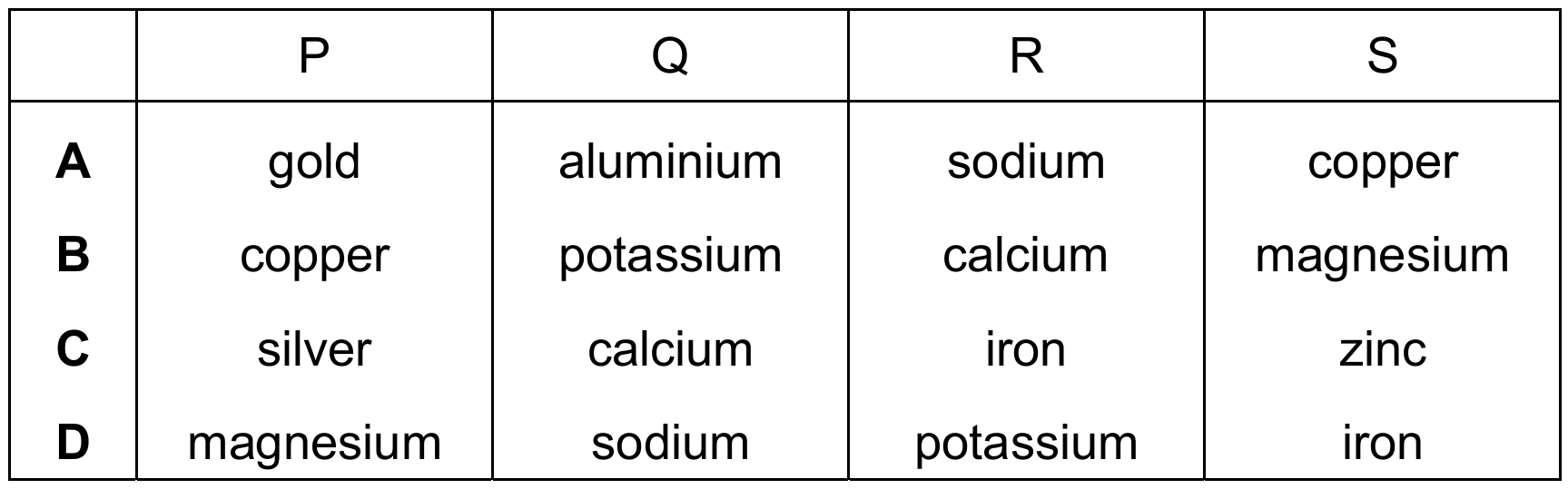
P does not react with dilute HCl → P is below hydrogen in the reactivity series (Cu, Ag, Au).
Q is more reactive than Mg → Q must be K, Na, or Ca.
R reacts rapidly with cold water → R must be K, Na, or Ca.
S reacts with dilute HCl to produce H₂ → S must be above hydrogen but not necessarily above Mg (Mg, Al, Zn, Fe).
In option (B): P = Cu (below H, correct), Q = K (more reactive than Mg, correct), R = Ca (reacts with cold water, correct), S = Mg (reacts with dilute HCl producing H₂, correct).
✅ Answer: (B)
Q is more reactive than Mg → Q must be K, Na, or Ca.
R reacts rapidly with cold water → R must be K, Na, or Ca.
S reacts with dilute HCl to produce H₂ → S must be above hydrogen but not necessarily above Mg (Mg, Al, Zn, Fe).
In option (B): P = Cu (below H, correct), Q = K (more reactive than Mg, correct), R = Ca (reacts with cold water, correct), S = Mg (reacts with dilute HCl producing H₂, correct).
✅ Answer: (B)