iGCSE Chemistry 0620 Extended - 9.5 Corrosion of metals- Exam Style Questions Paper 2- New Syllabus
Question
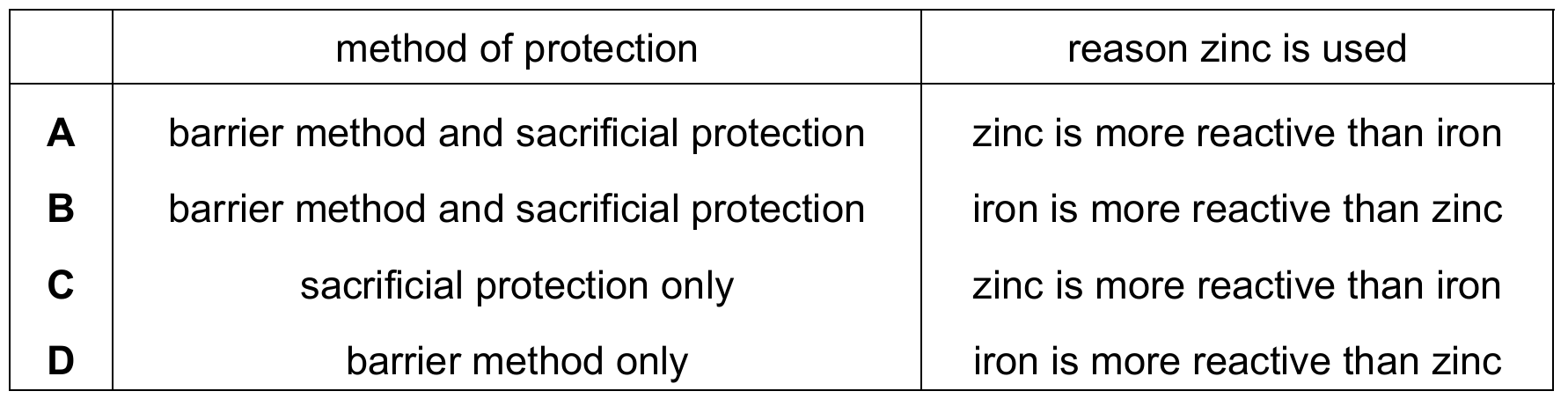
An iron nail is fully covered with zinc to prevent it from rusting.
Which row describes this method of protection and explains why zinc is used?

▶️ Answer/Explanation
Zinc coating acts as a barrier (preventing oxygen/water contact) and provides sacrificial protection. If scratched, zinc, being more reactive than iron, corrodes preferentially, protecting the iron.
✅ Answer: (A)
✅ Answer: (A)
Question
Zinc is used to galvanise iron to prevent it from rusting.
Which statements are correct?
- Galvanising is an example of a barrier method.
- If the zinc is scratched, the iron will rust very quickly.
- Galvanising is an example of sacrificial protection.
- Zinc is more reactive than iron and so accepts electrons more readily.
A. 1, 2 and 4
B. 1 and 3
C. 2, 3 and 4
D. 2 and 3 only
▶️ Answer/Explanation
Galvanising is the process of coating iron with a layer of zinc. This zinc layer acts as a barrier, preventing oxygen and water from reaching the iron (Statement 1 is correct). If the zinc is scratched, the iron does NOT rust quickly because zinc is more reactive and corrodes instead, acting as sacrificial protection (Statement 3 is correct, Statement 2 is wrong). Statement 4 is incorrect because zinc is more reactive and DONATES electrons more readily (not accepts them).
✅ Answer: (B)
✅ Answer: (B)
Question
Which row identifies methods used to prevent iron from rusting?

▶️ Answer/Explanation
Correct Answer: C
Explanation: Rusting of iron requires both oxygen and water. Barrier methods prevent rusting by excluding oxygen or water. Greasing and painting are effective barrier methods. Washing with distilled water does not prevent rusting; it actually removes any protective layers and exposes the iron to water, promoting rusting.
✅ Greasing ✓, Painting ✓, Washing with distilled water ×.
