
iGCSE Physics (0625) 1.2 Motion Paper 3 -Exam Style Questions- New Syllabus
Question
Most-appropriate topic codes (Cambridge IGCSE Physics 0625):
• Topic $1.2$ — Motion (Parts $\mathrm{(a)}$, $\mathrm{(b)}$, $\mathrm{(c)}$)
▶️ Answer/Explanation
(a)
For the correct answer:
(constant) acceleration OR accelerating OR increasing speed
Detailed solution:
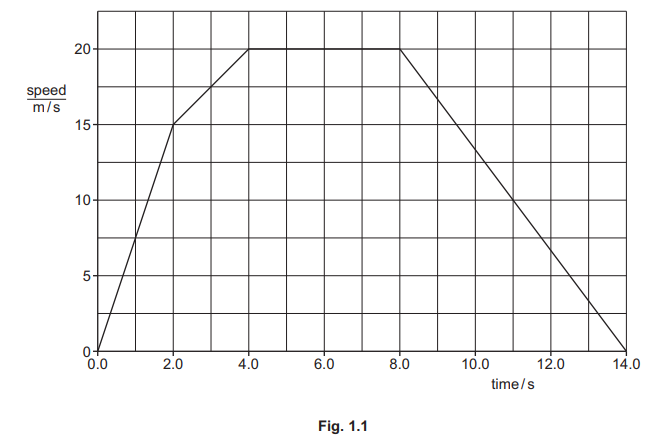
Between $0$ and $2.0\text{ s}$ the graph shows a straight line sloping upwards, meaning the speed increases at a constant rate. This indicates uniform acceleration.
(b)
For the correct answer:
zero
Detailed solution:
Between $4.0\text{ s}$ and $8.0\text{ s}$ the graph is a horizontal line, showing the speed is constant. Acceleration is the gradient of a speed–time graph; a horizontal line has zero gradient, so acceleration is zero.
(c)
For the correct answer:
$60\text{ (m)}$
$ \frac{1}{2} \times 6 \times 20$
distance = area under (speed–time) graph OR $ \frac{1}{2} \times b\times h$
Detailed solution:
Distance travelled equals the area under the speed–time graph. From $8.0\text{ s}$ to $14.0\text{ s}$ the graph forms a triangle with base $6\text{ s}$ and height $20\text{ m/s}$. Using the area of a triangle formula: $\frac{1}{2} \times 6 \times 20 = 60\text{ m}$.