iGCSE Physics (0625) 6.1.1 The Earth-Exam Style Questions- New Syllabus

Question

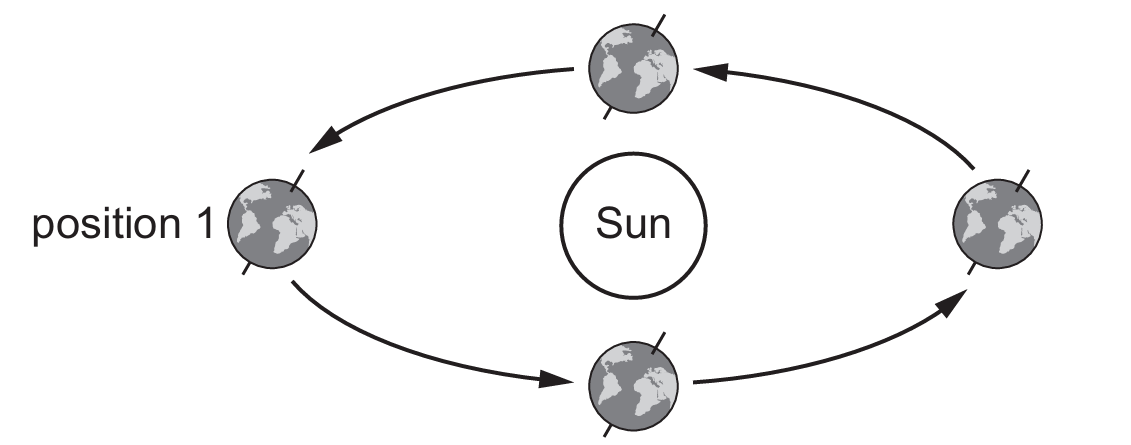
The diagram shows the Earth orbiting the Sun.
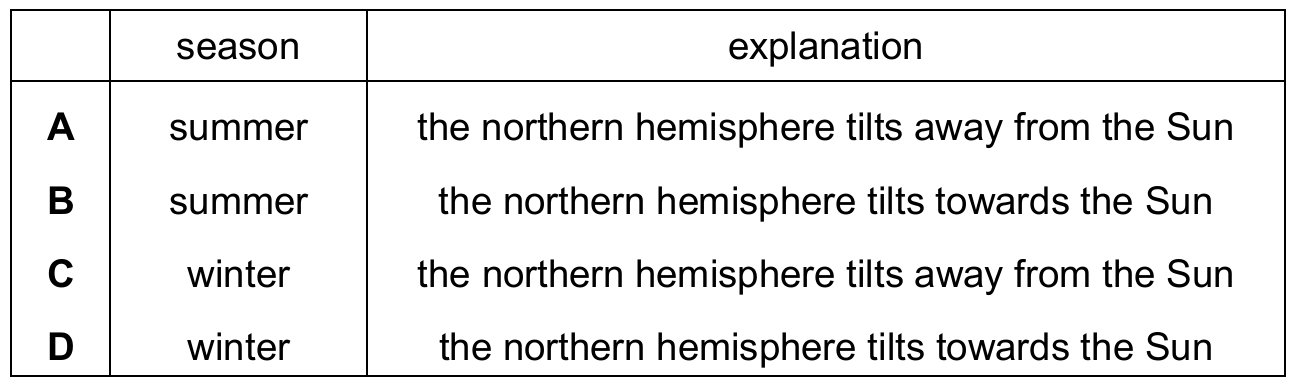
Which row identifies and explains the correct season in the northern hemisphere on the Earth in position 1?
▶️ Answer/Explanation
Correct Option: B

Detailed solution:

Seasons are caused by the tilt of the Earth’s axis, which is approximately 23.5 ∘ relative to its orbit.
In the diagram at position 1, the axis shows the northern hemisphere leaning toward the Sun.
When a hemisphere tilts toward the Sun, it receives more direct sunlight and longer daylight hours.
This increased solar intensity and duration characterize the season of summer.
Conversely, the southern hemisphere would be experiencing winter at this same position.
Therefore, Row B correctly identifies the season as summer because the northern hemisphere is tilted toward the Sun.
Question

The Sun, the Earth and the Moon are all bodies in the Solar System.
The Earth has a periodic cycle of day and night and a periodic cycle of seasons.
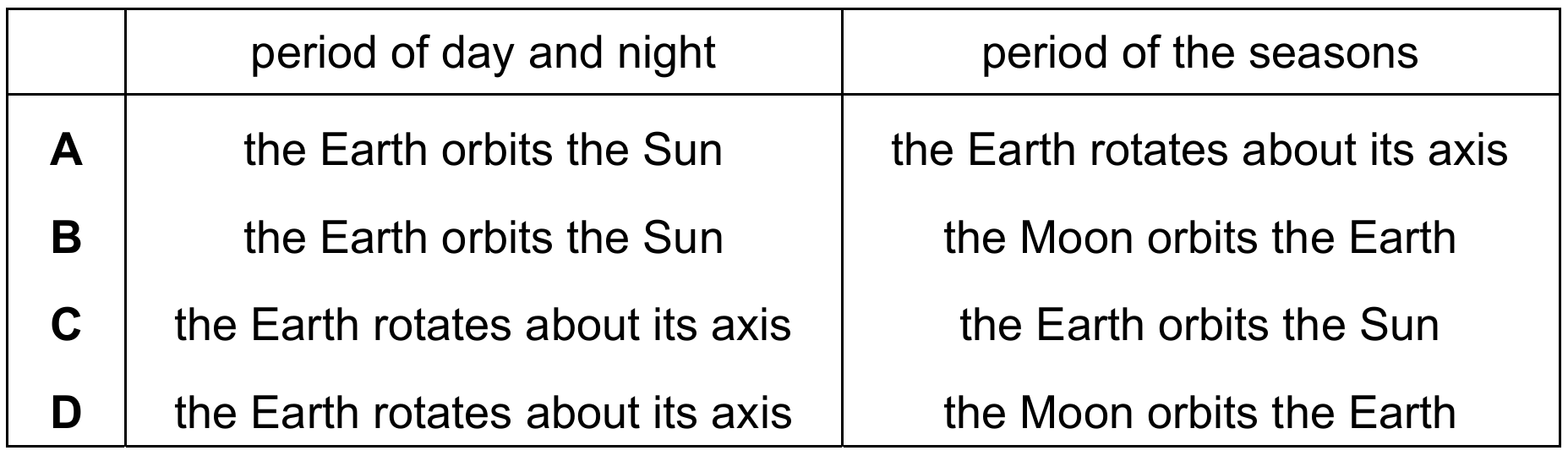
Which row relates the periods of these cycles to the motions of these bodies?
▶️ Answer/Explanation
Correct Option: C

Detailed solution:

The Earth rotates on its axis once every $24$ hours, which creates the periodic cycle of day and night as different parts of the planet face the Sun. The cycle of the seasons is caused by the Earth orbiting the Sun once every $365$ days combined with the tilt of its axis. The Moon’s orbit around the Earth takes approximately $1$ month and relates to lunar phases, not the Earth’s day or seasons. Therefore, the correct relationship is that rotation causes day/night and the orbit around the Sun causes seasons. This corresponds exactly to the information provided in Row C.

Question

What causes the phases of the Moon?
A. the Earth orbiting the Sun
B. the Earth turning on its axis
C. the Moon orbiting the Earth
D. the Moon orbiting the Sun
▶️ Answer/Explanation
Correct Option: C

Detailed solution:

The Moon does not produce its own light; it is visible because it reflects light from the Sun.
As the Moon orbits the Earth, its position relative to the Sun and Earth changes constantly.
This orbital motion takes approximately $1$ month to complete a full cycle.
Consequently, the fraction of the Moon’s illuminated half that we can see from Earth varies.
These changing views of the illuminated portion are known as the phases of the Moon.
Therefore, the phases are directly caused by the Moon orbiting the Earth.

Scroll to Top