iGCSE Physics (0625) 6.1.2 The Solar System -Exam Style Questions Paper 2 - New Syllabus

Question

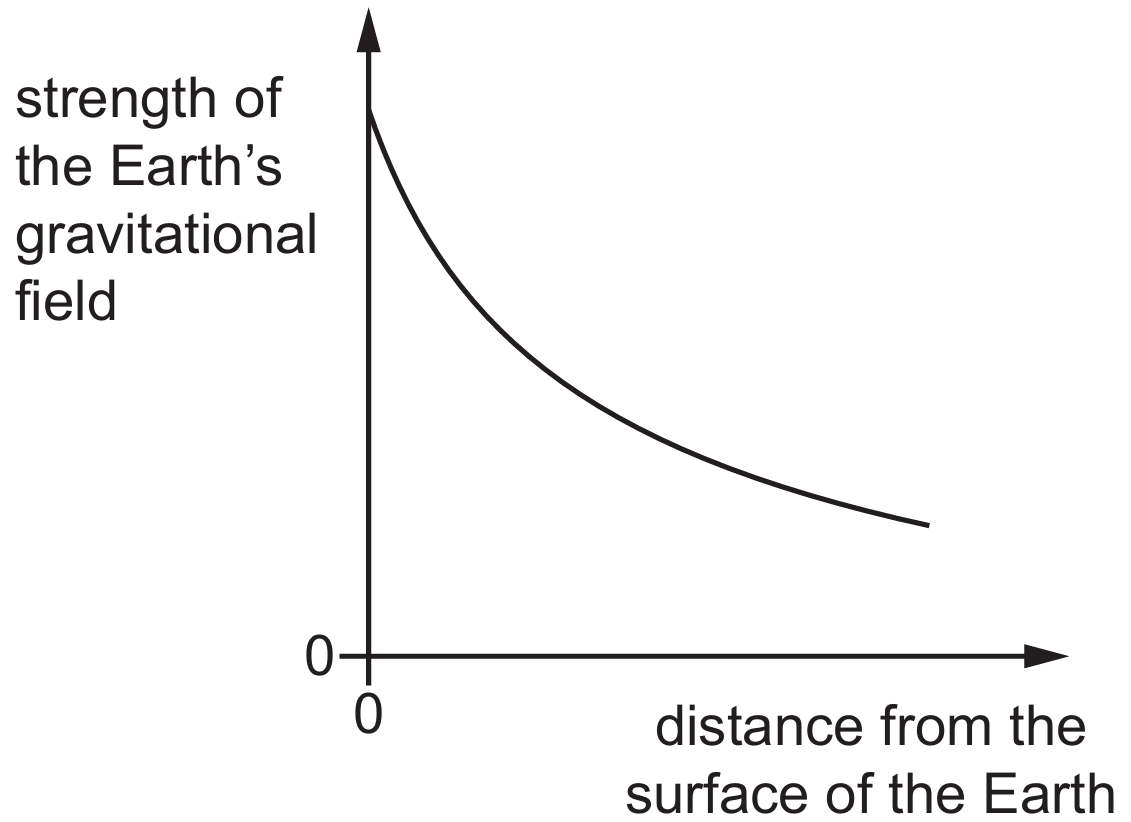
The graph shows how the strength of the Earth’s gravitational field varies as the distance from the Earth’s surface increases.
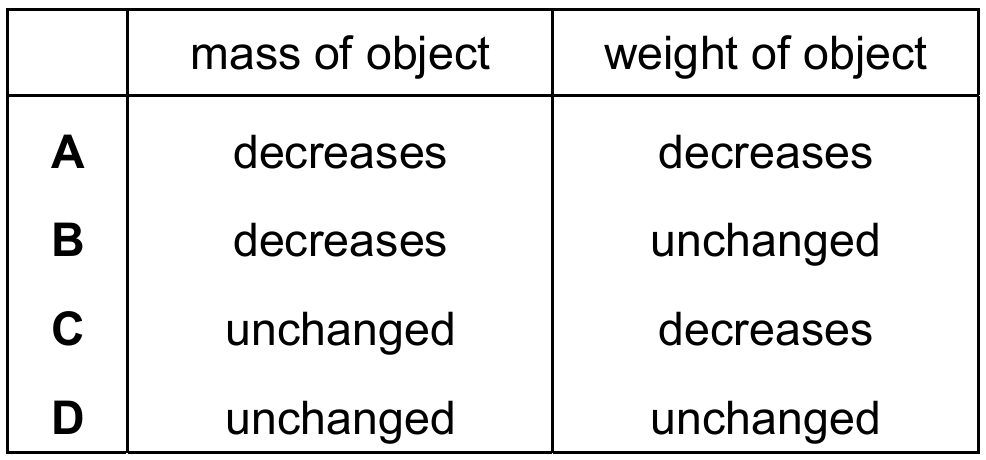
Which row describes the effect that this has on the mass and on the weight of an object as it moves further away from the Earth’s surface?
▶️ Answer/Explanation
Correct Option: C

Detailed solution:

Mass is the quantity of matter in an object and remains constant regardless of its position in a gravitational field.
Weight is the gravitational force acting on an object, calculated using the equation $W = m \times g$.
As the distance from the Earth increases, the gravitational field strength $g$ decreases, as shown in the provided graph.
Since $W \propto g$ for a constant mass, a decrease in $g$ results in a corresponding decrease in the object’s weight.
Therefore, the mass remains unchanged while the weight decreases.
This matches the description provided in Row C.

Question

Comets move round the Sun. Which statement describes the orbit of a comet?
A. The orbit is circular with the Sun at the centre of the circle.
B. The orbit is circular with the Sun not at the centre of the circle.
C. The orbit is elliptical with the Sun at the centre of the ellipse.
D. The orbit is elliptical with the Sun not at the centre of the ellipse.
▶️ Answer/Explanation
Correct Option: D

Detailed solution:

According to Kepler’s First Law and the IGCSE syllabus, comets move in highly elongated elliptical orbits.
In an elliptical orbit, the Sun is located at one of the two focal points (foci) of the ellipse.
Because the Sun is at a focus rather than the geometric center, it is not at the center of the orbital path.
This eccentricity explains why a comet’s distance r from the Sun varies significantly throughout its period T.
Therefore, statement D correctly identifies both the elliptical shape and the off-center position of the Sun.
Options A and B are incorrect as orbits are not circular, and C is incorrect because the Sun is not centered.

Question
A space probe measures the gravitational field strength at four different distances from a planet. The point furthest from the planet is measured first and the point nearest the planet is measured last. In which order were the measurements taken?
A. $6.3\text{ N/kg}, 10\text{ N/kg}, 14\text{ N/kg}, 20\text{ N/kg}$
B. $10\text{ N/kg}, 14\text{ N/kg}, 6.3\text{ N/kg}, 20\text{ N/kg}$
C. $20\text{ N/kg}, 14\text{ N/kg}, 6.3\text{ N/kg}, 10\text{ N/kg}$
D. $20\text{ N/kg}, 14\text{ N/kg}, 10\text{ N/kg}, 6.3\text{ N/kg}$
▶️ Answer/Explanation
Correct Option: A

Detailed solution:

The gravitational field strength $g$ around a planet is inversely related to the distance from the planet’s center. As the distance increases, the value of $g$ decreases. The problem states the probe starts at the point furthest from the planet (lowest $g$) and moves toward the point nearest the planet (highest $g$). Consequently, the measured values must appear in increasing order. Comparing the options, only Option A shows a sequence where values rise from $6.3\text{ N/kg}$ to $20\text{ N/kg}$. Therefore, Option A correctly represents the order of measurements taken by the probe.

Scroll to Top