Home / iGCSE Physics (0625) 4.5.1 Electromagnetic induction-Exam Style Questions

iGCSE Physics (0625) 4.5.1 Electromagnetic induction -Exam Style Questions Paper 2 - New Syllabus

Question

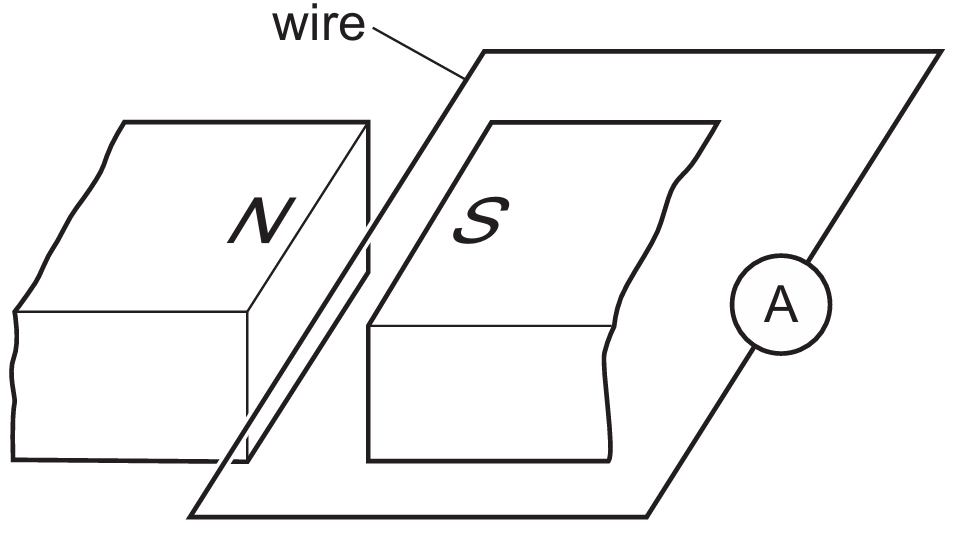
The diagram shows a wire between two magnetic poles. The wire is connected in a circuit with an ammeter.
The wire is moved downwards, towards the bottom of the page. A current is induced in the wire.
In which direction is the force on the wire caused by this current?
A. towards the bottom of the page
B. towards the left of the page
C. towards the right of the page
D. towards the top of the page
▶️ Answer/Explanation
Correct Option: D

Detailed solution:

This question is governed by Lenz’s Law, which states that the direction of an induced current is such that it creates a magnetic effect to oppose the change that produced it. The “change” in this scenario is the downward motion of the wire through the magnetic field. To oppose this downward movement, the induced current must generate a magnetic force acting in the opposite direction. Since the wire is being moved toward the bottom of the page, the opposing force must act toward the top of the page. This ensures the principle of conservation of energy is upheld by requiring work to be done against this resistive force.
Question

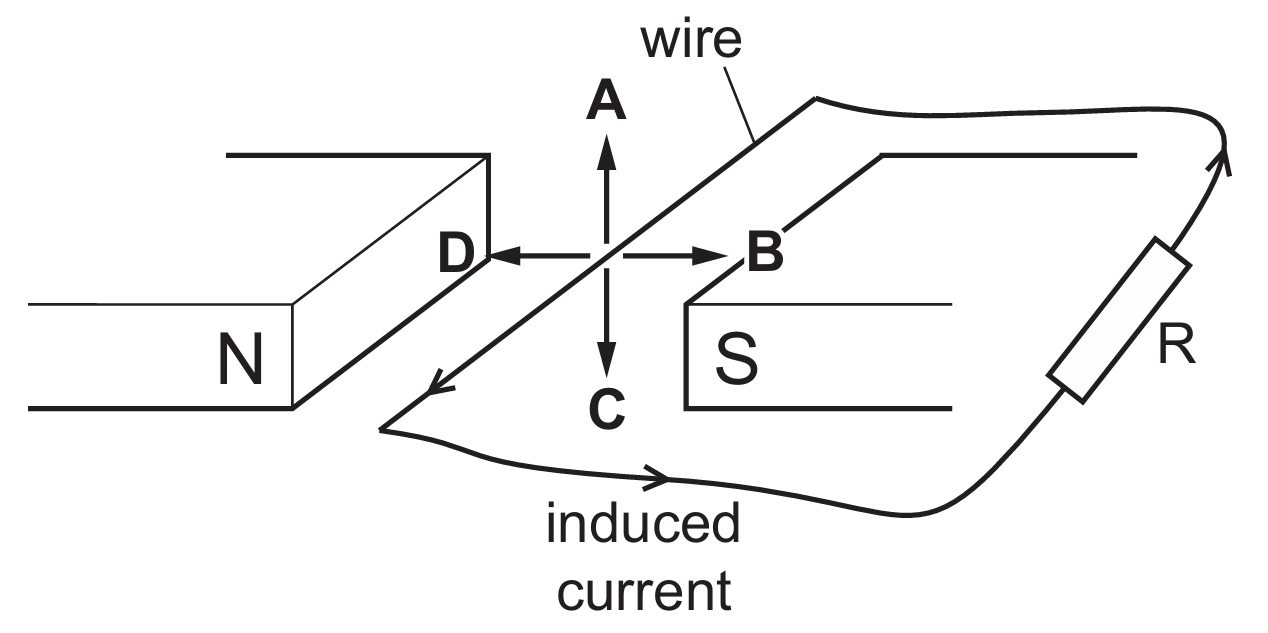
A wire connected to a resistor $R$ is moved in a magnetic field. A current is induced in the direction shown.
In which direction is the wire moved?
▶️ Answer/Explanation
Correct Option: C

Detailed solution:

To determine the direction of motion, we apply Fleming’s Right-Hand Rule for induced current.
The First Finger represents the magnetic field, pointing from North ($N$) to South ($S$) (rightward).
The Second Finger represents the direction of the induced current, which is pointing “out of the page” toward the observer as shown by the arrow on the wire.
The Thumb then points in the direction of the Motion (force) applied to the wire.
Aligning your hand accordingly, the thumb points vertically downward toward C.
Thus, to induce a current in the direction indicated, the wire must be moved in direction C.

Question
The lamps on a bicycle are powered by a simple electrical generator.
A permanent magnet rotates around a stationary coil of wire wound on an iron core.
Which statement is correct?
A. The current in the lamps decreases as the speed of rotation increases.
B. The current in the lamps decreases when the magnet is replaced by a stronger magnet.
C. The output electromotive force (e.m.f.) will be higher if the gap between the magnet and the coil is bigger.
D. The output e.m.f. will be higher if there are more turns on the coil.
▶️ Answer/Explanation
Correct Option: D

Detailed solution:

A generator works on the principle of electromagnetic induction, where a changing magnetic field induces an electromotive force ($e.m.f.$) in a conductor.
According to Faraday’s Law, the magnitude of the induced $e.m.f.$ is directly proportional to the rate of change of magnetic flux linkage.
Increasing the number of turns ($N$) on the stationary coil increases the total flux linkage, thereby resulting in a higher output $e.m.f$.
Options A and B are incorrect because increasing rotation speed or magnet strength actually increases the induced current.
Option C is incorrect because a larger gap weakens the magnetic field strength at the coil, which reduces the induced $e.m.f$.
Therefore, statement D is the only correct physical description of how to increase the generator’s output.

Scroll to Top