
iGCSE Physics (0625) 3.4 Sound -Exam Style Questions Paper 1 - New Syllabus
Question
The diagram shows the ranges of human hearing and of ultrasound waves.
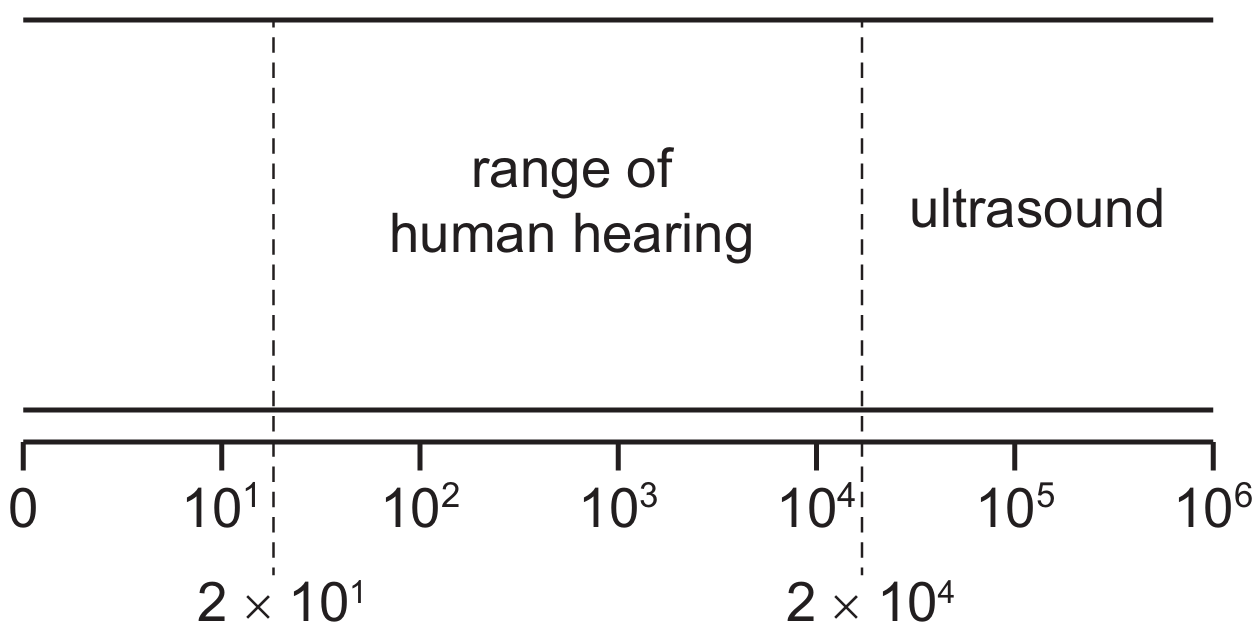
Which characteristic of sound waves do the numbers on the diagram refer to?
(B) frequency in \( \mathrm{Hz} \)
(C) speed in \( \mathrm{m/s} \)
(D) wavelength in \( \mathrm{m} \)
▶️ Answer/Explanation
Correct Answer: \( \boxed{\mathrm{B}} \)
The human ear can normally detect sounds with frequencies between:
\( 20\,\mathrm{Hz} \) and \( 20000\,\mathrm{Hz} \)
These limits are shown on the diagram as:
\( 2 \times 10^{1}\,\mathrm{Hz} \) and \( 2 \times 10^{4}\,\mathrm{Hz} \)
Ultrasound is defined as sound with a frequency greater than:
\( 20000\,\mathrm{Hz} \)
Therefore, the numbers on the horizontal axis represent the frequency of the sound waves.
Frequency is measured in hertz \((\mathrm{Hz})\), where:
\( 1\,\mathrm{Hz} = 1 \) oscillation per second.
Amplitude measures the size of vibrations, wavelength measures the distance between successive wave crests, and the speed of sound in air is approximately \(340\,\mathrm{m/s}\), none of which match the values shown.
Hence, the correct answer is (B).
Question
The diagrams show examples of wave motion.
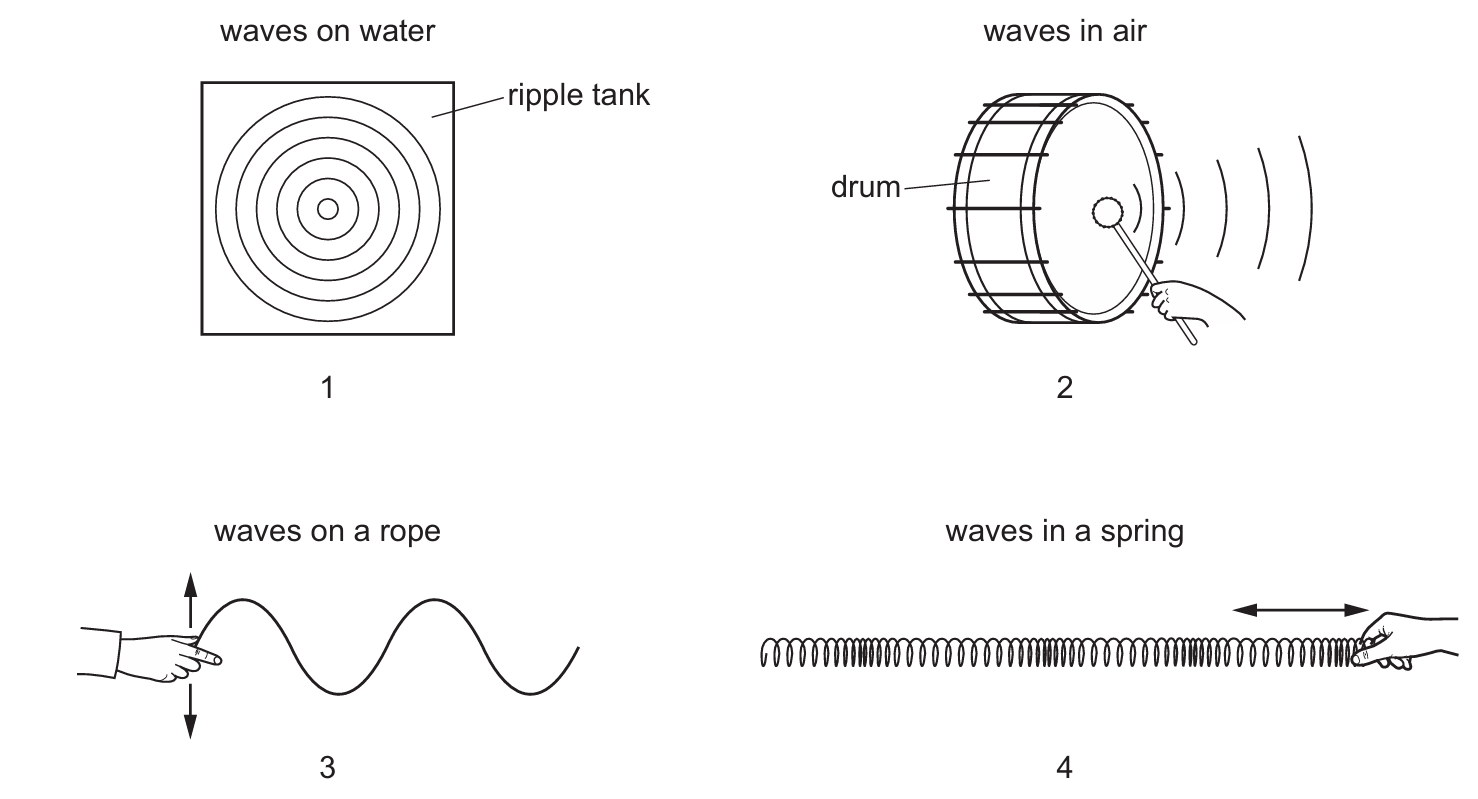
Which waves are longitudinal?
(B) 2, 3 and 4
(C) 2 and 3 only
(D) 2 and 4 only
▶️ Answer/Explanation
Correct Answer: \( \boxed{\mathrm{D}} \)
A longitudinal wave is one in which the particles of the medium vibrate parallel to the direction of wave travel.
Wave 2: Sound waves in air are longitudinal waves because air particles oscillate back and forth, producing compressions and rarefactions in the same direction as the wave travels.
Wave 4: The spring (slinky) shows regions of compression and expansion moving along the spring. The coils vibrate parallel to the direction of energy transfer, so this is also a longitudinal wave.
Wave 1: Water waves are not considered longitudinal at this level. They are treated as transverse waves because the surface moves mainly up and down as the wave travels.
Wave 3: Waves on a rope are transverse because the rope moves perpendicular to the direction of wave propagation.
Therefore, only waves 2 and 4 are longitudinal.
Hence, the correct answer is (D).
Question
A student places a loudspeaker inside each of four sealed jars.
From which jar will the student not hear a sound from the loudspeaker?
(B) sealed jar with carbon dioxide inside
(C) sealed jar with a vacuum inside
(D) sealed jar with water inside
▶️ Answer/Explanation
Correct Answer: \( \boxed{\mathrm{C}} \)
Sound is a mechanical wave and requires a medium through which its vibrations can travel.
Sound can travel through gases, liquids, and solids because these materials contain particles that can vibrate and transfer energy.
Air and carbon dioxide are gases, while water is a liquid. All of these can transmit sound waves.
A vacuum contains no particles, so there is no medium available to carry the sound vibrations.
Therefore, sound cannot travel through a vacuum.
This principle is demonstrated by the classic bell-jar experiment, where the sound becomes inaudible as the air is removed from the container.
Hence, the student will not hear the loudspeaker when it is placed in a jar containing a vacuum.
Therefore, the correct answer is (C).