iGCSE Physics (0625) 5.2.1 Detection of radioactivity-Exam Style Questions- New Syllabus

Question

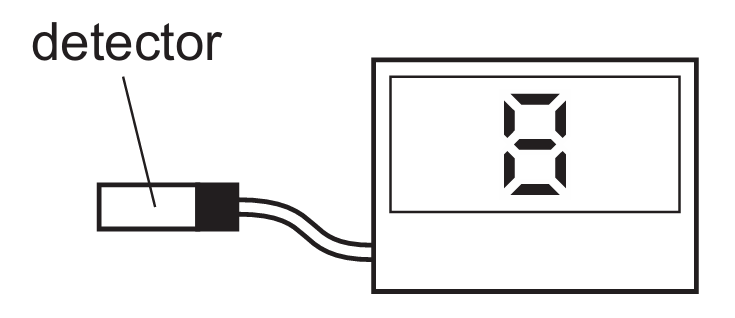
In a laboratory, a radiation detector is connected to a counter which shows a reading for the count rate due to background radiation.
Which unit is count rate measured in?
A. counts/s
B. minutes/count
C. coulombs/minute
D. amperes/s
▶️ Answer/Explanation
Correct Option: A

Detailed solution:

Count rate is defined as the number of decay events detected by a counter per unit of time.
Common units for this measurement include counts per second (counts/s) or counts per minute (counts/min).
Option B is incorrect because it represents the inverse of a rate (time per count).
Options C and D are incorrect as they involve electrical units like coulombs and amperes, which measure charge and current respectively.
Since the detector measures the frequency of ionizing events, counts/s is the standard scientific unit used.
Therefore, Option A is the correct unit for expressing the background radiation count rate.

Question

When the count rate from a radioactive source is measured, background radiation is taken into account.
Which option shows only examples of nuclear background radiation?
A. alpha-particles from radon gas and gamma radiation from space
B. alpha-particles from radon gas and infrared radiation from the Sun
C. gamma radiation from the Sun and microwaves from satellites
D. microwaves from satellites and X-rays from hospitals
▶️ Answer/Explanation
Correct Option: A

Detailed solution:

Background radiation refers to the ionizing radiation present in the environment from natural and artificial sources.
Radon gas is a natural source that emits $\alpha$-particles as it decays in the air.
Space is a major source of cosmic rays, which include high-energy $\gamma$ radiation and other particles entering Earth’s atmosphere.
Infrared radiation and microwaves are part of the electromagnetic spectrum but are non-ionizing and do not constitute nuclear background radiation.
Medical $X$-rays are ionizing but are typically considered artificial exposure rather than constant environmental background.
Therefore, Option A is the only choice containing exclusively nuclear, ionizing background sources.

Question

Which type of radiation is measured using a detector connected to a counter?
A. visible light
B. ionising nuclear
C. microwave
D. thermal
▶️ Answer/Explanation
Correct Option: B

Detailed solution:

Radioactive emissions such as $\alpha$-particles, $\beta$-particles, and $\gamma$-rays are types of ionising nuclear radiation.
These radiations possess enough energy to ionise atoms in their path, a property used for their detection.
Instruments like the Geiger-Müller (GM) tube act as detectors that produce electrical pulses when radiation enters.
These pulses are sent to a counter, which displays the count rate in units such as $counts/s$ or $counts/minute$.
Visible light, microwaves, and thermal radiation are non-ionising and typically measured using different sensors like LDRs or thermometers.
Therefore, ionising nuclear radiation is the only type listed that is specifically measured using a detector-counter setup.

Scroll to Top