Question1
Q1 (a) E1.1
Q1 (b) E1.1
![]()
From the list of numbers, write down
(a) a cube number
(b) a prime number
▶️Answer/Explanation
(a): 27
(b): 29
Detailed Solution
(a)
A cube number is a number that can be written as \( n^3 \).
\( 3^3 = 27 \)
(b)
A prime number has only two factors: 1 and itself.
29 Factors: 1, 29
Question2
Q2 (a) E1.3
Q2 (b) E1.3
$\textbf{v}= \begin{pmatrix} – 1\\ 3\end{pmatrix}$ $\textbf{y}= \begin{pmatrix} 2\\ 5\end{pmatrix}$
Find
$( a)$ $v- y$
$(b)2v.$
▶️Answer/Explanation
(a): $\begin{pmatrix} -3 \\ -2 \end{pmatrix}$
(b): $\begin{pmatrix} -2 \\ 6 \end{pmatrix}$
Detailed Solution
(a)
$
\mathbf{v} = \begin{pmatrix} -1 \\ 3 \end{pmatrix}, \quad \mathbf{y} = \begin{pmatrix} 2 \\ 5 \end{pmatrix}
$
$
\mathbf{v} – \mathbf{y} = \begin{pmatrix} -1 \\ 3 \end{pmatrix} – \begin{pmatrix} 2 \\ 5 \end{pmatrix}
$
$
= \begin{pmatrix} -1 – 2 \\ 3 – 5 \end{pmatrix}
$
$
= \begin{pmatrix} -3 \\ -2 \end{pmatrix}
$
(b)
$
\mathbf{v} = \begin{pmatrix} -1 \\ 3 \end{pmatrix}
$
$
2\mathbf{v} = 2 \times \begin{pmatrix} -1 \\ 3 \end{pmatrix}
$
$
= \begin{pmatrix} 2 \times (-1) \\ 2 \times 3 \end{pmatrix}
$
$
= \begin{pmatrix} -2 \\ 6 \end{pmatrix}
$
Question3
Q3 E1.2

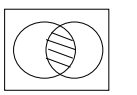
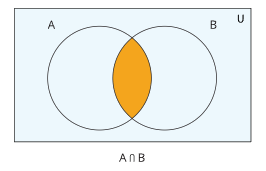
On the Venn diagram, shade the region $A \cap B$
▶️Answer/Explanation
Correct shading
Detailed Solution
The notation \( A \cap B \) represents the intersection of sets \( A \) and \( B \).
Question4
Q4 (a) E2.7
Q4 (b) E2.7
$23, 17, 11, 5,………$
(a) Write down the next number in this sequence
(b) Find the nth term of this sequence
▶️Answer/Explanation
(a): $-1$
(b): $29 – 6n$
Detailed Solution
(a)
The given sequence is
$
23, 17, 11, 5, \dots
$
Common difference
$
17 – 23 = -6, \quad 11 – 17 = -6, \quad 5 – 11 = -6
$
$
5 – 6 = -1
$
(b)
The general formula for an arithmetic sequence is
$
T_n = a + (n – 1) d
$
where:
\( a = 23 \) (first term),
\( d = -6 \) (common difference).
$
T_n = 23 + (n – 1)(-6)
$
$
T_n = 23 – 6n + 6
$
$
T_n = 29 – 6n
$
Question5
Q5 E2.2
Factorise completely. $8g-2g^2$
▶️Answer/Explanation
$2g(4 – g)$
Detailed Solution
$
8g – 2g^2
$
The common factor between both terms is 2g.
$
8g – 2g^2 = 2g(4 – g)
$
Question6
Q6 E1.4
Without using a calculator, work out $\frac{4}{7}\div 8$
You must show all your working and give your answer as a fraction in its simplest form.
▶️Answer/Explanation
$\frac{4}{7} \times \frac{1}{8}$ or $\frac{4}{7} \div \frac{56}{7}$. $\frac{1}{14}$
$
\frac{4}{7} \div 8 = \frac{4}{7} \times \frac{1}{8}
$
$
\frac{4 \times 1}{7 \times 8} = \frac{4}{56}
$
GCD (4,56) = 4
$
\frac{4}{56} = \frac{4 \div 4}{56 \div 4} = \frac{1}{14}
$
Question7
Q7 (a) E2.5
Q7 (b) E2.5
\(\begin{array}{cc}(\mathbf{a})&15t+8=4-t\\\\(\mathbf{b})&\frac{25-2u}{3}=2\end{array}\)
▶️Answer/Explanation
(a): $-\frac{1}{4}$
(b): $9.5$
Detailed Solution
(a)
$
15t + 8 = 4 – t
$
$
15t + t = 4 – 8
$
$
16t = -4
$
$
t = \frac{-4}{16} = -\frac{1}{4}
$
(b)
$
\frac{25 – 2u}{3} = 2
$
$
25 – 2u = 6
$
$
-2u = -19
$
$
u = \frac{-19}{-2} = \frac{19}{2}
$
Question8
Q8 E1.8
Calculate $0.3^2.$
Give your answer in standard form.
▶️Answer/Explanation
$9 \times 10^{-2}$
Detailed Solution
$
0.3^2 = 0.3 \times 0.3
$
$
= 0.09
$
$
0.09 = 9 \times 10^{-2}
$
Question9
Q9 E2.5
Solve the simultaneous equations. You must show all your working
$$\begin{matrix}3x-2y=19\\x+y=3\end{matrix}$$
▶️Answer/Explanation
Correctly eliminating one variable. $x = 5$, $y = -2$
Detailed Solution
$x + y = 3$
Substituting \( x = 3 – y \) into \( 3x – 2y = 19 \)
$
3(3 – y) – 2y = 19
$
$
9 – 3y – 2y = 19
$
$
9 – 5y = 19
$
$
-5y = 10
$
$
y = -2
$
Substituting \( y = -2 \) into \( x = 3 – y \)
$
x = 3 – (-2)
$
$
x = 3 + 2
$
$
x = 5
$
Question10
Q10 E3.4

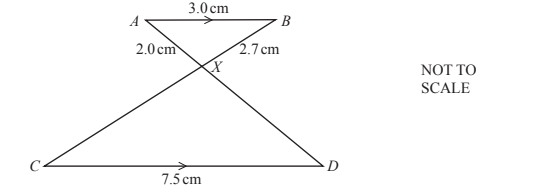
In the diagram, $AB$ and $CD$ are parallel The lines $CB$ and $AD$ intersect at $X.$ $AB=3.0$ cm, $AX=2.0$ cm, $BX=2.7$ cm and $CD=7.5$ cm
Find the length of $BC.$
▶️Answer/Explanation
$9.45$
$
\frac{3}{7.5} = \frac{2.7}{XC}
$
$
3 \times XC = 2.7 \times 7.5
$
$
3XC = 20.25
$
$
XC = \frac{20.25}{3}
$
$
XC = 6.75
$
$\text{BC}=\text{BX+CX}$
$\text{BC}=\text{6.75+2.7}$
$\text{BC}=9.45$
Question11
Q11 E1.6
Find the highest common factor (HCF) of 12x$^{12}$ and 16x$^{16}.$
▶️Answer/Explanation
$4x^{12}$
Detailed Solution
$
\text{Prime factorization: } 12 = 2^2 \times 3, \quad 16 = 2^4
$
$
\text{HCF 12,16} = 2^2 = 4
$
$
\text{HCF of } x^{12} \text{ and } x^{16} = x^{\min(12,16)} = x^{12}
$
$
\text{HCF} = 4x^{12}
$
Question12
Q12 E4.4
In a regular polygon, the interior angle and the exterior angle are in the ratio $\textbf{interior: exterior= 11: 1.}$
Find the number of sides of this regular polygon.
▶️Answer/Explanation
$24$
Detailed Solution
$
\frac{\text{interior}}{\text{exterior}} = \frac{11}{1}
$
Since the sum of an interior and exterior angle in any polygon is always \( 180^\circ \)
$
11x + x = 180
$
$
12x = 180
$
$
x = 15
$
The exterior angle of a regular polygon
$
\frac{360}{n} = x
$
$
\frac{360}{n} = 15
$
$
n = \frac{360}{15} = 24
$
Question13
Q13 E9.5

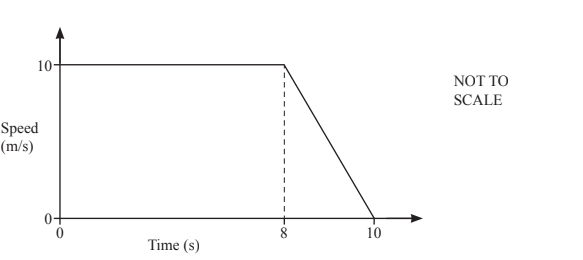
The diagram shows the speed–time graph for part of a car journey
Calculate the total distance travelled during the $10$ seconds
▶️Answer/Explanation
$90$
Detailed Solution
$
\text{Area of rectangle} = \text{width} \times \text{height}
$
$
= 8 \times 10
$
$
= 80 \text{ m}
$
$
\text{Area of traingle} = \frac{1}{2} \times \text{base} \times \text{height}
$
$
= \frac{1}{2} \times (10 – 8) \times 10
$
$
= \frac{1}{2} \times 2 \times 10
$
$
= 10 \text{ m}
$
$
\text{Total distance} = 80 + 10
$
Question14
Q14 E5.3
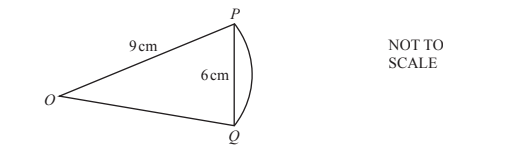
The diagram shows a sector of a circle with centre O and radius $9$cm
The length of the chord PQ is $6$ cm
Calculate the length of the arc PQ
▶️Answer/Explanation
$6.12$ or $6.116…$ to $6.118$
Detailed Solution
Chord length formula:
$
PQ = 2r \sin \frac{\theta}{2}
$
$
6 = 2(9) \sin \frac{\theta}{2}
$
$
6 = 18 \sin \frac{\theta}{2}
$
$
\sin \frac{\theta}{2} = \frac{1}{3}
$
$
\frac{\theta}{2} = \sin^{-1} \left( \frac{1}{3} \right)
$
$
\frac{\theta}{2} \approx 19.47^\circ
$
$
\theta \approx 38.94^\circ
$
Convert to radians
$
\theta \approx 38.94 \times \frac{\pi}{180} \approx 0.68 \text{ rad}
$
Arc length formula
$
s = r\theta
$
$
s = 9 \times 0.68
$
$
s \approx 6.12 \text{ cm}
$
Question15
Q15 E1.7
Simplify $(3125w^{3125})^{\frac{1}{5}}$
▶️Answer/Explanation
$5w^{625}$
Detailed Solution
$
(3125w^{3125})^{\frac{1}{5}}
$
$
3125^{\frac{1}{5}} \times (w^{3125})^{\frac{1}{5}}
$
Since \( 3125 = 5^5 \),
$
3125^{\frac{1}{5}} = (5^5)^{\frac{1}{5}} = 5
$
$
(w^{3125})^{\frac{1}{5}} = w^{\frac{3125}{5}} = w^{625}
$
$
5w^{625}
$
Question16
Q16 E2.8
$y$ is inversely proportional to $x^2.$
${\mathrm{When~}}x=3,y=2.$
Find $y$ when $x=2.$
▶️Answer/Explanation
$4.5$
Detailed Solution
$
y \propto \frac{1}{x^2}
$
$
y = \frac{k}{x^2}
$
Given \( x = 3, y = 2 \):
$
2 = \frac{k}{3^2}
$
$
2 = \frac{k}{9}
$
$
k = 18
$
Now, find \( y \) when \( x = 2 \):
$
y = \frac{18}{2^2}
$
$
y = \frac{18}{4} = 4.5
$
Question17N
Q17 (a) E4.7
Q17 (b) E4.7
Q17 (c) E4.7
Q17 (d) E4.7
Q17 (e) E4.7
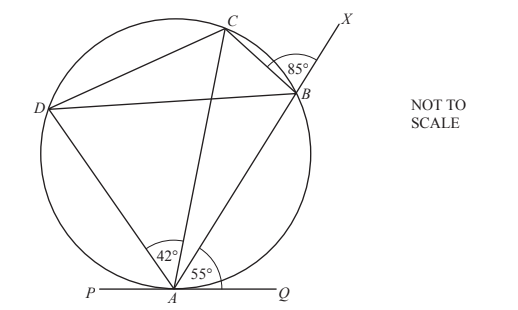
$ABCD$ is a cyclic quadrilateral, $ABX$ is a straight line and $PQ$ is a tangent to the circle at $A.$
$\angle$ $CBX=85^{\circ}$, $\angle$ $BAQ=55^{\circ}$ and $\angle$ $CAD=42^{\circ}.$
Find
$( \mathbf{a} )$ $\angle$ $CBD$
$( \mathbf{b} )$ $\angle$ $ACB$
$( \mathbf{c} )$ $\angle$ $ADC$
$( \mathbf{d} )$ $\angle$ $BCD$
$( \mathbf{e} )$ $\angle$ $PAD.$
▶️Answer/Explanation
(a): $42$
(b): $55$
(c): $85$
(d): $108$
(e): $53$
Detailed Solution
(a)
$\angle$s in the same segment subtended by the same arc are equal.
$\angle$ $CAD$ and $\angle$ $CBD$ subtend the same arc $CD$.
Therefore, $\angle$ $CBD$ = $\angle$ $CAD = 42^{\circ}$.
(b)
The $\angle$ between a tangent and a chord through the point of contact is equal to the $\angle$ in the alternate segment.
$PQ$ is a tangent at $A$, and $AB$ is a chord.
Therefore, $\angle$ $BAQ$ = $\angle$ $ACB$.
Given that $\angle$ $BAQ = 55^{\circ}$, so $\angle$ $ACB = 55^{\circ}$.
(c)
$ABX$ is a straight line, so $\angle$ $ABC$ and $\angle$ $CBX$ are linear pairs and their sum is $180^{\circ}$.
$\angle$ $ABC +$ $\angle$ $CBX = 180^{\circ}$
$\angle$ $ABC + 85^{\circ} = 180^{\circ}$
$\angle$ $ABC = 180^{\circ} – 85^{\circ} = 95^{\circ}$.
$ABCD$ is a cyclic quadrilateral, so the sum of opposite $\angle$s is $180^{\circ}$.
$\angle$ $ABC +$ $\angle$ $ADC = 180^{\circ}$
$95^{\circ} +$ $\angle$ $ADC = 180^{\circ}$
$\angle$ $ADC = 180^{\circ} – 95^{\circ} = 85^{\circ}$.
(d)
In tri$\angle$ $ADC$, the sum of $\angle$s is $180^{\circ}$.
$\angle$ $DAC +$ $\angle$ $ADC +$ $\angle$ $DCA = 180^{\circ}$
$42^{\circ} + 85^{\circ} +$ $\angle$ $DCA = 180^{\circ}$
$127^{\circ} +$ $\angle$ $DCA = 180^{\circ}$
$\angle$ $DCA = 180^{\circ} – 127^{\circ} = 53^{\circ}$.
$\angle$ $BCD =$ $\angle$ $BCA +$ $\angle$ $ACD$
$\angle$ $BCD = 55^{\circ} + 53^{\circ} = 108^{\circ}$.
(e)
The $\angle$ between a tangent and a chord through the point of contact is equal to the $\angle$ in the alternate segment.
$PQ$ is a tangent at $A$, and $AD$ is a chord.
Therefore, $\angle$ $PAD$ = $\angle$ $ACD$.
$\angle$ $ACD$ (which is the same as $\angle$ $DCA$) is $53^{\circ}$.
So, $\angle$ $PAD = 53^{\circ}$.
Question18
Q18 E5.4
Two solids are mathematically similar and have volumes $81$ cm3 and $24$ cm3 The surface area of the smaller solid is $44$ cm2
Calculate the surface area of the larger solid
▶️Answer/Explanation
$99$
The ratio of volumes gives the cube of the linear scale factor
$
k^3 = \frac{81}{24} = \frac{27}{8}
$
$
k = \sqrt[3]{\frac{27}{8}} = \frac{3}{2}
$
$
k^2 = \left(\frac{3}{2}\right)^2 = \frac{9}{4}
$
$
A_1 = 44 \times \frac{9}{4}
$
$
A_1 = 99 \text{ cm}^2
$
Question19
Q19 E2.5
Find the values of x when $6x+y=10$ and $y=x^2-3x+10.$
▶️Answer/Explanation
$0$ and $-3$
Detailed Solution
\( y = x^2 – 3x + 10 \), substitute it into $6x + y = 10$
$
6x + (x^2 – 3x + 10) = 10
$
$
6x + x^2 – 3x + 10 = 10
$
$
x^2 + 3x + 10 – 10 = 0
$
$
x^2 + 3x = 0
$
$
x(x + 3) = 0
$
$
x = 0 \quad \text{or} \quad x + 3 = 0
$
$
x = 0 \quad \text{or} \quad x = -3
$
Question20
Q20 (a) E2.7
Q20 (b) E2.7
Find the $n$th term of each sequence
$(\mathbf{a})$ $-1,\quad 0,\quad7,\quad26,\quad63,\quad…$
$( \mathbf{b} )$ $24\quad , 12\quad, 6\quad, 3\quad, 1.5, \ldots$
▶️Answer/Explanation
(a): $(n-1)^3 – 1$
(b): $24 \times (\frac{1}{2})^{n-1}$
Detailed Solution
(b)
$
24, \quad 12, \quad 6, \quad 3, \quad 1.5, \quad \ldots
$
$
r = \frac{12}{24} = \frac{1}{2}
$
General formula for a geometric sequence
$
T_n = a r^{n-1}
$
where \( a = 24 \), \( r = \frac{1}{2} \):
$
T_n = 24 \times \left(\frac{1}{2}\right)^{n-1}
$
Question21
Q21 E1.10
A car travels $14$km, correct to the nearest kilometre. This takes $12$ minutes, correct to the nearest minute. Calculate the lower bound of the speed of the car.
Give your answer in kilometres per minute.
▶️Answer/Explanation
$1.08$
Detailed Solution
The car travels \( 14 \) km, correct to the nearest km.
The lower bound of the distance is
$
14 – 0.5 = 13.5 \text{ km}
$
The time taken is \( 12 \) minutes, correct to the nearest minute.
The upper bound of the time is
$
12 + 0.5 = 12.5 \text{ minutes}
$
$
\text{Speed} = \frac{\text{Distance}}{\text{Time}}
$
$
\text{Lower Bound of Speed} = \frac{13.5}{12.5}
$
$
= 1.08 \text{ km/min}
$
Question22
Q22 E6.6

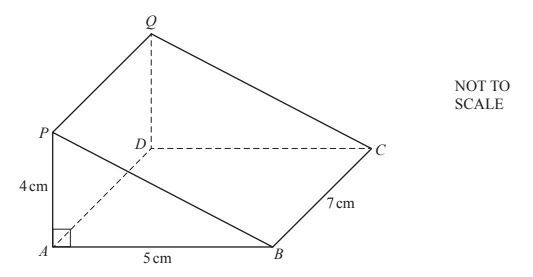
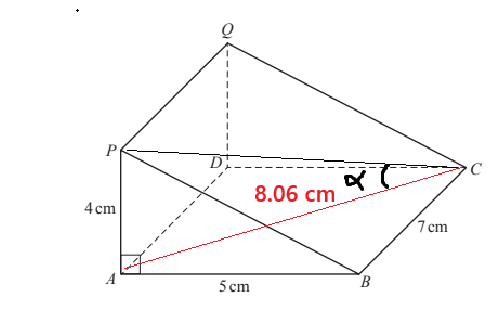
The diagram shows a triangular prism $ABCDQP$ of length $7$cm.
The cross-section is triangle $PA\hat{B}$ with $PA=\tilde{4}$cm, $AB=5$ cm and angle $PAB=90^\circ$
Calculate the angle between the line $PC$ and the base $ABCD.$
▶️Answer/Explanation
$24.9$ or $24.93$ to $24.94$
$
\tan \alpha = \frac{4}{\sqrt{5^2 + 7^2}}
$
$
5^2 + 7^2 = 25 + 49 = 74=\sqrt{74} \approx 8.6023
$
$
\tan \alpha = \frac{4}{8.6023} \approx 0.465
$
$
\alpha \approx 25.0^\circ
$
Question23
Q23 E2.3
Simplify.
$\frac{5x^2-19x+12}{x^2-9}$
▶️Answer/Explanation
$\frac{5x-4}{x+3}$
Detailed Solution
$
\frac{5x^2 – 19x + 12}{x^2 – 9}
$
Factor the denominator
$
x^2 – 9 = (x – 3)(x + 3)
$
Factor the numerator
$
5x^2 – 19x + 12 = (5x – 4)(x – 3)
$
$
\frac{(5x – 4)(x – 3)}{(x – 3)(x + 3)}
$
Cancel \( (x – 3) \) (for \( x \neq 3 \))
$
\frac{5x – 4}{x + 3}
$
Question24
Q24 E8.3
The probability that he hits the target for the first time on his $n$th attempt is $\frac{64}{2187}.$
The probability of Jamie hitting a target is $\frac{1}{3}.$
Find the value of $n.$
▶️Answer/Explanation
$7$
Detailed Solution
The probability that Jamie misses a shot is
$
1 – \frac{1}{3} = \frac{2}{3}
$
For him to hit the target for the first time on the \( n \)th attempt, he must miss the first \( n-1 \) attempts and then hit on the \( n \)th attempt.
The probability of this happening is
$
\left(\frac{2}{3}\right)^{n-1} \times \frac{1}{3}
$
$
\left(\frac{2}{3}\right)^{n-1} \times \frac{1}{3} = \frac{64}{2187}
$
$
\left(\frac{2}{3}\right)^{n-1} = \frac{64 \times 3}{2187}
$
$
64 \times 3 = 192
$
$
\frac{192}{2187} = \left(\frac{2}{3}\right)^6
$
$
\left(\frac{2}{3}\right)^{n-1} = \left(\frac{2}{3}\right)^6
$
$
n – 1 = 6
$
$
n = 7
$
Question25
Q25 E2.13
\(\mathrm{f}(x)=x^3+1\mathrm~{Find~f}^{-1}(x).\)
▶️Answer/Explanation
$\sqrt[3]{x-1}$ or $(x-1)^{\frac{1}{3}}$
Detailed Solution
\( f(x) = x^3 + 1 \)
Replace \( f(x) \) with \( y \)
$
y = x^3 + 1
$
$
y – 1 = x^3
$
$
x = \sqrt[3]{y – 1}
$
$
f^{-1}(x) = \sqrt[3]{x – 1}
$